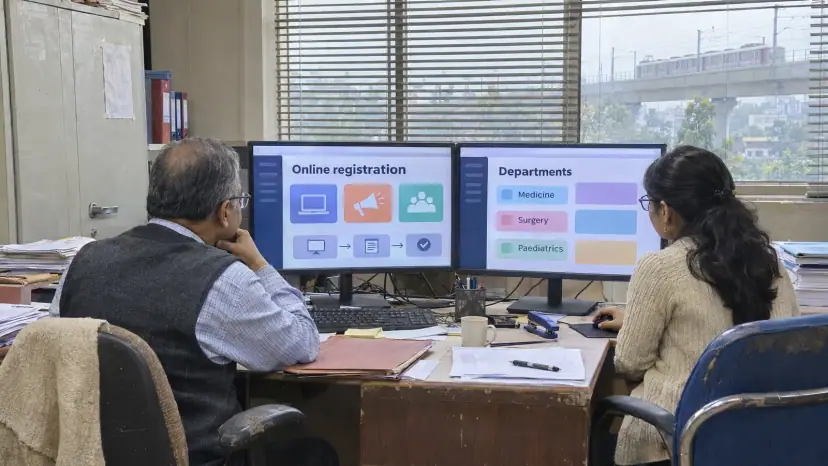
What AI marketing for healthcare in Delhi should do
AI marketing for Healthcare in Delhi has a modest, useful job: giving patients correct appointment details and putting every enquiry in front of a staff member before anything is confirmed. This guide covers what to collect, which official source to check, what an assistant may say and where a person must approve the next step.
The workflows here are for planning and are not reported Brainguru client results. Each service we scope reflects the provider's actual business, data and permissions, and nothing below replaces the judgement of the doctor responsible for the facility.
Thirteen revenue districts: placing a Delhi facility
According to the Delhi Revenue Department's site, the city has 13 revenue districts. A Deputy Commissioner heads each one, and Sub Divisional Magistrates and Tehsildars work under that office. A patient who reads only "Delhi" on a page has very little to go on. Record the revenue district and the locality of every facility, not just the city name.
The Revenue Department's district pages tie a real Delhi address to its office: the menu carries District Offices and Sub division Offices, while the Find Your Locality tool tells you which district a locality belongs to. The reference here is the Delhi Revenue Department, and it speaks only to local administrative context. Nothing on it speaks to patient demand or to which services are on sale, and no private clinic or hospital carries its endorsement.
Enter the Delhi revenue district and locality for each facility, keep any site outside Delhi as its own entry, and compare the result with the approved business record. If the two disagree, a reviewer settles it first; until then the page and the assistant give no directions, coverage notes or appointment instructions. A group with clinics in several districts should hold one record per clinic, each with its own hours, so the assistant never answers for the wrong building.
The Delhi enquiry brief, field by field
A city name beside a national offer serves no patient. Work from the list below instead. Each statement stays attached to its source and its reviewer. Log missing information and send it to a person; the model must not fill a healthcare gap with an assumption.
- Facility address and service hours: Record the revenue district and locality of the site that actually operates, with any site outside Delhi kept separately, plus the hours for that address.
- Approved department or service description: Keep the responsible doctor's signed-off text for every department or service, what it excludes, and when that text was last reviewed.
- Appointment type and reception contact: Say which appointment this is and which person at reception owns it; a blank field goes to review as a question.
- Permitted public information source: File the approved source with its version date. A photograph of the building or the word "Delhi" cannot show that information is cleared for publication.
- Non-clinical enquiry category: Label the administrative request, what it needs next and whether it is unsupported or misrouted.
- Staff escalation owner: Name the staff member responsible for the answer; no next step goes to the patient without them.
Picture an illustrative request reaching reception from a patient who gives a locality but no district. It has to pass the location check and the department description check before any next step is mentioned. When a check fails, the item stays open at handoff, so reception gets a specific question to settle rather than a lead that only looks qualified.
A careful role for an appointment assistant
Approved questions about opening hours, appointment arrangements and how to reach reception are the assistant's territory, and nothing more. It must treat an appointment request and a confirmed slot as two different things, and no slot is confirmed until someone at reception has looked at the live schedule. If symptoms or an emergency come up in a message, the assistant neither markets to the sender nor tries to diagnose. The assistant gives the emergency instruction the provider has approved and passes the message to a person straight away.
Reception information also stays apart from clinical records. Medical information travels only through the secure clinical channel the provider has approved, never through the marketing tool. Connect nothing the provider has not authorised. In practice that means the approved knowledge pack, the booking or operational system it needs, and a CRM or intake route only if reception uses one. The source version behind each reception answer should be on record. Test access permissions and who may revise the content before any live patient data is used. For the reviewer, a draft, prediction or extracted field is only an aid and cannot be an automatic commercial commitment.
Ownership matters more than the tool. Give the front-desk lead the weekly job of confirming opening hours and slot rules, give the responsible doctor the job of approving every line about a service, and name one person who removes outdated entries from the approved pack. When nobody holds that last task, a doctor who has moved sites or a department that has changed its OPD days keeps appearing in answers, and reception spends its day apologising to patients who came for nothing.
Patient data and the DPDP Act
An enquiry form for a Delhi clinic needs a name and a phone number, and very little else. Ask only for what the first reply requires: name, a contact route, the department and a preferred day. Tell people plainly what the details will be used for, how to correct or withdraw them, and who to contact. Do not invite symptoms or reports in a free-text box.
The DPDP Rules, 2025 reached the Gazette on 13 November 2025, and the bulk of the Data Fiduciary duties follow eighteen months later, on 13 May 2027. Those duties include the notice to the person, security safeguards and telling people about a data breach. A form built now should already work that way, so nothing has to be rebuilt in a hurry. Our DPDP Act 2023 checklist for digital marketers covers notice wording and retention in more detail.
Medical advertising rules Delhi pages must follow
Restrictions apply to medical professional advertising and to patient solicitation. The responsible provider has to review any proposed public information against applicable professional rules, the NMC ethics resources among them. The Code of Medical Ethics Regulations, 2002, on the National Medical Commission's site, call soliciting patients unethical, whether by a physician, a group of physicians or an institution. The same regulation says a physician must not boast of cases, operations, cures or remedies, or permit reports of them to be published.
For independent reference, see the NMC medical ethics resources. Regulation 7.12 is the most practical part for a facility page. Under it, a nursing home, private hospital or other physician-run institution may place a lay-press advertisement, provided it keeps to the institution's name, the kinds of patient it admits, its training and other facilities, and what it charges. Regulation 1.8 adds that a "no cure no payment" contract is unethical.
That gives a sensible default for a Delhi page: name, departments, the kind of patients seen, facilities, hours and how to book. Before adding anything beyond that, such as patient stories, star ratings, before-and-after pictures or a line calling one doctor the most experienced in the city, put it to the responsible professional as a question. Look again at current instructions on the page, because this guide is about permitted information and administrative support, and unrestricted patient-acquisition advertising is outside it.
Hindi and English wording, consistent listings and appointment tracking
Because the Revenue Department publishes its site in English and in Hindi, plan for both languages from the start. Where the audience needs pages in Hindi and English, a fluent reviewer for each language should look over the medical terms, the spelling of localities and the next step offered. Treat both languages as options to discuss with the provider; naming them is not a claim that every patient reads them or that we can supply every translation.
The actual address and a steady contact route should match on the page, in the clinic's local search listing and in business records. No extra offices or profiles should be created to suggest presence in another district. A patient may search from one part of Delhi and receive care at a facility elsewhere, so log those two locations apart, and keep page content and routing within the approved serviceable area.
Track each stage on its own:
- Appointment requested.
- Checked by staff.
- Appointment confirmed or declined.
- Attended or cancelled.
Rejected, cancelled and unsupported requests remain part of the evaluation, as a click or conversation does not represent revenue. Before launch, try the assistant on four awkward cases: a department closed that day, a slot that has gone, a patient asking what their symptoms mean, and a message with a report attached. Compare the reviewed outcomes with the provider's own baseline before any increase in spend. We do not promise rankings, inclusion in AI answers, a level of enquiries or any return on spend.
In the first weeks, sit a receptionist beside you and read a sample of conversations together. Watch for the same reason appearing again and again in the handoff, such as a missing department description or a question about a doctor who is not in the approved pack. That pattern is what should change the plan, and the first fix to try is a better source entry, not more advertising.
Questions to ask before you hire anyone
Whoever builds the assistant, find out who signs off every sentence that goes live and where the sign-off is kept. Ask what happens when a patient uploads a report, and whether the file is kept. Ask how phone enquiries and chat enquiries reach the same reception queue; a healthcare call centre and a website assistant that answer differently confuse patients. Ask which numbers will be reported. A provider that reports only chats has missed the four stages above.
Further reading and consultation for Delhi providers
AI Marketing for Healthcare outlines what the service covers across the sector. For the build itself, Delhi teams can turn to AI Marketing for Healthcare in India: A DPDP-Aware Playbook for Hospitals and Clinics, which goes into how it is put in place. The playbook explains a related workflow and is not evidence of a Delhi client engagement.
Elsewhere in Delhi you can plan tasks with AI Marketing for Insurance in Delhi, or with AI Marketing for HR and Recruitment in Delhi. For supported information and official references in other places, open Delhi and other city guides.
For a free consultation, the useful things to bring are the address and revenue district of each facility, its hours, the department wording the doctor has approved, your source material and the name of the person who can approve a next step. We deliver from our Noida office; no Delhi branch is claimed. Case-by-case discussion covers scope and integrations.
We first read the local and sector sources on 5 October 2026. On 3 November 2026 we reopened each one for this revision, and each still supported what this guide says about it. Current instructions need a fresh look before campaign changes. Photographs illustrate the topic and are not verified photographs of local offices, patients or facilities.