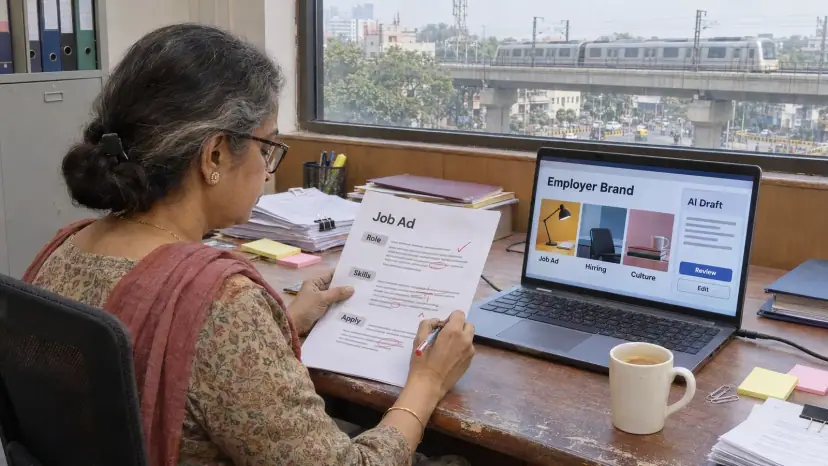
Accurate job descriptions and recruiter-checked candidate enquiries in Delhi
A candidate reading a Delhi vacancy needs the true role, the true employer and the true workplace. This guide helps HR and Recruitment teams get job descriptions right and have a recruiter review what comes in. It sets out what to collect, the local source to look up, the jobs an assistant may do and where a person must approve. Each workflow is a planning example; none reports a Brainguru client result. Scope is agreed around your actual business, data and permissions.
Delhi is not the whole NCR
Delhi and the wider NCR are different scopes. Keep a Delhi address apart from Noida and Gurugram, because their state administrations differ. To find the office linked to an actual Delhi address, use the Revenue Department’s district resources.
Open the Delhi Revenue Department site as your first reference. Administrative context is what it supports. It says nothing about hiring demand or commercial availability and does not endorse a private employer or agency. Enter the Delhi district and locality, with NCR locations held separately, and then match that against your approved business record. A reviewer must resolve any disagreement before the page or assistant gives directions, coverage information or an appointment instruction.
Six fields behind a Delhi vacancy
Treat these fields as the working brief, and never run a city name beside an unrelated national offer. Each statement in the vacancy stays linked to a source and a reviewer. When something is unknown, record it as a gap and route it to a person, so the model does not fill it with an assumption about the role.
- Actual work location and work mode: State the Delhi district and locality, any NCR location on its own line, and the work mode the employer requires.
- Approved role description and requirements: Use the approved wording for the role and its requirements, with limits and the current reference, so the job shown is the job on offer.
- Employer/agency identity: Say who the employer or authorised agency is, and leave unconfirmed details as questions for review.
- Permitted candidate information: List what you may collect from candidates and hold the approved evidence for it in its current version; a photograph or city name settles nothing.
- Application/referral enquiry type: Mark each message as an application or a referral, note the next step requested, and separate misrouted ones.
- Recruiter-review owner: Name the recruiter who confirms the reply before a candidate is offered a next step.
An illustrative Delhi request has two checks to pass, on location and on the approved role description and requirements, before anybody suggests a commercial or professional next step. If either fails, it stays unresolved in the handoff. Recruiters then have a concrete question to answer, and no falsely qualified lead reaches them.
What AI does with vacancies, and what recruiters keep
Recruitment content has to identify the real role, the employer or authorised recruiter, the work location and the application route. AI can organise approved vacancy information and point out candidate questions that are missing. It must not create a job that does not exist, and it must not imply a remote arrangement where the employer requires attendance. An application, a recruiter-reviewed match, an interview and an accepted offer should each be logged separately.
Connect only sources and systems the business has authorised, namely an approved knowledge pack, the operational system concerned and a CRM or intake route where needed. Record the source version behind each vacancy answer. Check access permissions and who can revise content before using live candidate data. Drafts, predictions and extracted fields help the reviewer, and none of them is an automatic commercial commitment.
As a planning example, follow an applicant who writes that she has seen a vacancy and asks whether it is work from home. The assistant checks the approved vacancy record, finds that the role is on site at the employer's office three days a week and says exactly that. It does not soften the answer. The recruiter then reviews her application and decides who contacts her. A candidate who is told the truth at the start drops out early, and the team saves the interview.
Fair hiring and candidate privacy limits
Never use protected traits, or a proxy for them, to exclude applicants. Automated scores need recruiter oversight along with a route for correcting errors. CVs and applicant contact information stay off public pages, with access restricted to approved reviewers. Using Delhi as a keyword must not hide the actual workplace or the employment terms.
The Delhi Labour Department site lists a Shops and Establishments Inspectorate, contract labour licence renewal through the e-district portal and a minimum wages page. These matter when a recruiter places people with a client through a contractor. Ask the client and the contractor which registrations apply, keep copies on file and let a person decide what a vacancy may say about pay. The assistant should never state a wage rate or an entitlement. The site shows where to look, and it does not say that any employer or agency holds a licence.
Hindi and English, local search and hiring stages
Where candidates need Hindi and English, competent speakers should review the terminology, locality names and proposed next step. See these as language options to assess with the business. They do not claim that every customer uses them, or that we supply every translation. Show the actual address and one contact route consistently on the page and in your business records, and do not create more offices or profiles to simulate a local presence.
A candidate’s location and the place where the work happens are different things in Delhi and the NCR, so record them separately. Vacancy pages and enquiry routing should stick to the approved serviceable area. Keep a separate count for each stage: vacancy enquiry → authorised application → recruiter review → interview → offer/decline. Rejected, cancelled and unsupported requests stay in the evaluation, as a click or conversation with a candidate is not revenue.
Test four situations: a closed vacancy, a work-mode mismatch, a wrong qualification extraction and a request to withdraw an application. Compare reviewed outcomes with the business’s own baseline before increasing spend. Use search queries to spot mismatched intent, then improve the answer or handoff in question. There is no guarantee of a ranking, a place in AI answers, lead volume or return on investment.
Next reading for Delhi recruiters
See HR & Recruitment solutions for the industry scope and AI Resume Screening: Recruiter Oversight, Candidate Privacy and ATS Integration for implementation detail. The article explains a related workflow, and you should not read it as evidence of a Delhi client engagement.
Delhi’s other planning tasks include SaaS and Education & EdTech. Browse Delhi and other city guides when you want to compare supported information and official references.
At a free consultation, it pays to have the actual work location and work mode, the approved role description and requirements, approved source material and the reviewer who can decide the next step. Delivery is from our Noida office, and Delhi has no branch of ours, nor do we claim one. Scope, integrations and on-site work are discussed by case.
These local and sector resources were checked on 5 October 2026, so recheck current instructions ahead of any campaign change. Photographs are illustrative images of the topic and are not verified photographs of local offices, candidates, customers or workplaces.