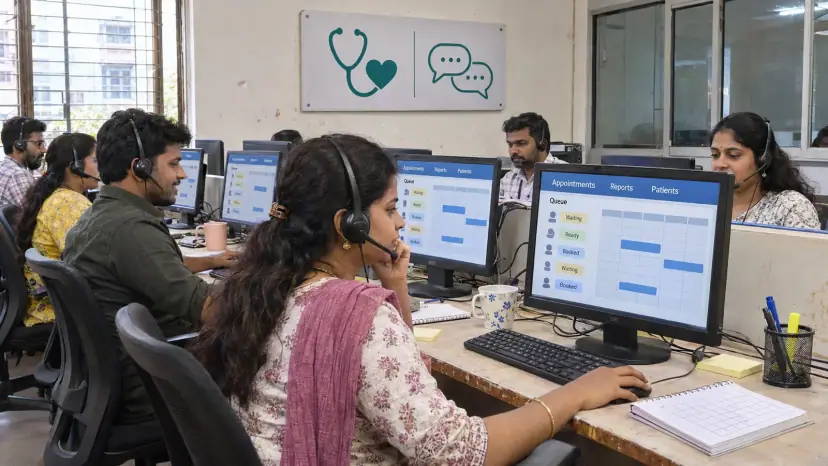
Healthcare call center services handle the calls and messages between a hospital, clinic, lab or telemedicine provider and its patients: bookings, reminders, report queries, follow-ups and urgent routing. Brainguru builds healthcare call center solutions in India on cloud telephony, multilingual IVR, CRM and EMR integration and AI assistants, with patient data protected under the DPDP Act.
Why healthcare call center solutions matter in India
Patients in India now expect to reach their hospital as easily as they reach a bank or a delivery app. Several things make that hard to deliver with a traditional front desk:
- Volume: Busy hospitals and diagnostic chains take a large number of calls every day, with peaks in the morning and after report releases.
- Languages: Patients may prefer Hindi, English or a regional language, and a single front desk cannot cover them all.
- Remote care: Teleconsultation is now routine. A Health Ministry release of 6 October 2026 says the national eSanjeevani service crossed 50 crore teleconsultations and handles about 2.5 to 3 lakh a day, in English and 14 Indian languages.
- Digital records: A PIB note on ABDM dated 6 July 2026 reports over 104 crore health records linked to over 93 crore ABHA accounts, so patients increasingly ask for reports and records digitally.
- Privacy: Calls and messages carry health data, which needs careful handling under India's data protection law.
A well-designed healthcare call center takes routine work off clinical and front-desk staff, answers patients faster and keeps a record of every interaction.
Key features of a healthcare call center solution
Automated appointment reminders
Missed appointments waste clinic time and delay care. Reminders by voice call, SMS, WhatsApp or email tell patients about their booking and let them confirm or reschedule. The evidence supports reminders, with a caveat on channel: a 2026 systematic review in the Journal of Hospital Management and Health Policy pooled 10 studies with 8,236 participants and found reminders improved hospital attendance compared with usual care (risk ratio 1.11). Telephone reminders showed a clear effect, while the pooled result for SMS alone was not statistically significant.
In practice, this suggests combining channels: a message for convenience, and a call for patients who do not confirm or who have important procedures.
Multilingual IVR
Interactive voice response (IVR) menus greet callers in their chosen language and route them to the right department, doctor or recorded information. Good IVR design keeps menus short, offers a way to reach a person quickly, and is tested with real patients, including older callers.
CRM and EMR integration
When the call system is linked to your CRM and electronic medical record or hospital management system, the agent sees who is calling, their upcoming appointments and their last visit. Calls are logged against the patient record automatically, so follow-ups are not lost. Our CRM solutions cover this side of the work.
Secure handling of patient data
Call recordings, transcripts and notes contain health data. They should be encrypted, stored in a known location, kept only as long as needed and visible only to staff who need them, with logs of every access.
AI assistants and chatbots
AI can answer routine questions, such as clinic timings, test preparation, report availability or insurance documents, without an agent. It should hand over to a person whenever a question is clinical, urgent or unclear. See our AI chatbot development service for how these assistants are built.
Omnichannel communication
Patients use different channels for different things. A modern system brings voice calls, SMS, WhatsApp, email, video consultations and app notifications into one view, so a conversation that starts on WhatsApp can continue on a call without the patient repeating themselves.
Rules for calling and messaging patients
Outbound calls are regulated, and the rules depend on the purpose of the call.
Promotional calls: TRAI's press release of 10 July 2026 confirms that promotional calls by entities of any sector must use 140-series numbers, after registering with telecom operators under the TCCCPR framework. Customers who block a sector on the Do Not Disturb registry will not receive those calls. A hospital promoting a health check-up package falls here.
Service and transaction calls: The same release says the 1600 series is mandated for service and transaction calls by regulated financial entities to their existing customers and by government entities. Hospitals and clinics are outside that list, so check the current TRAI rules with your telecom provider before you set up reminder and follow-up calling.
WhatsApp messages: Business messaging has its own templates and charges. Our article on WhatsApp chatbot development cost explains how Meta charges for messages.
Patient data: Under the Digital Personal Data Protection Rules, 2025, the main duties of the Digital Personal Data Protection Act, 2023 start on 13 May 2027. Rule 6 sets minimum security safeguards, including keeping logs for one year, and rule 7 requires a breach to be reported to the Data Protection Board without delay, with a detailed report within seventy-two hours. Where you serve patients in the United States, HIPAA applies as well.
How healthcare call centers improve patient care
- Faster access: Calls reach the right department or specialist without being passed around.
- Medication and care plans: Reminders help patients take medicines and attend follow-ups.
- After discharge: Follow-up calls check on recovery and catch problems early.
- Urgent cases: Clear triage scripts route urgent calls to emergency staff straight away.
- Health camps and drives: Vaccination drives, screening camps and chronic care programmes can be announced to the right patient groups, within the calling rules. Our guide to DPDP-aware healthcare marketing covers consent for outreach.
Call center technology for hospitals and clinics
- AI-powered IVR: Understands spoken requests and routes callers without long menus.
- Cloud-based call centers: Agents can work from any location, and capacity can grow during peaks. See our cloud telephony solutions.
- CRM-linked platforms: Every call is tied to the patient record.
- Telemedicine support: Voice, video and chat in one place for virtual consultations.
- Reporting dashboards: Call volumes, waiting times, abandoned calls and outcomes, by department and hour.
Why telemedicine needs call center support
Teleconsultation creates its own patient questions: how to join a video call, what to do when the connection drops, where to collect a prescription and how to book a test the doctor ordered. A call center linked to the telemedicine platform can help patients set up the call, send consultation summaries by SMS or WhatsApp, coordinate prescriptions and tests, and offer help in the patient's language. This matters most for patients in smaller towns and for older patients who are less used to apps.
In-house or outsourced?
Many hospitals run a mix: core patient calls handled in-house on a modern platform, with an outside partner for overflow, late hours or specific languages. When you decide, compare:
- Control: In-house staff know your doctors and processes best.
- Flexibility: Outside partners can add capacity for seasonal peaks or campaigns.
- Technology: Either way, you need a platform that logs calls against patient records and protects the data.
- Time zones: Medical tourism providers may need support during overseas patients' working hours.
How to choose healthcare call center services
- Integration with your HMS or EMR, not a separate system staff must update by hand
- Clear data handling: where recordings are stored, who can access them and for how long
- Languages your patients actually use
- Escalation rules for clinical and urgent calls, written with your medical staff
- Reports you can act on, such as missed calls by hour and department
- Compliance with TRAI calling rules and the DPDP Act
Where healthcare call centers are heading
- Voice AI in Indian languages: Speech recognition that handles regional languages and mixed Hindi-English.
- Predictive outreach: Flagging patients likely to miss an appointment so staff call them first.
- Connected devices: Alerts from home monitoring devices that trigger a follow-up call.
- Linked records: With patient consent, ABHA-linked records may make it easier to answer report and history questions quickly.