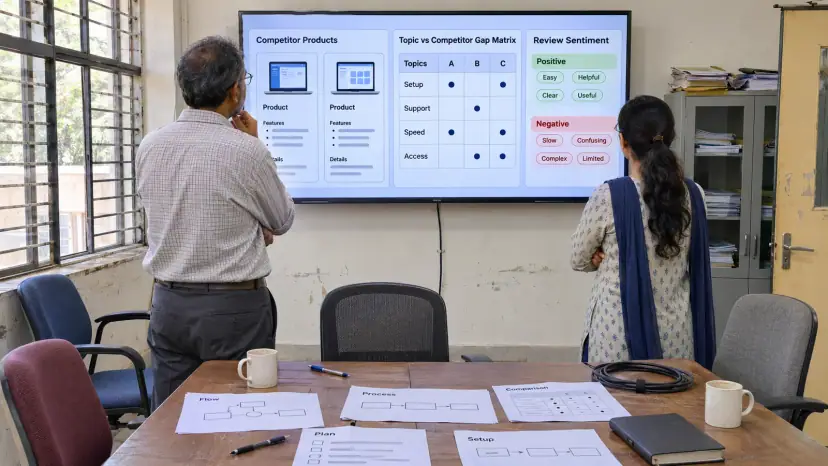
Competitive analysis with AI turns a quarterly research task into continuous monitoring. AI tools track competitor websites, prices, ads, content, reviews and hiring, sort routine changes from important ones, and send the right alerts to the right people. This page explains six areas where AI helps, what to watch out for, and how Brainguru sets it up.
Why competitive analysis needs to be continuous
Most deals now involve a rival. In Crayon's 2025 State of Competitive Intelligence report, sellers went head-to-head with competitors in 68% of deals, yet 44% of companies lacked competitor visibility within their CRM. Information that sits in one analyst's slides does not help a salesperson on a call.
Buyers also do much of their comparison without you. A Gartner survey published in June 2025 found that 61% of B2B buyers prefer an overall rep-free buying experience, researching on their own through digital channels. Your website, prices, reviews and content are compared with competitors' long before anyone speaks to sales.
Manual methods, such as quarterly reviews and occasional website checks, miss changes that happen in days. AI does not replace judgement here. It handles the collection and first sorting, so people spend their time deciding what to do.
Six areas of AI competitor analysis
Automated competitor monitoring: Crawlers and language models track competitor websites, blogs, social accounts, press releases, job postings and product updates. They detect new features, pricing pages, messaging shifts and senior hires, and learn to separate routine edits from changes that matter. Alerts go to the team that owns each topic: product, sales, marketing or leadership.
Pricing intelligence: Tools collect competitor prices across websites and marketplaces, match products even when names and pack sizes differ, and normalise for shipping, bundles and offers. The output is a live view of where you sit on price for each product and segment. Our AI for pricing optimization page explains how that data feeds pricing decisions.
Content gap analysis: Content tools such as MarketMuse and Clearscope compare your content with competitors' by topic, question and keyword, showing what they cover that you do not. The result is a ranked list of pages to create or improve, based on search demand and relevance to your business.
Social listening and sentiment: Platforms such as Brandwatch, Sprinklr and Talkwalker monitor social media, forums, reviews and news for mentions of you and your competitors, and break sentiment down by topic, such as price, service or product quality. The scale is large: DataReportal counted 491 million social media user identities in India in January 2025.
Ad and market share tracking: Public ad libraries show what competitors are running. Meta's Ad Library keeps social issue, electoral and political ads for 7 years, and for ads delivered in the EU it archives other ads for one year after their last impression. Estimation tools such as Similarweb and Sensor Tower add directional data on web traffic and app downloads where official market share data does not exist.
Predictive insights: Patterns in hiring, patents, partnerships and product releases can signal a competitor's next move. These are probabilities, not certainties, so treat them as early warnings that prompt scenario planning. Win/loss analysis of your own deals often gives the most reliable signals of all.
How to run AI competitive analysis well
- Start with questions: Decide what you need to know, such as "Which competitor is winning our enterprise deals and why?", before choosing tools.
- Define the competitor set: Include direct rivals, adjacent players and new entrants, and review the list every quarter.
- Put insight where work happens: Push alerts and battlecards into the CRM and chat tools your teams already use, not into a separate portal nobody opens.
- Keep humans in the loop: Let AI sort and summarise, and let an analyst confirm before anything reaches leadership.
- Measure use: Track whether sales opens the battlecards and whether win rates against each competitor change.
AI use in this field is rising fast. The same Crayon 2025 report found a 76% year-over-year increase in AI adoption among competitive intelligence teams, with 60% using AI daily.
Legal and ethical limits
Competitive intelligence should rely only on information that is public or that you have the right to use. Good practice is to:
- Respect website terms: Check terms of use and robots rules before automated collection, and avoid anything behind a login you are not entitled to.
- Never misrepresent yourself: Do not pose as a customer, candidate or journalist to get information.
- Handle personal data carefully: Social listening collects posts by individuals. Keep only what you need, aggregate where possible, and follow India's DPDP Act and other data laws that apply.
- Follow a code: Many teams adopt the SCIP Code of Ethics for competitive intelligence professionals as their baseline.
How Brainguru delivers competitive intelligence
- Discovery: We agree your key questions, competitor set and the decisions the intelligence should inform.
- Tool setup: We configure monitoring, pricing, content, social and ad tracking, choosing existing tools before building anything custom.
- Dashboards and alerts: We build dashboards and route alerts into your CRM and chat tools, with rules for what counts as significant.
- Training: We show your teams how to read and use the output, including battlecards for sales.
- Review: We run regular reviews, refine the competitor set and alerts, and answer one-off questions as they come up.
Where competitive data shapes campaigns, it links naturally with our AI for ad optimization work, and where it shapes forecasts, with AI for sales forecasting. Our data intelligence services cover the warehouse and reporting underneath.
Turning competitive insight into action
Intelligence only pays off when it changes what teams do. These are the most common ways it feeds day-to-day work:
- Sales: Battlecards for each main competitor, with their strengths, weak points, pricing and the questions that expose the difference, kept up to date from the monitoring feed.
- Marketing: Content gaps become a publishing plan, and competitor messaging shifts inform your own positioning. Our AI SEO automation work turns content gap findings into briefs and page updates.
- Product: Competitor releases and review themes highlight features customers ask for, and complaints you can avoid.
- Customer success: When customers mention a competitor in support tickets or renewal calls, that is an early churn signal. Our AI for customer retention page explains how such signals feed retention workflows.
- Leadership: Quarterly summaries of competitor moves, market share signals and win/loss trends support planning and investment decisions.
Keep the loop closed. When a battlecard is used in a deal, record the outcome. When a content gap is filled, track the ranking. Over time this shows which kinds of intelligence are worth collecting and which can be dropped, so the programme stays focused rather than growing into a pile of unread alerts.
Questions to ask before you start
- Decisions: Which decisions should this intelligence change?
- Owners: Who reviews alerts, and who acts on them?
- Sources: Which sources are allowed, and which are off limits?
- Cadence: What needs real-time alerts, and what can wait for a monthly briefing?
- Success: How will you know the programme is paying off?