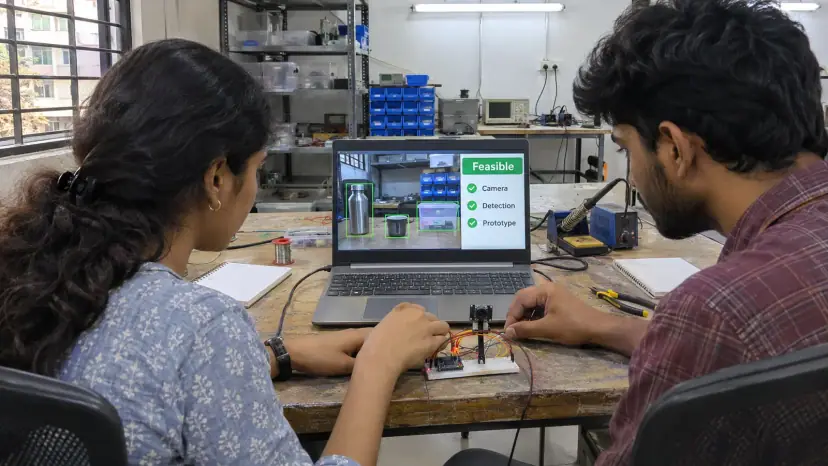
Our PoC development services help startups find out whether the riskiest part of an idea works before paying for a full product. A proof of concept is a small, focused build that tests one technical question, such as an AI model, an integration or a data workflow. Brainguru scopes it, builds it and reports a clear go or no-go.
What is a proof of concept?
A proof of concept (PoC) is a small working model built to answer one question: can this be done, with this technology, to the standard the product needs? It is usually internal and experimental. It does not need a polished design, user accounts or payment flows, because nobody outside the team will use it.
A PoC is different from the stages that follow it:
- PoC: Tests technical feasibility. The audience is the founders, the engineering team and sometimes investors.
- Prototype: Shows how the product will look and flow, often with little real logic behind it. Our product prototype development covers this stage.
- MVP: A first working product that real customers use, built to test product-market fit. See our MVP development services.
Not every startup needs a PoC. If your product uses well-proven technology in a familiar way, the risk is in the market, not the code, and an MVP is the better first step.
Why startups use PoC development services
- Lower financial risk: A few weeks of focused work can stop months of building on an idea that cannot work.
- Investor confidence: A working demonstration of the hard part is more convincing than a slide that says it is possible.
- Technical choices: Testing two approaches side by side shows which model, service or architecture to build on.
- Faster MVP: Code, data pipelines and lessons from the PoC often carry straight into the MVP.
- Cost control: The findings give a far better basis for estimating the full build.
Why AI proofs of concept need extra care
AI ideas are the most common reason founders ask for a PoC, and the stage where many projects stall. In July 2024, Gartner predicted, as Intelligent CIO reported, that at least 30% of generative AI projects would be abandoned after proof of concept by the end of 2025, because of poor data quality, inadequate risk controls, escalating costs or unclear business value.
Later research pointed the same way. CIO.com reported in March 2025 that IDC research with Lenovo found 88% of observed AI proofs of concept did not make it to wide deployment: for every 33 launched, only four reached production. IDC linked this to low readiness in data, processes and IT infrastructure. In August 2025, Fortune reported that MIT NANDA's study, The GenAI Divide: State of AI in Business 2025, found only about 5% of AI pilot programmes achieved rapid revenue acceleration.
The lesson is not to avoid AI PoCs, but to design them properly: define success in business terms, test with real data, and price the cost of running the model at scale before you commit. Our AI model development team can take a successful PoC forward.
How we build a proof of concept
- Find the riskiest assumption: We work with you to name the one or two things that, if they fail, sink the product.
- Set success criteria: Each test gets a measurable bar agreed in advance, such as accuracy on your data, response time or cost per request.
- Keep scope tight: We build only what the test needs, and leave out design polish, logins and admin screens.
- Build and measure: We use the most suitable tools, run the tests and record the results honestly, including what did not work.
- Report and recommend: You get a short report with findings, risks, a rough architecture for the full build and a clear recommendation.
What can a PoC test?
- AI and machine learning: Whether a model can classify, predict, extract or generate well enough on your own data.
- Language and chat: Whether a chatbot or language model can answer accurately within your rules.
- Integrations: Whether a payment gateway, ERP, government API or device can be connected reliably.
- Data workflows: Whether data can be collected, cleaned and processed at the volume you expect.
- Performance: Whether a design holds up under realistic load and response-time limits.
- SaaS foundations: Whether multi-tenant data separation, usage billing or cloud scaling can work as planned.
Testing AI tools inside the build
Developers now use AI tools widely while building software. In the Stack Overflow 2025 Developer Survey, 84% of respondents were using or planning to use AI tools in their development process. The same survey found more developers distrusted the accuracy of AI tools (46%) than trusted it (33%). For a PoC, that is a reminder to check AI-generated code and results by hand before treating them as evidence.
What affects the cost and timeline of a PoC?
We do not publish prices or fixed timelines, because PoCs vary widely. These factors drive both:
- Number of assumptions: Testing one question is quicker than testing three.
- Data readiness: Clean, labelled data saves time; collecting or cleaning data adds it.
- Third-party access: Approval for APIs, sandboxes or hardware can set the pace.
- Model and infrastructure costs: Paid AI services or cloud resources used during testing.
- Reporting depth: A demo for investors needs more preparation than an internal test.
Before you start, our startup technology consulting can help decide whether a PoC, a prototype or an MVP is the right first step. Investors who want an outside view of the result may also ask for technical due diligence.