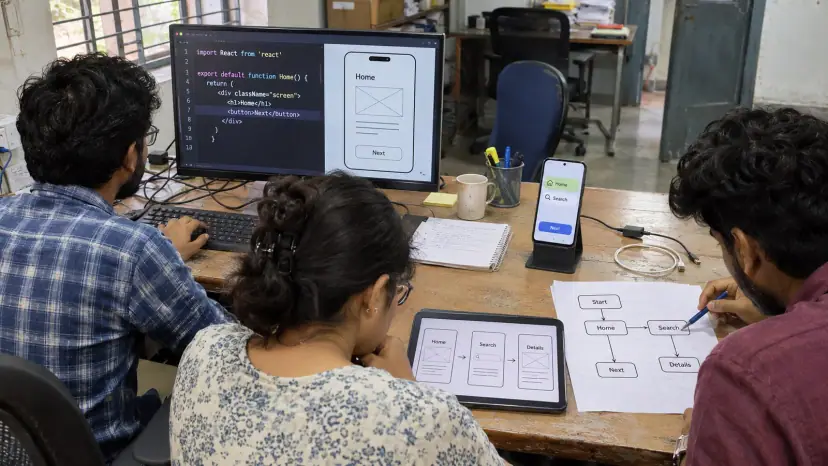
MVP development services help founders turn an idea into a first working product that real users can try, with only the features needed to test the idea. Brainguru covers each stage: consulting and scope, proof of concept, prototype design, the build itself, launch, and then scaling or changing direction based on what users actually do.
Why start with an MVP?
A minimum viable product is the smallest version of your product that delivers its core value and lets you learn from real use. It is not a rough demo, and it is not the full product with corners cut. It is a deliberate first release.
- Lower first spend: You pay for what tests the idea, not for features nobody may use.
- Faster to market: A narrow scope ships sooner, so learning starts sooner.
- Real evidence: Sign-ups, usage and payments tell you more than surveys.
- Stronger investor conversations: A working product with early users is easier to discuss than slides, and pairs well with a clear startup pitch deck.
- Room to change course: If the data says pivot, you have spent less getting there.
Many founders are making this call at the same time. IBEF reported in April 2026 that India's DPIIT-recognised startups had passed 2.23 lakh as of 31 March 2026.
Who our MVP development services are for
- Non-technical founders: You have the idea and the market knowledge, and need a team to scope and build the product.
- Technical founders: You want extra hands for design, mobile, testing or cloud set-up while you focus on the core.
- Startups after a first version: You have something live but need to rebuild it properly or add what users are asking for.
- Companies testing a new product line: You want to test a new idea without disturbing your main systems.
What our MVP services cover
MVP consulting and planning: Before any code, we define the core value, the users, the one or two journeys that matter, the measures of early traction and a roadmap for what comes after.
Proof of concept: For ideas with real technical risk, such as a new AI model, an unusual integration or heavy data processing, a small proof of concept tests whether it can work before you fund a full build. Our PoC development services page explains when that step is worth it.
Prototype design: Wireframes, user flows and a clickable prototype let you test the journey with users and stakeholders before development.
MVP build: Front end, back end, database, admin panel and integrations, delivered in short sprints with a demo at the end of each.
Testing and launch: Manual and automated testing, security checks, cloud deployment, app store submission and analytics set-up.
Validation: Controlled beta releases, in-app feedback, and tracking of behaviour, conversion and engagement with tools such as Google Analytics or Mixpanel.
Scaling the product: New features, refactoring, better performance and security, and infrastructure ready for growth once the idea is proven.
Our MVP development process
- Discovery and planning: Scope, target users and success measures.
- UX and UI design: Wireframes, flows and interactive prototypes.
- PoC or MVP development: Core features built in short iterations.
- Quality assurance: Manual and automated testing for stability and security.
- Launch and feedback loop: Release to users and collect real usage data.
- Scale or pivot: Expand what works, or change direction based on the evidence.
Technology we use for MVPs
We choose a stack your future team can maintain and hire for, not the newest tool on the market. Widely used tools have more maintained libraries and more developers who know them. In the Stack Overflow 2025 Developer Survey, PostgreSQL was used by 55.6% of respondents, the most used database, and Docker by 71.1%.
- Front end: React, Angular, Vue.js.
- Back end: Node.js, Express, Django, Laravel.
- Mobile: React Native, Flutter, Kotlin, Swift. See cross-platform app development for when one codebase is enough.
- Databases: PostgreSQL, MySQL, MongoDB, Firebase.
- Cloud: AWS, Google Cloud, Azure, DigitalOcean.
- DevOps: Docker, Kubernetes, GitHub Actions and CI/CD pipelines.
- Analytics: Mixpanel, Amplitude, Google Analytics, Firebase.
India's developer base keeps growing, which helps when you later hire your own team. GitHub's Octoverse 2025 report says India added more than 5.2 million developers in 2025, the largest source of new developers on GitHub.
Using AI in MVP work
AI tools can speed up prototyping, test writing and routine code, and AI features such as search, recommendations or chat can be part of the product. They need checking. In the Stack Overflow 2025 AI survey, more developers distrusted the accuracy of AI tools (46%) than trusted it (33%). We treat AI output like any other code: reviewed, tested and owned by a person.
Building security in from the first release
An MVP still handles real user data, so basic security cannot wait for version two. The Verizon 2026 Data Breach Investigations Report found that 31% of breaches now start with software vulnerabilities. We check permissions on the server, keep libraries up to date, store secrets safely and run security testing before launch.
Industries we build MVPs for
- FinTech: Personal finance tools, investment dashboards and payment features.
- HealthTech: Patient apps and appointment scheduling.
- EdTech: Learning portals, course platforms and student engagement tools.
- eCommerce: Marketplaces, inventory tools and logistics dashboards.
- SaaS: CRM tools, analytics dashboards and team collaboration apps.
- On-demand apps: Food delivery, transport and home services.
Example MVP paths (illustrative, not client results)
SaaS analytics tool: A lightweight analytics MVP for online stores can test demand with a few early users before it grows into a full SaaS product.
HealthTech idea: A proof of concept for a wearable-linked health monitor can test technical feasibility before pilots or an investor pitch.
EdTech platform: A clickable prototype followed by an MVP for a student engagement tool can measure real engagement before more investment.
What affects the cost of an MVP?
We quote each MVP individually. The main drivers are the number of features, platforms (web, mobile or both), design depth, integrations, AI components and the support you need after launch. Our guide to MVP development cost for startups explains each driver in more detail.