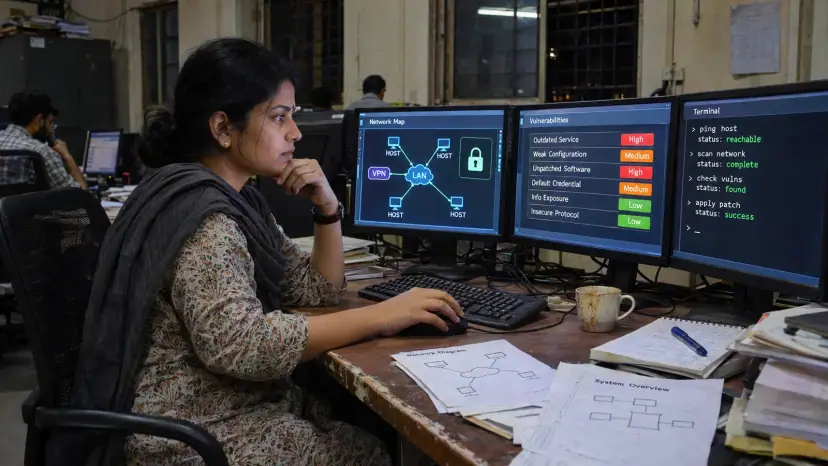
Security testing services check your applications, APIs, networks and cloud accounts for weaknesses that an attacker could use, then explain each one and how to fix it. Brainguru combines automated scanning with manual penetration testing, ranks every finding by risk, and retests once your team has made the fixes, for businesses in India and abroad.
What is security testing?
Security testing is a planned check of software and infrastructure for flaws that could let someone steal data, take over accounts or stop a service. It covers how users log in, what each user is allowed to do, how data is stored and sent, how input is handled and how systems are configured. The aim is to find problems on your terms, before someone else finds them on theirs.
Two kinds of work are usually combined:
- Vulnerability assessment: Broad, mostly automated scanning that lists known weaknesses, such as missing patches, outdated libraries and unsafe settings, across many systems quickly.
- Penetration testing: Deeper, manual testing where a tester tries to exploit weaknesses the way an attacker would, chaining small issues together to show real impact.
Why security testing matters
Attackers increasingly start with software flaws. Verizon's 2026 Data Breach Investigations Report found that 31% of breaches now start with software vulnerabilities, ahead of stolen passwords as the top way in. In India, IBM's Cost of a Data Breach Report 2025 found that vulnerability exploitation caused 13% of breaches, and that the average breach cost INR 220 million.
The most common flaws are not exotic. The OWASP Top 10:2025 ranks broken access control first and reports that 100% of the applications tested had some form of it. Security misconfiguration moved up from fifth to second place, again found in 100% of the applications tested. These are exactly the issues that manual testing finds and automated scanners often miss.
Our security testing services
Vulnerability assessment: We scan applications, servers, databases and network devices for known weaknesses, remove false positives, and give you a ranked list with clear remediation steps.
Penetration testing: Our testers simulate real attacks on your applications, networks and infrastructure in a controlled way, agreed in writing beforehand, to show how far an attacker could get and what data they could reach.
Web application security testing: We test against the OWASP Top 10 and beyond, including broken access control, injection such as SQL injection, cross-site scripting, authentication flaws, session handling and security misconfiguration.
API security testing: Modern apps run on APIs, and APIs often expose more than the screen does. We check authentication, object-level access, rate limits and data exposure on each endpoint. This fits naturally with our API development work.
Mobile application security testing: We test Android and iOS apps for insecure data storage, weak encryption, exposed API keys, unsafe communication and flaws in authentication.
Network security testing: We test internal and external networks for open services, weak firewall rules, outdated systems and unauthorised access points.
Cloud security testing: We review cloud configurations, identity and access management, storage permissions and logging across AWS, Azure and Google Cloud, including multi-cloud and hybrid set-ups.
IoT security testing: We test connected devices, their firmware, communication protocols and the apps and cloud services behind them.
How our security testing process works
- Scope and rules: We agree in writing what is in scope, which environments to test, when testing may run and who to call if something critical turns up.
- Reconnaissance: We map the attack surface: domains, endpoints, user roles, data flows and third-party services.
- Automated scanning: Scanners cover known issues quickly and give testers a starting point.
- Manual testing: Testers look for logic flaws, access control gaps and chains of small issues that scanners cannot judge.
- Report: Each finding has a severity rating, evidence, the business impact and a practical fix, with a short summary for managers.
- Retest: Once fixes are in, we retest each finding and confirm which are resolved.
Standards and rules we test against
We align testing with recognised standards, such as the OWASP Top 10, NIST guidance and ISO 27001 controls, and with the rules that apply to your business, such as GDPR for EU personal data, PCI DSS for card payments and HIPAA where you handle US health data.
In India, two sets of rules matter most. The CERT-In directions of 28 April 2022 require listed cyber incidents, including targeted scanning and compromise of critical systems, to be reported within 6 hours of noticing them. The DPDP Rules notified on 13 November 2025, whose main duties apply from 13 May 2027, require reasonable security safeguards for personal data, including encryption or masking, access control and logging under Rule 6. Regular testing is one of the clearest ways to show those safeguards actually work.
Why automated scans are not enough
A scanner can find a missing patch or an outdated library. It cannot tell that a customer can change one number in a web address and see another customer's invoice, or that a discount code can be applied twice. Those are access control and business logic flaws, and they are among the most damaging. Good testing uses automation for breadth and people for depth.
When should you run security testing?
- Before launch: Test a new application or major feature before real users and real data arrive.
- After major changes: New login flows, payment features, integrations or infrastructure moves deserve a fresh look.
- On a schedule: Many teams test at least once a year and scan more often, because new vulnerabilities are published all the time.
- In the pipeline: Automated checks in each build catch regressions early. Our DevOps services can build these into your release process.
- For customers and audits: Larger customers and auditors often ask for a recent independent test report.
For a quick self-check of a business website before a full test, our article on running a cyber security audit of your website is a useful start.
What affects the cost of security testing?
- Size and complexity: The number of applications, user roles, endpoints and integrations.
- Depth: A vulnerability scan takes less effort than a full manual penetration test.
- Approach: Black-box testing with no inside knowledge, or grey-box and white-box testing with accounts, documents or code.
- Environments: Web, mobile, API, network and cloud are separate pieces of work.
- Frequency: A one-off test or regular testing tied to releases.
- Compliance needs: Some standards add specific test types or reporting formats.
We quote after a free consultation and a short scoping call, so effort goes where the risk is highest.
Questions to ask a security testing provider
- How much is manual? Ask what testers do beyond running a scanner.
- What does a finding look like? Ask for a sample report with evidence, severity and a clear fix.
- Is a retest included? Confirm that fixes will be checked.
- How is my data handled? Ask how test data, credentials and findings are stored and deleted afterwards.
- What happens if you find something critical? You should hear about it the same day, not in the final report.