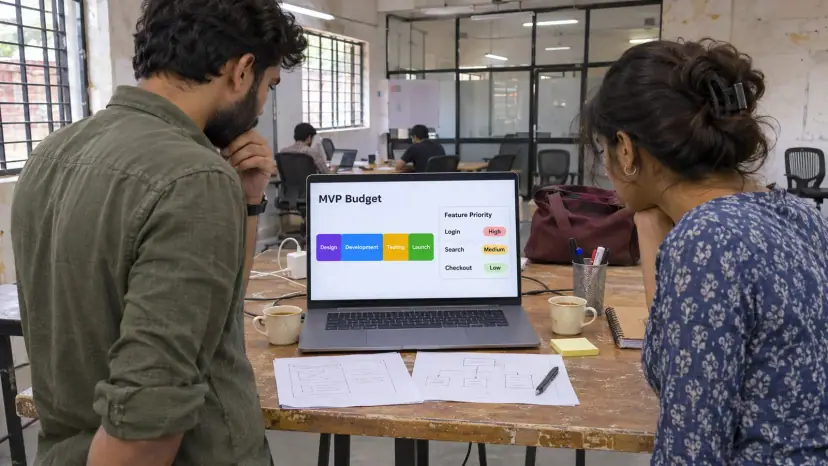
MVP development cost for startups depends on what you build, how much of it you build first and who builds it. This guide explains what drives the budget for a minimum viable product: product type, each stage of work, technical choices, the team and costs after launch.
Why MVP development cost for startups is hard to pin down
Founders often ask for a single figure, but two products with the same label can differ several times over in effort. A "marketplace" might be a simple listing site with enquiry forms, or a two-sided platform with payments, ratings, disputes and payouts. Ranges quoted online rarely say which one they mean, so they are a poor basis for a budget.
A better approach is to understand what makes the work bigger or smaller, then shape the first release around the one question it must answer: will real users want this? India has a large pool of founders asking the same question. According to IBEF, reporting government data in April 2026, the number of DPIIT-recognised startups crossed 2.23 lakh as of 31 March 2026, with more than 55,200 recognised in 2025-26 alone. Many of them face the same trade-off between building enough to learn and spending too much too early.
If your MVP is a mobile app or a website, our free app and website cost calculator explains what drives the cost of an MVP-first build compared with a full first release.
How the type of MVP changes the effort
- Simple web MVP: A responsive site with sign-up, a basic dashboard and one or two integrations. Usually the smallest build.
- Mobile app MVP: Native or cross-platform apps for Android and iOS, plus a back end, an admin panel and store submission.
- SaaS MVP: Accounts for several organisations, roles, subscription billing and secure sign-in, which add work early.
- Marketplace MVP: Two sets of users, listings, search, payments and often payouts to sellers.
- AI-powered MVP: A model or AI service, data preparation, evaluation and monitoring on top of the normal product work.
- Enterprise MVP: Complex workflows, detailed permissions, audit trails, integrations with existing systems and compliance needs.
A cheaper way to test an idea is sometimes not to build software at all: a landing page, a clickable prototype or a manual service behind a simple form. Our guide to building an MVP covers these options.
Where the budget goes, stage by stage
Discovery and design: Research, user journeys, feature priorities, wireframes and a clickable prototype. Skipping this stage rarely saves money; it usually moves the cost into rework later.
Development: The front end, back end, database, APIs and integrations. This is normally the largest share. Your choice of stack matters: popular tools have more ready-made libraries and more developers who know them. In the Stack Overflow 2025 Developer Survey, 66% of respondents used JavaScript, and Node.js (48.7%) and React (44.7%) were the most used web technologies.
Testing: Functional, device, performance and security checks, plus testing by real users. Security is not optional even for a first release. The OWASP Top 10:2025 ranks broken access control first and reports that 100% of applications tested had some form of it.
Deployment and launch: Cloud set-up, automated builds and releases, domain and certificates, app store submission, analytics and monitoring.
Six factors that change the cost
- Feature scope: Every feature adds design, code, testing and maintenance. Email login is far less work than social login, two-factor authentication and biometrics together.
- Technology choices: Native apps for each platform cost more to build and maintain than one cross-platform codebase, though native can suit apps that need deep device features. Microservices cost more at the start than a single well-structured application.
- Design depth: A clean design built on a proven component library costs less than custom illustration, animation and a bespoke design system.
- Integrations: Payments, SMS, email, maps, CRMs and analytics each add work, more so where the API is poorly documented. APIs are now central to most products: Postman's 2025 State of the API report found that 82% of organisations have adopted some level of an API-first approach.
- Team model: Freelancers, an agency or an in-house hire each change the cost of coordination, accountability and continuity, not only the rate.
- Post-launch work: Bug fixes, small improvements and changes based on feedback start the day you launch. Budget for them from the start.
Running costs after launch
The build is not the only cost. Hosting, databases, email and SMS, maps, app store accounts and paid APIs all bill monthly, and their cost grows with usage. Cloud bills in particular can drift: the Flexera 2026 State of the Cloud Report put estimated wasted spend on cloud infrastructure and platform services at 29%. Simple steps such as right-sized servers, budgets and alerts help an MVP avoid paying for capacity it does not use.
AI features carry their own running cost, usually charged per request or per token, so estimate expected usage before choosing a model.
Building in India or abroad
Many founders compare teams in India with teams in the US or Europe. Rates differ, but the total cost of an MVP depends just as much on how clearly the scope is defined, how well the team communicates and how much rework is needed. When comparing quotes from anywhere, compare what is included: discovery, design, testing, deployment, documentation and support.
How to build your MVP on a budget
- Cut the feature list hard: Keep only what tests your main assumption. The MoSCoW method (Must have, Should have, Could have, Will not have) helps make the calls.
- Reuse proven services: Use an established payment gateway, a hosted sign-in service and open-source UI components instead of building them.
- Consider cross-platform: If you need a mobile app, frameworks such as Flutter or React Native let one codebase serve Android and iOS. See cross-platform app development.
- Work in short cycles: Two-week sprints with a demo at the end of each keep spending tied to visible progress.
- Use AI tools with care: AI coding assistants can speed up routine work, but review their output. In the Stack Overflow 2025 survey, 84% of respondents were using or planning to use AI tools, yet 46% distrusted the accuracy of their output.
What to ask before you sign
- What exactly is in the first release, and what is left for later?
- Is the price for a fixed scope, or for time and materials?
- Who owns the code, cloud accounts and designs at the end?
- Which tests run before launch, and who does them?
- What support is included after launch, and for how long?
- Which running costs will we pay directly to third parties?
How Brainguru approaches MVP projects
We quote each MVP individually after a discovery conversation, because a fair estimate depends on your scope. One team covers design, front end, back end, testing and deployment, so there is a single group accountable for the result. Work runs in short sprints with regular demos. After launch we can fix, improve and scale the product, or hand it over with documentation to your own team.