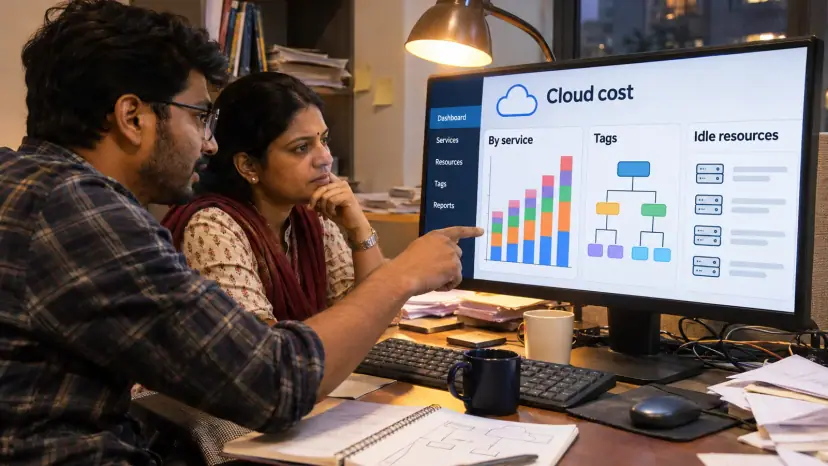
Cloud FinOps services help you see where your cloud money goes, remove what you do not need and keep spending in line with what the business gets back. Brainguru sets up cost visibility, tagging, budgets and regular reviews on AWS, Azure and Google Cloud, so engineering and finance work from the same numbers.
What Cloud FinOps means
FinOps, short for cloud financial operations, treats cloud spending as a shared job between engineering, finance and business teams. The FinOps Foundation framework describes it as an operational framework and cultural practice, and splits the work into three phases: Inform, Optimize and Operate.
- Inform: Find out who spends what, on which service, for which product or customer.
- Optimize: Remove waste, right-size resources and use the discounts your provider offers.
- Operate: Turn good habits into budgets, policies and reviews that keep running after the first clean-up.
The aim is not the lowest possible bill. A product that is growing should spend more on cloud. The aim is that every rupee or dollar maps to a team and a purpose, and that someone notices when spend moves without a reason.
Why cloud costs drift
Cloud is easy to start and easy to forget. A developer can create a server in minutes, and nothing forces anyone to delete it. Test environments stay on over weekends. Storage grows because old snapshots are never cleared. Discounts go unused because no one owns the decision to buy them.
This is common. In the Flexera 2026 State of the Cloud Report, respondents estimated that 29% of their cloud spend is wasted, a figure that rose this year after a five-year downward trend. The same report found that fewer than half of organisations use any one commitment discount per cloud provider.
Waste also hides in applications nobody uses. AWS migration guidance describes zombie applications as those with average CPU and memory use below 5 percent, and idle applications as those between 5 and 20 percent over 90 days. Finding these is often the quickest saving in a first review.
Our Cloud FinOps services
Each engagement is built from the pieces your setup needs. Most start with visibility, because nothing else works without it.
- Cost visibility and tagging: A tagging standard for team, product, environment and cost centre, applied to existing resources and enforced on new ones, with dashboards that show spend by owner rather than only by service.
- Waste removal: Finding idle servers, unattached disks, old snapshots, oversized databases and forgotten test environments, then removing or scheduling them with the owner's agreement.
- Right-sizing: Matching compute, storage and database sizes to real use, based on weeks of monitoring data rather than guesses.
- Commitment planning: Deciding how much steady use to cover with reserved instances, savings plans or committed-use discounts, and reviewing that cover as usage changes.
- Budgets and anomaly alerts: Budgets per team or product, with alerts when spend jumps, so a runaway job is caught in a day rather than at month end.
- Forecasting: Monthly forecasts that finance can plan around, built from usage trends and known launches.
- Governance: Policies on who can create what, where and at what size, with approval steps for large or unusual resources.
- Multi-cloud and SaaS: One view across AWS, Azure and Google Cloud and, where useful, your SaaS subscriptions.
FinOps is moving beyond the cloud bill
The practice has grown from cleaning up servers to managing the value of technology more broadly. The State of FinOps 2026 report from the FinOps Foundation, based on 1,192 respondents, found that workload optimisation and waste reduction remain the single top current priority. It also found that 98% of respondents now manage AI spend, and 90% manage SaaS or plan to in the coming year.
For a business this has two practical effects. AI workloads, such as model APIs and GPU instances, need the same tagging and budget discipline as servers, because their costs climb quickly with usage. And SaaS licences that nobody uses are as much waste as an idle server.
Formal ownership is becoming normal too. Flexera's 2026 report found that FinOps team prevalence climbed to 63%, and that 49% of respondents use unit economics, such as cost per customer or per transaction, up from 40% the year before.
How a FinOps engagement runs
- Access and baseline: Read-only access to billing and usage data, and a picture of recent spend by service, account and owner.
- Quick wins: A list of low-risk savings, such as idle resources and unused storage, agreed with the owners before anything changes.
- Structural fixes: Tagging, account structure, right-sizing and commitment planning, which take longer but keep savings in place.
- Budgets and reporting: Dashboards, alerts and a monthly report that engineering and finance both read.
- Regular review: A recurring meeting to compare spend with the forecast, look at anomalies and agree the next changes.
If you are early in your cloud journey, setting up accounts and tags correctly from the start is far cheaper than fixing them later. Our startup cloud architecture work covers this. If you have just moved, our guide to cloud migration planning, cost and downtime explains why the first bills after a move are often higher than planned.
Common FinOps mistakes
- Cutting before measuring: Deleting resources without knowing who owns them can break a service. Tag and ask first.
- Buying commitments too early: Reserved capacity bought before right-sizing locks in the wrong size for a year or more.
- Treating it as a one-off project: Savings fade within months if nobody reviews spend regularly.
- Leaving engineers out: Finance can see the bill, but only engineers can change what drives it.
- Ignoring architecture: Some costs come from design choices, such as services moving large amounts of data between regions. These need a design change, not a discount.
Who do we work with?
- Startups: Teams whose cloud bill has grown faster than revenue and who need clear owners for each cost.
- SaaS businesses: Companies that need cost per customer or per feature to price plans with confidence.
- Mid-sized companies: Businesses running several accounts, or more than one cloud, without a single view of spend.
- Enterprises after a migration: Organisations whose new cloud estate needs budgets, policies and regular reviews.
We work with clients in India and abroad, with delivery from our Noida office. For a wider review of your platforms and plans, see our cloud consulting company in Noida page.
What affects the cost of FinOps services?
We do not publish prices, because the effort depends on your setup. These factors drive the estimate:
- Size of the estate: Monthly spend matters less than the number of accounts, subscriptions and services involved.
- Number of clouds: Each provider has its own billing data, discounts and tools.
- State of tagging: An estate with no tags needs more work before any report is reliable.
- One-time or ongoing: A single review costs less than monthly reporting and reviews, but savings last longer with the second.
- Automation: Scheduled shutdowns, policy checks and automated reports take setup time and save effort later.
Questions to ask a FinOps provider
- Access: Can you start with read-only access to billing and usage data?
- Approval: Who approves a change before a resource is removed or resized?
- Measurement: How will savings be measured, and against what baseline?
- Handover: Will our own team be able to run the reports without you?
- Commitments: How do you plan discounts so we are not stuck if usage drops?
We are happy to answer each of these in a free consultation.