
In this article
- Key takeaways
- Why AI Matters for Business Growth
- How AI Can Grow Your Business Through Better Customer Insight
- Automating Repetitive Business Tasks
- Better Marketing and Lead Generation
- Customer Support With Chatbots and Virtual Assistants
- Better, Data-Driven Decisions
- Predictive Lead Scoring for Sales
- Operational Efficiency
- Personalisation at Scale
- Security for a Growing Business
- Lower Costs and Better Margins
- How Small Businesses Can Use AI on a Low Budget
- Final Thoughts
- Frequently Asked Questions
AI can grow your business by helping you understand customers, automate routine work, spend marketing money better, answer enquiries faster, rank leads and plan with real data. This guide covers each of those uses with practical examples, the risks to watch, and how a small business can start without a large budget.
Why AI Matters for Business Growth
Every business now produces data: website visits, ad clicks, enquiries, CRM notes, invoices and stock records. On its own, that data does little. AI tools can sort through it, find patterns and act on them, for example by sending a follow-up at the right time or flagging which product is about to run out.
Most organisations have started. The Stanford AI Index 2025 reported that 78% of organisations reported using AI in 2024, up from 55% the year before. For a growing business, the question is which uses will bring more customers, more sales or better margins, and which are just interesting technology.

How AI Can Grow Your Business Through Better Customer Insight
AI is good at spotting patterns in customer behaviour that people miss in spreadsheets. Predictive analytics tools can show:
- What customers are searching for on your site.
- Which products or services each customer is likely to buy next.
- What tends to trigger a purchase, such as a price drop or a reminder.
- When a customer is likely to need support or a repeat order.
Example: an online store can use purchase history to show each shopper the products they are most likely to want next. Relevant suggestions tend to lift sales and make shopping easier.
Why Customer Insight Matters for Growth
Better customer understanding means better marketing and more targeted ads. When you know what a customer is likely to want next, you can stop spending on people who were never going to buy and put that money behind those who are. Even a small business can start this way, using the searches, clicks and purchase history it already has.
Automating Repetitive Business Tasks
AI is well suited to routine tasks that take time away from your team, such as:
- Qualifying new leads.
- Data entry.
- Sorting email.
- Answering common customer questions.
- Billing and invoicing.
- Scheduling social media posts.
- Booking appointments.
With these handled, your team can spend more time on strategy, new products and customer relationships.
Use case: a real estate firm using a CRM with AI features can assign new leads to the right agent, send follow-up reminders, score leads by intent and trigger WhatsApp messages when a buyer shows interest. Fewer leads are forgotten, and agents spend their time on the buyers most likely to visit a site.
Better Marketing and Lead Generation
Marketing has become more data-driven, and AI helps by:
- Analysing how customers behave across channels.
- Moving ad budget towards what works.
- Showing which channels bring the most enquiries.
- Personalising content for different groups.
- Predicting how a campaign is likely to perform.
- Automating lead nurturing by email or WhatsApp.
AI Writing and Creative Tools
Tools such as ChatGPT, Google Gemini and the AI features in marketing platforms help draft ad copy, social posts, landing page text and email sequences faster. The drafts still need a person who knows the business to check facts, tone and claims before anything goes out. Our post on AI marketing tools for Indian startups compares the main options.
Impact on Marketing Results
AI helps campaigns reach the right audience at the right time with the right message. In practice, budget moves away from the channels and ads that are not bringing enquiries and towards the ones that are. For a small Indian business with a limited monthly ad budget, this can matter more than any single creative idea.
Customer Support With Chatbots and Virtual Assistants
Customers now expect quick replies, including outside office hours. Staffing a support team round the clock is expensive for most small firms. AI chatbots help fill that gap.
Chatbots can handle: common questions, order status, basic troubleshooting, appointment bookings, feedback collection and first-level lead qualification.
Modern chatbots can understand natural language and reply in several languages, which matters for businesses serving customers across India.
Why Faster Support Matters
You can handle more queries without long delays, keep support costs under control and keep customers happier. This is useful during a sale or festival season, when enquiries on WhatsApp and the website can jump well beyond what a small team can answer. Queries the bot cannot handle should still pass to a person, so customers are not left stuck in a loop. Our guide to AI chatbot development cost in India explains what drives the cost of building one.
Better, Data-Driven Decisions
Many business decisions are still made on instinct. AI tools reduce guesswork by giving regular insight into:
- Market trends.
- Competitor activity you can observe, such as prices and ads.
- Sales patterns by product, area and season.
- Customer behaviour.
- Bottlenecks in operations.
Dashboards present this clearly, so owners and managers can decide faster.
Example: a forecasting tool can predict next quarter's sales from past orders and seasonal patterns, helping you plan stock, staffing and marketing budgets more accurately.
Predictive Lead Scoring for Sales
Not every lead is equally likely to buy. Instead of treating them all the same, predictive lead scoring ranks leads by intent and behaviour, using signals such as:
- Pages visited on your website and time spent there.
- Engagement with your social media posts.
- Email opens and clicks.
- Past interactions recorded in the CRM.
- Past purchases.
- Company size or location, where relevant.
Your sales team then calls the highest-scoring leads first. The aim is more conversions, shorter sales cycles and better use of each salesperson's time. The scores are only as good as the data behind them, so ask sales to mark which leads turned out to be genuine. Our article on how AI is changing lead generation in India goes deeper.
Operational Efficiency
AI helps operations in supply chain management, logistics, inventory planning, manufacturing, scheduling and HR. It can spot bottlenecks, reduce delays and make better use of people and machines.
Example: manufacturers use sensor data and AI to spot signs that a machine is likely to fail, so they can plan the repair before a breakdown stops production.
Personalisation at Scale
Customers respond better to offers that match their needs. AI makes it practical to personalise:
- Product suggestions.
- Email campaigns.
- Website content.
- Ads.
- Offers and discounts.
- Chat replies.
The aim is higher engagement, better conversion and stronger loyalty. Personalisation uses customer data, so be clear with customers about what you collect and why, and follow India's data protection law.
Security for a Growing Business
As a business grows, it holds more customer data and becomes a bigger target. AI security tools help detect unusual behaviour, suspicious patterns and unauthorised access attempts, with features such as real-time threat detection, malware blocking, automated alerts, network monitoring and data protection. They work best alongside basics such as strong passwords, two-step login and regular backups.
Lower Costs and Better Margins
AI reduces errors, automates tasks and improves accuracy, which lowers operating costs. Typical examples:
- Customer support: chatbots handle routine questions, so you need fewer extra hires as volume grows.
- Marketing: automation reduces spend on ads that do not convert.
- Sales: lead scoring helps the team convert more of the leads it already has.
- Forecasting: better demand estimates reduce wasted stock.
Growth with better margins is the real goal: more sales without costs rising at the same pace.
How Small Businesses Can Use AI on a Low Budget
AI is not only for large companies. Small businesses can use it for:
- Social media content ideas and drafts.
- Website and WhatsApp chatbots.
- Basic CRM automation.
- Lead generation workflows.
- Google Ads campaigns that use automated bidding. For example, Performance Max is a goal-based campaign type that gives access to all Google Ads inventory, including YouTube, Search and Maps, from a single campaign.
- Email marketing automation.
- Invoicing and bookkeeping.
Many of these features come inside tools you may already pay for, or have free and low-cost plans. Start with one, measure what it changes, and add the next only when the first is working. If you are choosing a CRM to connect these tools, our CRM comparison for Indian startups can help.
Final Thoughts
AI is changing how companies market, sell, serve customers and run operations. It does not replace a good product or good service, but it helps a business reach the right customers, respond faster and make better decisions. Start with a clear problem, use the data you already have, keep people checking the results and grow your use of AI step by step.
Frequently Asked Questions
How can AI help grow a small business in India?
AI helps small businesses answer customers faster through chatbots, target ads more precisely, automate routine tasks such as invoicing and follow-ups, rank leads so sales calls the best ones first, and draft content faster. Start with the area where your team loses the most time or the most leads, and measure the change.
What is the easiest way for a small business to start using AI?
Start with tools that need no technical skills: an AI writing assistant such as ChatGPT for drafts, a WhatsApp Business chatbot for common queries, Google Ads campaigns with automated bidding, and AI design features in tools such as Canva. Many have free or low-cost plans. Try one at a time and measure the result.
What is predictive lead scoring?
Predictive lead scoring uses data such as website visits, email clicks, CRM history and past purchases to rank leads by how likely they are to buy. Your sales team then calls the highest-scoring leads first. The scores improve when sales staff record which leads turned out to be genuine customers.
Do AI chatbots replace customer support staff?
Not fully. Chatbots handle routine questions such as order status, bookings and common queries, especially outside office hours or in busy seasons. Harder or sensitive issues should pass quickly to a person. Used this way, chatbots let a small support team handle more enquiries without long delays or extra hires.
Want help with this?
Talk to our team about AI and ML solutions.
Read next

LLM Development in India (2026): Build, Fine-Tune or Use an API?
Most business uses need only an API and good retrieval. Fine-tuning and self-hosting suit a few specific cases.
Read article
AI Claims Document Processing: Workflow, Data Requirements and Human Review
Plan an insurance claims document AI pilot: extraction fields, source evidence, exception handling, data controls and human-reviewed tests.
Read article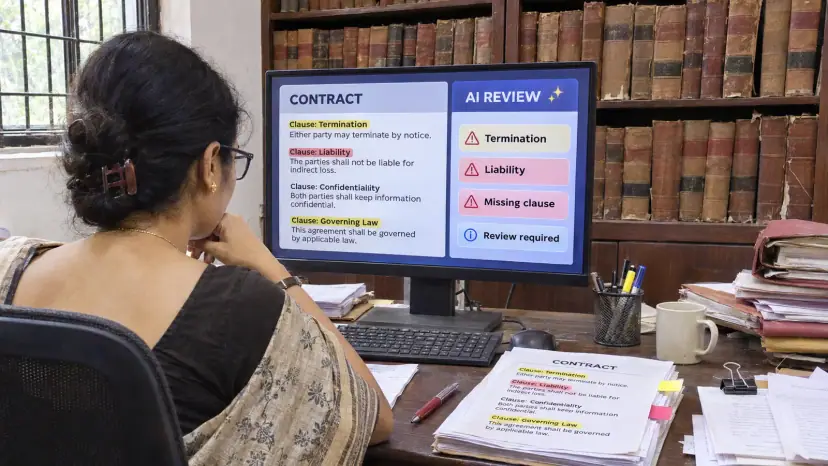
AI Contract Review for Indian Legal Teams: Playbooks, Citations and Confidentiality
Evaluate AI contract review with a playbook, clause evidence, matter permissions and lawyer-reviewed tests, plus an NDA pilot checklist.
Read article
Comments
Be the first to share your thoughts on this article.