In this article
- Key takeaways
- Why Indian Hospitals Need More Than a Front Desk
- How Healthcare Call Center Solutions Improve Patient Care
- Five Kinds of Healthcare Call Center Setup
- Why Call Centers Matter for Digital Healthcare
- Patient Data and the DPDP Act
- How to Measure Whether It Works
- What to Ask Before You Choose
- What Is Coming Next
- Final Thoughts
- Frequently Asked Questions
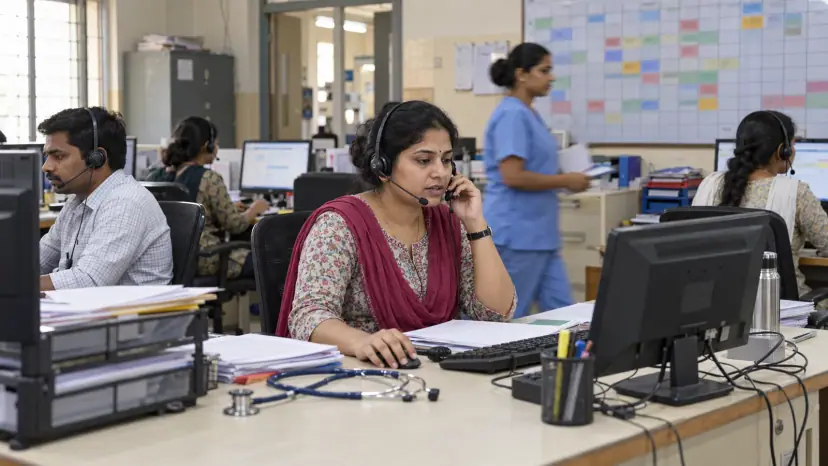
Healthcare call center solutions are the phone, IVR, WhatsApp and agent systems that hospitals and clinics use to talk to patients. In India they now handle appointment reminders, regional-language support, urgent calls and patient data, and they link patients to digital health services. This guide is for managers deciding what such a setup should do and how to judge one.
Why Indian Hospitals Need More Than a Front Desk
India's healthcare system is large and mixed. Patients move between public and private providers, and between visits, phone calls and online consultations. Rising rates of lifestyle diseases mean more patients need regular follow-up over years, not a single visit. Patients in rural areas often travel far for care, so a missed appointment costs them a day.
Digital health is also part of daily care now. Under the Ayushman Bharat Digital Mission (ABDM), over 104 crore health records had been linked to over 93 crore ABHA accounts by July 2026. Patients expect quick answers, help in their language and the choice of phone, WhatsApp or video. A front desk with two phone lines cannot meet that. A planned call center can.
How Healthcare Call Center Solutions Improve Patient Care
Appointment Management and Reminders
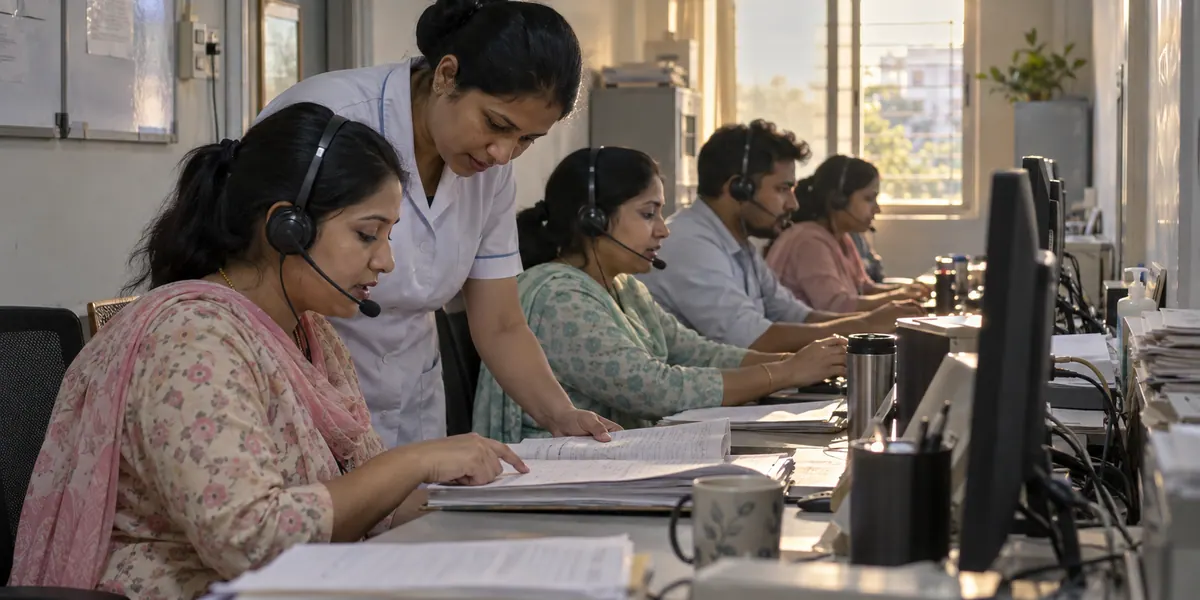
Missed appointments waste doctors' time and delay treatment. A call center can send reminders by IVR call, SMS, WhatsApp and email, let patients book or move slots outside clinic hours, and update the hospital management system directly. The result is fewer empty slots and steadier doctor schedules.
Multilingual IVR and Patient Support
The Eighth Schedule of the Constitution lists 22 languages, and many more are spoken across the country. One English-only menu does not work. A multilingual IVR lets callers choose their language, uses voice recognition for simple self-service, and routes them to an agent who speaks it. That cuts miscommunication and builds trust, especially with rural and older patients.
Telemedicine Integration
The call center is often the first contact for an online consultation. Patients book teleconsultations by phone or WhatsApp, receive the joining link and reminders, pay securely and get follow-up messages afterwards. This makes remote care practical in tier 2 and tier 3 towns where specialists are scarce. Our article on telemedicine call center support looks at that side in depth.
Urgent and Emergency Calls
A hospital helpline is not a replacement for emergency services, but it will receive urgent calls. Routing rules can put calls flagged as urgent at the front of the queue and connect them to a nurse or the emergency department at once. Agents should have a written script for sending callers to emergency services and ambulance numbers without delay. Some emergency lines also use the caller's location to send the nearest ambulance.
Secure, Consent-Based Patient Data Handling
Every call carries personal data: names, numbers, symptoms and sometimes recordings. Good practice includes encrypted storage of records and recordings, role-based access so staff see only what they need, and clear notices to patients about what is recorded and why. The legal side is covered below.
AI-Powered Patient Engagement
Chatbots and IVR can answer routine questions such as lab timings and report status, while any question about medicines or dosage goes to a doctor. Automated reminders cover check-ups, vaccinations and follow-ups. Speech analytics can flag calls where a caller sounds distressed or urgent so a supervisor can step in.
CRM and EHR Integration
When the call center connects to the CRM and electronic health records (EHR), every interaction is logged. Doctors can see the patient's history during a call, agents can answer without asking the same questions twice, and managers can see where service is slow. This is what makes continuity of care possible across visits and channels.
Five Kinds of Healthcare Call Center Setup
Most hospitals and clinics combine some of these. Start with the one that fixes your biggest gap.
- Cloud telephony and IVR: numbers, menus and routing that scale with call volume and need no on-site hardware.
- AI chatbots and voice bots: first-level answers to routine questions, with handover to staff.
- Telemedicine-linked support: booking, links, payments and follow-up around online consultations.
- CRM and EHR linked platforms: patient history and call records in one place for agents and doctors.
- Multilingual urgent-care lines: priority routing and language options for urgent calls.
Vendors package these differently. As one example, LeadNXT, a cloud telephony and CRM platform built by Brainguru, the publisher of this blog, lists IVR appointment booking, lab report delivery and WhatsApp confirmations on its healthcare page. Compare any vendor against the questions later in this guide. For the telephony basics, see our guide to cloud telephony and IVR for Indian businesses.
Why Call Centers Matter for Digital Healthcare
ABDM gives citizens ABHA health IDs and links hospitals, labs and pharmacies into one digital health network. Online consultation is part of the same push: the government's eSanjeevani service had passed 50 crore teleconsultations by October 2026, in 15 languages, All India Radio reported.
Not every patient can use these services alone. The call center connects patients, hospitals, insurers and digital systems:
- Single point of access: one number for appointments, reports, billing and teleconsultations.
- Bridging the digital divide: phone support helps patients who are not comfortable with apps.
- Better decisions: call data shows which questions come up most and where patients drop off.
- Rural access: multilingual IVR and mobile support reach patients far from the hospital.
Patient Data and the DPDP Act
Health details shared on a call are personal data under India's Digital Personal Data Protection Act, 2023. Its main duties apply from 13 May 2027 under the DPDP Rules. Hospitals should prepare now: give patients a plain notice about what is collected and recorded, collect only what each call needs, keep consent records, and bind the call center vendor by contract on security, storage, deletion and breach reporting. If you treat patients from abroad, check foreign laws too, such as the GDPR for patients in the EU or HIPAA for US healthcare data. Our DPDP-aware playbook for hospitals and clinics covers consent in more detail.
How to Measure Whether It Works
Agree on a few measures before launch and review them every month. Useful ones include:
- No-show rate for booked appointments.
- Average wait time before a caller reaches a bot or a person.
- Share of calls dropped before they are answered.
- Share of calls the bot resolves without a handover, and how many callers ask for a person.
- Follow-up visits booked after a reminder.
- Patient satisfaction after the call, asked in the caller's language.
Listen to a sample of recordings too. Numbers show where a problem is; recordings show why.
What to Ask Before You Choose
- Which languages are supported, and were they tested with real patients?
- Does it connect to our hospital management system, EHR and payment gateway?
- Where are recordings stored, who can access them, and when are they deleted?
- How do callers reach a person, and how are urgent calls routed?
- What reports do we get, and can we export our data if we change vendor?
Cost depends on call and message volume, the number of languages, the hours and number of live agents, and the integration work your systems need. A pilot in one department, for example outpatient appointments, shows real volumes before you sign a large contract.
What Is Coming Next
Several ideas are being tested across healthcare: AI triage that asks structured questions before a nurse takes over, wearables that send readings so staff can follow up on out-of-range values, voice biometrics to confirm a caller's identity, and one platform for phone, WhatsApp, email, chat and video. Each one adds value only if handover to people stays fast and patient data stays protected.
Final Thoughts
Healthcare call center solutions do far more than answer phones. Done well, they reduce missed appointments, reach patients in their own language, support telemedicine, route urgent calls quickly and keep patient data secure. Start with your biggest gap, connect the system to your records, keep people in charge of clinical questions and measure the results. For hospitals and clinics in India, the call center is now part of patient care, not just administration.
Frequently Asked Questions
How do healthcare call centers reduce missed appointments?
They send automated reminders by IVR call, SMS, WhatsApp and email, and let patients book or move appointments outside clinic hours. When the system is connected to the hospital management software, freed slots can be offered to other patients, which keeps doctors' schedules full and cuts waiting times.
Why does multilingual support matter in Indian healthcare?
The Eighth Schedule of the Constitution lists 22 languages, and many more are spoken. An English-only menu loses many patients. A multilingual IVR lets callers choose their language and reach an agent who speaks it, which reduces miscommunication and builds trust, especially in rural areas.
How should a hospital call center handle emergencies?
A helpline does not replace emergency services, but it will get urgent calls. Use routing rules that put urgent calls first and connect them to a nurse or the emergency department. Give agents a written script for directing callers to emergency services and ambulance numbers without delay.
How is patient data protected in a healthcare call center?
Through encrypted storage of records and recordings, role-based access for staff, plain notices to patients and vendor contracts covering security and deletion. India's Digital Personal Data Protection Act, 2023 applies to this data, and foreign laws may also apply if you treat patients from abroad.
How do call centers support digital healthcare in India?
They link patients, hospitals, insurers and digital health systems such as ABHA records and teleconsultations. Phone support helps patients who are not comfortable with apps, and multilingual IVR reaches people far from the hospital. Call data also shows managers where patients drop off.
Want help with this?
Talk to our team about AI and ML solutions.
Read next
LLM Development in India (2026): Build, Fine-Tune or Use an API?
Most business uses need only an API and good retrieval. Fine-tuning and self-hosting suit a few specific cases.
Read article
AI Claims Document Processing: Workflow, Data Requirements and Human Review
Plan an insurance claims document AI pilot: extraction fields, source evidence, exception handling, data controls and human-reviewed tests.
Read article
AI Contract Review for Indian Legal Teams: Playbooks, Citations and Confidentiality
Evaluate AI contract review with a playbook, clause evidence, matter permissions and lawyer-reviewed tests, plus an NDA pilot checklist.
Read article
Comments
Be the first to share your thoughts on this article.