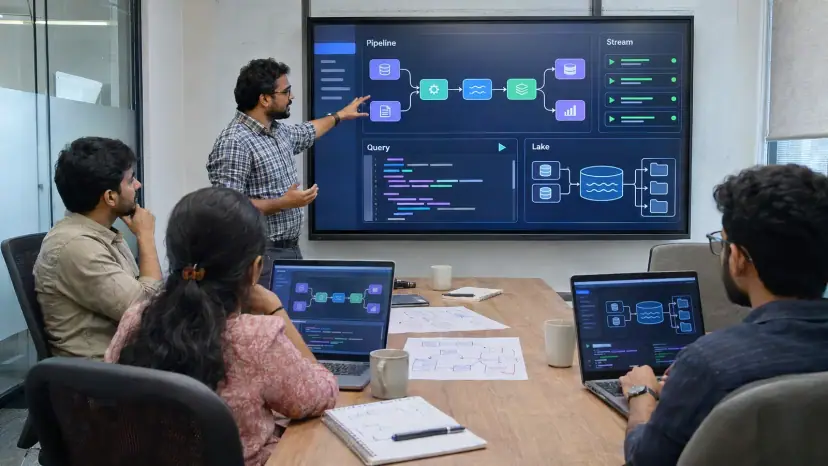
AI and big data solutions combine large-scale data processing with machine learning, so a business can spot patterns, predict outcomes and automate routine decisions. Brainguru builds these systems for finance, healthcare and retail, where data volumes are high and decisions are frequent, from fraud detection and demand forecasting to hospital operations analytics.
How AI and big data work together
Big data is the raw material: transactions, records, sensor readings, clicks and messages collected at scale. AI is what learns from it. Neither is much use alone. A data lake without models is an expensive archive, and a model trained on poor data makes confident mistakes.
Adoption is now widespread. The Stanford AI Index 2026 reports that organisational adoption of AI reached 88%. The businesses that get value from it usually have three things in place: reliable data pipelines, a clear business question for each model, and people who check and act on the output.
Our work brings together:
- Machine learning and deep learning models: For classification, forecasting, recommendations and image or text analysis.
- Predictive analytics: Forecasts of demand, risk, admissions or churn, with ranges rather than single numbers.
- Real-time data processing: Streams of events processed as they happen, for fraud checks, alerts and live dashboards.
- Secure, scalable cloud platforms: Infrastructure that supports data security, compliance and growth.
- Custom AI applications: Systems built around your own data, workflows and rules.
AI and big data solutions in finance
Financial services generate data at very high volume. Outlook Money, citing NPCI data, reported that UPI processed 24.07 billion transactions in September 2026 alone. Each payment is a data point that can help spot fraud, understand customers and manage risk.
Fraud detection and risk management: Models analyse transaction patterns and flag unusual activity in real time, so analysts can stop suspicious payments before losses grow. Risk models use repayment history, spending behaviour and market data to support lending and credit decisions, alongside your credit policy and human review.
Personalised financial services: Analysing customer data, with consent, lets banks and NBFCs suggest relevant products, credit options and service messages based on behaviour and needs.
Market analysis and forecasting: Models can process historical prices, news sentiment and economic indicators to support research and trading desks. Forecasts of markets are uncertain by nature, so these tools inform human decisions and must follow the market regulator's rules on algorithmic trading.
For more on technology for banks and insurers, see our BFSI technology solutions and AI solutions for insurance.
AI and big data solutions in healthcare
Healthcare in India is a large and growing market. IBEF estimates the hospital market at US$ 122.3 billion in 2025 and projects US$ 202.5 billion by 2030. More patients, more digital records and more connected devices mean more data that can improve care and operations.
Predictive analytics for health risks: Models trained on patient records and medical history can help clinicians identify people at higher risk, so they can plan earlier follow-up.
AI-assisted diagnostics and imaging: Image recognition can help radiologists prioritise and review X-rays, MRIs and CT scans. These tools support clinicians; they do not replace them. Software used for diagnosis may be regulated as a medical device and needs clinical validation before use.
Treatment support: Analysis of how patients respond to treatment can help doctors review medication plans and spot possible adverse reactions earlier.
Hospital operations and maintenance: Forecasts of admissions, staffing needs and inventory, and predictive maintenance for medical equipment, help hospitals plan beds, people and stock.
Health data is sensitive personal data. Access controls, encryption and audit logs are essential, and in India the Digital Personal Data Protection Act 2023 applies, with its main duties starting on 13 May 2027 under the DPDP Rules.
AI and big data solutions in retail
Retail moves fast and runs on thin margins. IBEF reports that India's quick commerce segment became a US$ 7 to 8 billion market in FY25. Fast delivery promises only work when stock, demand and logistics data are accurate.
Customer behaviour analysis and personalisation: Browsing patterns, purchase history and engagement data feed product recommendations and targeted campaigns.
Demand forecasting: Historical sales, seasonality, promotions and weather help predict demand by product and location, reducing both stock-outs and overstock. Our page on AI for sales forecasting goes deeper.
Pricing analytics: Models that track demand, competitor prices and margins to support pricing decisions, with rules your team sets.
AI chatbots and virtual assistants: Instant answers to order, return and product questions, with clear hand-off to a person for anything complex.
Supply chain analytics: Shipment and warehouse data used to plan routes, balance stock across locations and warn of likely delays.
How we deliver AI and big data projects
- Define the question: Agree the decision the system will support and how its value will be measured.
- Audit the data: Check sources, quality, gaps, consent and access rules.
- Build the data foundation: Pipelines, storage and data models that the rest depends on.
- Develop and validate models: Train, test against held-back data and review results with domain experts.
- Deploy and monitor: Put models into the workflow, watch accuracy and drift, and retrain when patterns change.
Data that is collected centrally needs protecting. IBM's 2025 Cost of a Data Breach research for India put the average cost of a breach at INR 220 million, so security is part of every design, not a later add-on.
What drives the cost of an AI and big data project?
We do not publish prices. These factors shape the estimate:
- Data volume and variety: More sources and formats mean more integration and cleaning.
- Model complexity: A forecasting model differs greatly from a deep learning system for images.
- Integrations: Links to core banking, hospital, ERP or e-commerce systems.
- Infrastructure: Real-time processing and large storage cost more to run than daily batches.
- Compliance: Sensitive financial or health data adds security, audit and review work.
- Support: Monitoring and retraining after launch.
Starting with a focused pilot, one use case with clear success measures, is the safest way to prove value before scaling.