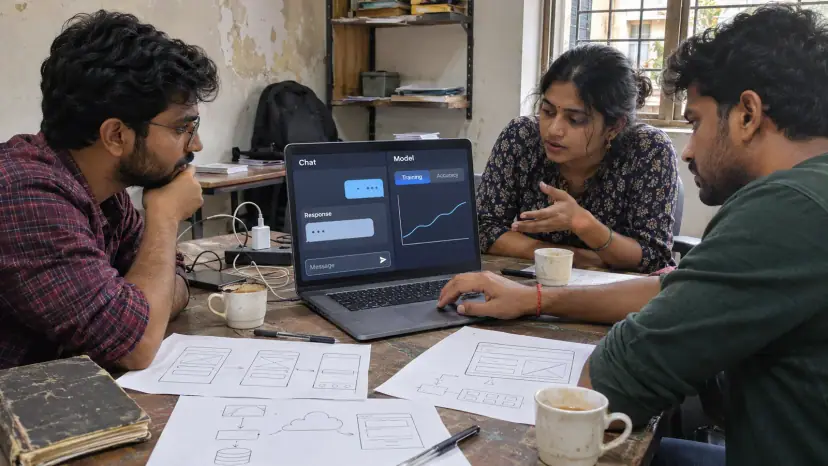
AI solutions for startups help founders add the right AI at the right time: a proof of concept for investors, a first AI feature for users, or automation that lets a small team do more. Brainguru builds custom models, generative AI and LLM features, chatbots, automation and computer vision for startups from pre-seed to growth stage.
The aim is not to add AI everywhere. It is to find the one use case that would make a measurable difference at your current stage, test it cheaply, and build on what works.
Why startups are building with AI now
Building AI features is far cheaper and faster than it was a few years ago, because founders can start from pre-trained foundation models and cloud services instead of training everything from scratch. AI use is also now normal: the Stanford AI Index 2026 reports that organisational adoption reached 88%. For a startup, that means customers and investors increasingly expect a clear answer to the question of how the product uses AI, and why.
India's startup base keeps growing. According to government figures relayed by IBEF in April 2026, more than 55,200 startups were recognised in 2025-26, the most in a single year, taking the total past 2.23 lakh as of 31 March 2026. Public support for AI is growing too: in March 2024 the Cabinet approved the IndiaAI Mission with an outlay of Rs 10,371.92 crore, including public AI compute of 10,000 or more GPUs and financing for AI startups.
Our AI solutions for startups
AI consulting and strategy: Our AI consulting services help you find where AI can make a measurable difference, review your data, compare building with buying, and set out a phased roadmap so you spend on the right thing first.
Custom AI model development: Our custom AI model development covers recommendation engines, anomaly detection, scoring and classification models trained on your own data, from data preparation and feature engineering to validation and deployment.
Generative AI and LLM solutions: Our generative AI solutions and LLM development services cover content generation, document processing, code assistance and conversational features, including retrieval over your own documents and fine-tuning where it is justified.
AI chatbots and virtual assistants: Our AI chatbot development service builds assistants that answer customer questions, qualify leads and book appointments on your website, app or messaging channels, with a clear handover to a person.
AI agents and process automation: Our AI agent development and automation services build agents that carry out multi-step workflows such as data extraction, invoice processing, scheduling and CRM updates, with approval steps where an action affects money, customers or records.
NLP and text intelligence: Our NLP development services cover sentiment analysis, entity extraction, classification and semantic search, for example to analyse customer feedback or pull structured data from contracts and reports.
AI for marketing and growth: Our startup AI growth service and AI marketing solutions cover lead scoring, audience segmentation, campaign testing, content personalisation and churn prediction.
Computer vision: Image classification, object detection, document OCR and visual quality inspection, deployed as cloud APIs or on devices, for retail, manufacturing, agriculture and property products.
Which AI work fits your stage?
Pre-seed
Use AI to test the idea, not to build the company. Analyse customer interviews and survey answers for recurring themes, study competitors, and build a small prototype that shows the core AI feature is technically possible. A proof of concept is usually enough for early conversations with investors.
Seed
Build a minimum viable AI product around one core value proposition and put it in front of real users. Add basic analytics to see which features drive retention, and consider a support assistant to keep response times short with a lean team. Our MVP development services cover this stage.
Series A
Move models from notebooks into production with monitoring, automated retraining and testing. Add forecasting for revenue and resource planning, personalisation for a growing user base, and automation in sales, marketing and operations so output grows faster than headcount.
Growth stage
Scale infrastructure for volume while watching latency and cost per prediction. Larger platforms add recommendation and pricing models, fraud and risk detection as transaction volumes rise, and a shared data platform so teams can build on the same data.
AI use cases by startup sector
Fintech: Credit scoring with alternative data, fraud detection on transactions, document checks for KYC, and risk models, all within RBI rules and with explainable decisions.
Healthtech: Appointment scheduling, triage support, remote monitoring alerts and medical document processing, with clinicians responsible for clinical decisions and health data handled under India's data protection law.
Edtech: Adaptive practice, question generation matched to the syllabus, feedback on written answers and learning analytics for teachers.
E-commerce and D2C: Product recommendations, visual search, demand forecasting, churn prediction and conversational shopping assistants.
SaaS and B2B: Lead scoring, onboarding guidance, account health scores, churn alerts and AI search over help documentation.
Logistics: Route planning, warehouse demand forecasting, parcel sorting with computer vision and predictive maintenance for fleets.
Proptech: Valuation support, virtual staging labelled as such, lead qualification and portfolio analytics.
Agritech: Crop disease detection from images, yield prediction from weather and soil data, irrigation planning and price forecasting.
How a startup AI project should run
- Discovery: Review your business model, data, current technology and goals, and pick the use case with the clearest return for your stage.
- Plan and architecture: Agree success measures, data needs, the technology stack and a design that can grow with the product.
- Prototype: Build a working prototype in short cycles and test it with real users before committing to production work.
- Production: Add monitoring, retraining, security review, API documentation and integration testing before launch.
- Improve: Track model performance, retrain on fresh data, control cost and latency, and add capabilities as the product grows.
Whoever builds it, insist on regular demos, tests you can see and code you own. Many AI pilots never reach production. In July 2024, Gartner predicted that at least 30% of generative AI projects would be abandoned after proof of concept by the end of 2025, because of poor data quality, inadequate risk controls, escalating costs or unclear business value. A startup can check each of those before writing code.
Common mistakes founders make with AI
- Building a model when an API would do: Many early features work well on an existing model with good prompts and retrieval. Train your own only when you have the data and a clear reason.
- No evaluation set: Without a set of real examples with known answers, nobody can tell whether a change made the feature better or worse.
- Ignoring running costs: Model usage costs grow with users. Estimate cost per user or per request early.
- Letting agents act unchecked: Agents are improving fast, but the AI Index 2026 notes they still fail roughly 1 in 3 attempts on structured benchmarks. Keep approvals on actions that matter.
- Leaving privacy until later: India's DPDP Rules, notified in November 2025, bring the main duties into force on 13 May 2027. Notices, purpose limits and security are easier to design in than to retrofit.
What affects the cost of AI development for a startup?
We do not publish prices, because two AI features with the same name can differ greatly in effort. These factors drive the estimate:
- Use case complexity: A chatbot over your help pages is far smaller than a custom risk model.
- Data readiness: Clean, labelled data saves weeks; scattered data needs collection and cleaning first.
- Build or adapt: Adapting an existing model costs less than training a new one.
- Integrations: Each app, CRM, payment or partner system adds work.
- Running costs: Model usage, hosting and monitoring continue after launch.
The cheapest route is a small first release: one feature, real users and measures agreed in advance. Our guide on off-the-shelf versus custom AI development helps with the build-or-buy decision.
Explore more startup solutions
- Startup Solutions and Ideation: an overview of our startup services, from validating a concept to building the product.
- Startup AI Growth: AI for customer acquisition, sales automation and other growth work.
- Startup Product Development: full-cycle development from product ideation and validation through roadmap and build.
- Startup Technology Consulting: stack selection, architecture advice and fractional CTO support.
- Startup Cloud Architecture: scalable, secure and cost-efficient cloud infrastructure for startups.