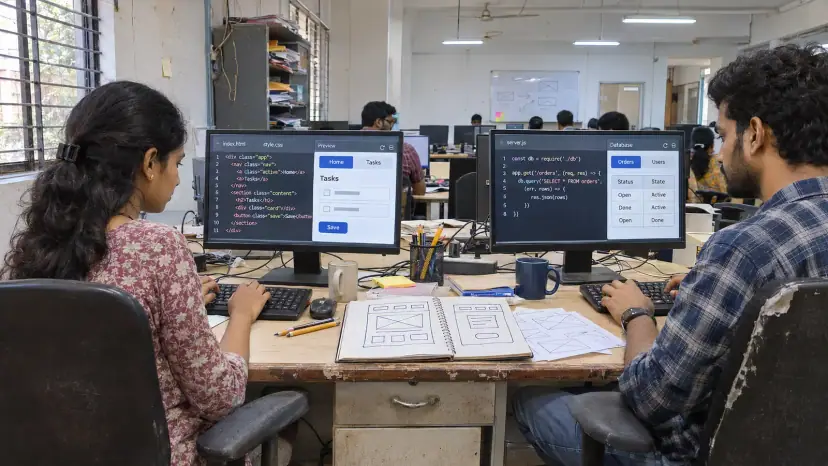
Full stack development services cover everything a web application needs to work: the screens people use, the server logic behind them, the database, the integrations and the hosting. Brainguru builds and maintains these applications for startups, small businesses, tech companies and enterprises, with one team accountable for the whole product from first scope to live support.
What our full stack development services cover
A full stack project is more than a website with a login. It is a working system with users, roles, data and connections to other software. Our work usually spans these layers:
- Front end: The interface people see and use, built with frameworks such as React or Angular, working on phones, tablets and desktops, and usable with a keyboard or a screen reader.
- Back end and APIs: Business rules, user accounts, roles and permissions, and APIs that your web app, mobile app and partner systems can all call.
- Databases: A data model designed around how your business works, a relational database where the data has a clear structure, and backups and migrations planned from the start.
- Integrations: Payment gateways, CRMs, ERPs, email and SMS, maps and analytics, connected through documented APIs rather than one-off scripts.
- Web, mobile and cross-platform: One back end can serve a browser app, a mobile app and other systems, so features stay consistent across every channel.
- Deployment and hosting: Cloud setup, automated builds and releases, monitoring and logs, so a release is a routine step rather than an event.
- Support and enhancements: Bug fixes, security patches, framework upgrades and new features once the application is live, including for applications another team built.
Why use one team for front end and back end?
Most problems in a web project appear where two pieces meet: a screen expects data the API does not send, or a database change breaks a report. When one team owns both sides, those gaps are found in the same planning meeting instead of in a support ticket. There are fewer handoffs, one backlog and one group that answers for the result.
This way of working is now mainstream. In the Stack Overflow 2024 Developer Survey, 30.7% of respondents described their main job as full-stack developer, the most common role in the survey. That does not mean every developer does everything equally well. A good full stack team still has people who lean towards interface work and people who lean towards data and infrastructure, and it plans the work so each person does what they are strongest at.
Separate specialist teams can still make sense for very large products, or where a company already has a strong in-house front end or back end group. In that case we can work alongside your team on one side of the stack, or supply developers through our hire a full stack developer model.
How do you choose a technology stack?
The stack is the set of languages, frameworks, databases and hosting a product is built on. It is a business decision as much as a technical one, because it decides who you can hire, how easily the product can be maintained, and what it costs to run.
Popularity is not the only test, but it matters. A widely used stack has more maintained libraries, more answers to common problems and a larger pool of developers. In the Stack Overflow 2025 Developer Survey, 66% of all respondents used JavaScript and 55.6% used PostgreSQL, making them the most used language and database in the survey. The same survey found Node.js used by 48.7% of respondents and React by 44.7%, the two most used web technologies.
| Layer | What usually decides the choice |
|---|---|
| Front end framework | How interactive the screens are, search visibility needs, and what your team already knows |
| Back end language | Existing systems, the skills you can hire, and the type of work: real-time, data-heavy or transactional |
| Database | How structured the data is, reporting needs, and how much it must grow |
| Hosting | Expected traffic, data location rules, and who will run it after launch |
We recommend a stack after we understand the product, and we explain the trade-offs in plain terms. For founders weighing this decision, our guide on how to choose the right tech stack for your startup walks through the questions in more detail.
How a full stack project runs
- Discovery: We map users, workflows, data, integrations and any compliance needs, and agree what success looks like.
- Scope and first release: We split the product into a first usable release and later phases. Many clients start with MVP development and grow from there.
- Design: Wireframes and a clickable prototype let you test the flow before code is written.
- Build in short cycles: Work is delivered in small increments with regular demos, so you see progress and can change priorities early.
- Testing: Automated tests run on every change, alongside manual checks of key journeys and dedicated security testing before launch.
- Release: Automated pipelines build and deploy the application the same way every time.
- Support: After launch we monitor, fix, patch and add features as your users ask for them.
Release automation is now standard practice. In the same Stack Overflow 2025 survey, 71.1% of respondents used Docker, the most used tool in its cloud and infrastructure category. For teams that want the pipeline and hosting run as an ongoing service, this links naturally to DevOps as a Service.
Security, performance and quality
These three qualities are cheapest to build in at the start and most expensive to add later.
Access control: Broken access control is ranked first in the OWASP Top 10:2025, which reports that 100% of the applications tested had some form of it. Permissions belong on the server, checked on every request and never only in the browser, with tests for what each role can and cannot reach.
Patching: The Verizon 2026 Data Breach Investigations Report found that 31% of breaches now start with software vulnerabilities. Keeping frameworks and libraries up to date is part of support, not an optional extra.
Speed on real phones: According to the HTTP Archive Web Almanac 2024, 43% of websites had good Core Web Vitals on mobile, against 54% on desktop. Performance budgets and testing on mid-range phones and slower networks, not only on a developer's laptop, catch problems before users do.
Maintainable code: Shortcuts cost money later. The CISQ 2022 report put the cost of poor software quality in the US at no less than $2.41 trillion, with accumulated technical debt of about $1.52 trillion. Code review, automated tests and written documentation keep your product changeable by any competent team, including one that is not ours.
Who do we work with?
- Startups and entrepreneurs: A first release that can be shown to users and investors, built so it can grow without a rewrite.
- Small businesses: Customer portals, booking and order systems, and internal tools that replace spreadsheets and email chains.
- Tech companies: Extra capacity on an existing product, or modernising an older codebase one part at a time.
- Enterprises: Internal applications and integrations with ERP and CRM systems, with clear roles, audit trails and documentation.
We work with clients in India and in other countries, with delivery from our Noida office and communication planned around your time zone.
What affects the cost of a full stack project?
We do not publish prices, because two projects with the same name can differ several times over in effort. These are the factors that drive the estimate:
- Number and depth of features: A simple form and a multi-step workflow with approvals are very different amounts of work.
- Roles and permissions: Every additional user type adds screens, rules and tests.
- Integrations: Each external system adds work, more so when its API is poorly documented.
- Design depth: A custom design system takes longer than adapting a proven component library.
- Data migration: Moving and cleaning data from an old system is often underestimated.
- Scale and security needs: Expected traffic, data sensitivity and audit requirements.
- Engagement model: A fixed scope suits a well-defined first release, while a dedicated team suits a product that will keep evolving.
The cheapest way to control cost is a smaller first release. Build the core journey, put it in front of users, and let real use decide what comes next.
Questions to ask any full stack provider
- Ownership: Who owns the source code, the cloud accounts and the domain at the end of the project?
- Testing: Which tests run automatically, and what is checked by hand before each release?
- Releases: How is code deployed, and how quickly can a bad release be rolled back?
- Handover: What documentation will you leave, and could another team pick up the code?
- Data: Where will the data be hosted, who can access it, and how are backups tested?
- People: Will you speak directly with the developers doing the work?
We are happy to answer each of these in a free consultation before any commitment.