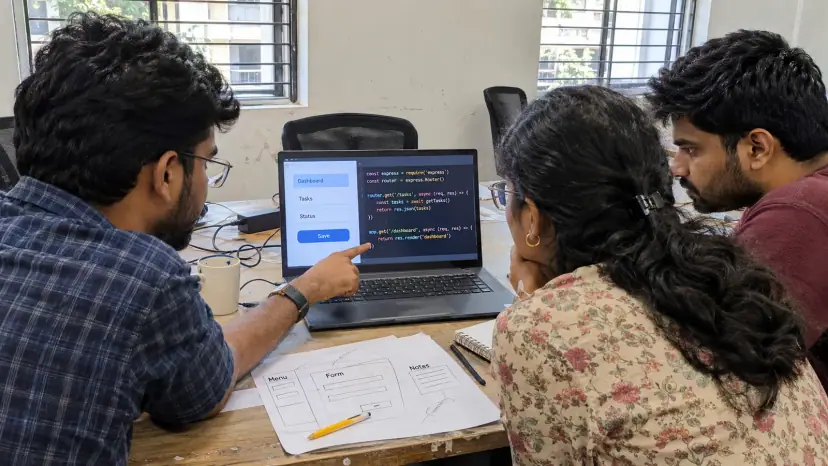
When you hire a full stack developer, you get one person who can work on both the screens users see and the servers, databases and APIs behind them. Brainguru provides full stack developers to startups, product companies and businesses that need a web or mobile application built, extended or maintained by someone who understands the whole system.
What does a full stack developer do?
A full stack developer works across the layers of an application:
- Front end: Interfaces built with frameworks such as React, Angular or Vue.js, working on phones and desktops.
- Back end: Business logic, user accounts and permissions in Node.js, Python (Django, Flask), PHP (Laravel, CodeIgniter) or Java (Spring Boot).
- Databases: Data models and queries in MySQL, PostgreSQL, MongoDB or Firebase.
- APIs and integrations: REST and GraphQL APIs, payment gateways, CRMs and other third-party services.
- Cloud and DevOps: Deployment on AWS, Google Cloud or Azure, with Docker, Kubernetes and automated build pipelines.
Full stack is now the most common developer role. In the Stack Overflow 2025 Developer Survey, 27% of respondents described their job as full-stack developer, far ahead of back-end (14.2%) and front-end (4.3%). Among respondents from India the share was 25.3%.
When should you hire a full stack developer?
A full stack developer is a good fit when:
- Small team: You need one or two people who can build a complete feature without waiting on others.
- Early product: You are building an MVP or first release, where speed and fewer handoffs matter most.
- Maintenance: An existing application needs fixes and features across the interface and the server.
- Integration work: A feature touches the screen, the API and the database at once.
Specialists still make sense for deep problems: a complex design system, heavy data processing or performance tuning at large scale. Many teams combine one or two full stack developers with specialists brought in when needed. If you want a whole team to own the product instead, our full stack development services cover that model.
Which technology stack should your developer know?
Choose a developer who knows the stack your product uses, or will use. Widely used technologies make it easier to hire, find libraries and replace people later. In the Stack Overflow 2025 technology results, 66% of respondents used JavaScript and 58.6% used SQL. PostgreSQL was the most used database at 55.6%, Node.js and React were the most used web technologies at 48.7% and 44.7%, and Docker was used by 71.1%.
| Common stack | Typical parts |
|---|---|
| MERN | MongoDB, Express, React, Node.js |
| MEAN | MongoDB, Express, Angular, Node.js |
| Python stack | Django or Flask, PostgreSQL, React or Vue.js |
| PHP stack | Laravel, MySQL, Vue.js or React |
| Java stack | Spring Boot, PostgreSQL, Angular or React |
If you have not chosen yet, our guide on how to choose the right tech stack for your startup sets out the questions to ask.
Skills to check when you hire
- Depth on both sides: Ask about a feature they built from database to screen, and what they would change now.
- Security basics: Broken access control is ranked first in the OWASP Top 10:2025, which reports that 100% of the applications tested had some form of it. Ask how they check permissions on the server for every request.
- Performance on phones: The HTTP Archive Web Almanac 2024 found that only 43% of websites had good Core Web Vitals on mobile. Ask how they test on mid-range phones and slow networks.
- Testing habits: Which tests they write, and how they make sure a change does not break something else.
- Communication: Whether they explain trade-offs in plain language and write down decisions.
A short paid task close to your real work tells you more than a general coding test.
How hiring a full stack developer works
- Share your needs: The product, the stack, the first tasks, hours and time zone overlap.
- Review profiles: Look for past work similar to yours.
- Interview: Talk to the developer directly and set a small practical task.
- Onboard: Give access to the code, tickets and the people they will work with, with a written first-week plan.
- Review: Weekly check-ins at first, then a monthly review of output and quality.
Engagement options
- Dedicated full-time: One developer working only on your product during agreed hours.
- Part-time: A set number of hours each week for maintenance or smaller features.
- Project phase: A developer for a defined build, such as an MVP or a migration.
- Extended team: Developers who join your in-house team and follow its process.
Industries we work with
- E-commerce: Online stores with payment gateway integration and order management.
- Healthcare: Appointment, patient and clinic applications with careful handling of personal data.
- Finance: Dashboards, onboarding flows and reporting tools.
- Education: Learning platforms, course portals and assessment tools.
- Retail: Point of sale and inventory systems.
Where an application handles personal data of people in India, the developer should know the security safeguards in rule 6 of the Digital Personal Data Protection Rules, 2025, such as access controls, logs and backups. These duties apply from 13 May 2027.
What affects the cost of a full stack developer?
We do not publish rates. The main factors are:
- Experience: Senior developers cost more but usually need less supervision.
- Stack: Less common technologies cost more than widely used ones.
- Hours: Full-time, part-time or a fixed number of hours each month.
- Duration: Longer engagements usually cost less per month.
- Complexity: Integrations, data migration and security needs add effort.
We work with clients in India and abroad. Book a free consultation to discuss the role.