In this article

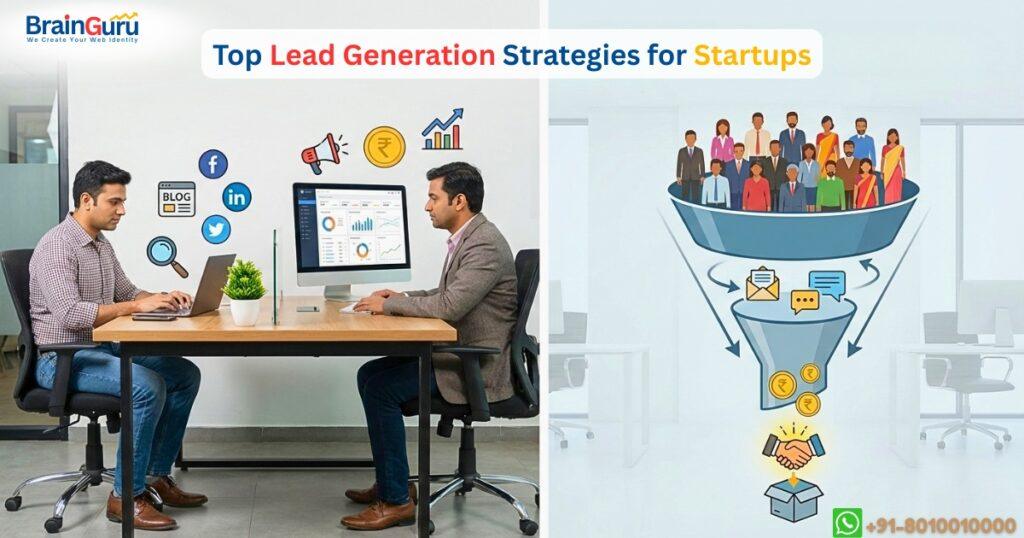
Top Lead Generation Strategies for Startups
A Practical Guide to Building a Consistent and Scalable Lead Pipeline
For startups running on limited budgets but chasing big growth goals, lead generation is not optional-it’s survival. Every website visitor, email subscriber, demo request, or inbound call could be the customer who validates your product and pushes your startup forward.
The real challenge?
You’re competing with established brands, limited resources, and a market that doesn’t know you yet. So how do you generate high-quality leads without draining your marketing budget or burning through your runway?
The answer lies in smart, focused lead generation strategies that deliver quick results today while building long-term growth for tomorrow.
What Lead Generation Really Means for Startups
Lead generation is the process of attracting potential customers and turning them into prospects who have shown interest in your product or service.
For startups, this goes beyond just collecting emails or phone numbers. You’re also:
- Building brand awareness
- Testing your positioning and messaging
- Learning who your ideal customer really is
- Validating demand in the market
The most successful startups treat lead generation as an ongoing experiment. They test channels, track results, double down on what works, and quickly drop what doesn’t.
Paid vs Organic Lead Generation: Which Is Better for Startups?
This is one of the most common questions startup founders ask-and the honest answer is: you need both, used strategically.
Paid Lead Generation: Fast but Costly
Paid advertising gives startups one powerful advantage-speed. Platforms like Google Ads, LinkedIn Ads, and Facebook Ads can start generating leads within hours.
Benefits of paid lead generation:
- Instant traffic and visibility
- Highly targeted audiences
- Predictable scaling once optimized
- Quick feedback on messaging and offers
- Useful data on customer behavior
Paid campaigns work best when you understand your numbers. If it costs ₹1,000 to acquire a lead and that lead brings ₹10,000 in lifetime value, paid ads can become a reliable growth engine.
However, paid advertising has drawbacks:
- Costs rise quickly in competitive markets
- Leads stop the moment you pause spending
- Poorly optimized campaigns can waste money fast
For early-stage startups, paid ads should be used carefully-mainly for testing, learning, and short-term acceleration.
Organic Lead Generation: Slower but Sustainable
Organic lead generation focuses on long-term growth through channels like:
- SEO and content marketing
- Social media engagement
- Email marketing
- Community building
Why organic lead generation works so well for startups:
- Lower cost per lead over time
- Builds trust and brand authority
- Delivers compounding results
- Attracts higher-intent prospects
- Works even with limited budgets
Content marketing is especially powerful. A single SEO-optimized blog post can bring qualified leads for years. When your content solves real problems your audience is searching for, leads come naturally.
The downside? Patience is required. SEO and organic growth usually take 6–12 months to show strong results-but once they do, the impact is long-lasting.
The Smart Approach: Combining Paid and Organic Channels
The best startup lead generation strategies blend both approaches.
A simple framework many startups follow:
- 70% on proven channels
- 20% on promising experiments
- 10% on new or innovative ideas
Use paid ads to generate early traction and insights, while steadily investing in organic channels that build a sustainable pipeline.
How to Build a High-Converting Lead Generation Funnel
Traffic alone doesn’t create customers. You need a lead funnel that guides prospects step by step toward conversion.
Stage 1: Awareness and Attraction
At the top of the funnel, your goal is to attract the right audience-not everyone.
Use SEO, blog content, social media, and ads to address specific pain points.
Generic content brings generic leads. Focused content brings buyers.
Example:
Instead of “How to Grow Your Business,” write
“How Early-Stage SaaS Startups Can Reduce Customer Churn”
Specific problems attract serious prospects.
Stage 2: Engagement and Lead Capture
Once visitors land on your website, give them a clear reason to stay-and share their contact details.
This is where lead magnets work best:
- Free templates
- Tools or calculators
- Checklists and guides
- Webinars or workshops
- Industry reports
Keep your forms simple. Ask for minimal information initially, then collect more details as trust builds.
Stage 3: Lead Nurturing and Qualification
Most leads aren’t ready to buy immediately. That’s where email nurturing plays a key role.
Use email sequences to:
- Educate prospects
- Share value-driven content
- Build credibility and trust
- Stay top-of-mind
Segment your leads based on behavior. Someone who downloaded a beginner guide needs different messaging than someone who viewed your pricing page.
Lead scoring helps identify sales-ready prospects by tracking actions like:
- Email opens
- Website visits
- Content downloads
- Demo or pricing page views
Stage 4: Conversion Optimization
At the final stage, remove friction and build confidence.
Use:
- Clear and action-oriented CTAs
- Simple signup or demo processes
- Testimonials and case studies
- Trust badges and social proof
Small changes-like better headlines or stronger CTA text-can significantly improve conversion rates.
Proven Lead Generation Tactics for Startups
Some additional strategies that work especially well for startups:
- Referral programs: Turn customers into promoters
- Strategic partnerships: Collaborate with complementary businesses
- Communities: Build value-driven groups on LinkedIn, Slack, or forums
- Webinars & events: Generate highly qualified, intent-driven leads
Focus on being genuinely helpful, not overly promotional.
Metrics That Actually Matter
To know if your lead generation is working, track:
- Conversion rates at each funnel stage
- Cost per lead (CPL)
- Lead-to-customer conversion rate
- Customer acquisition cost (CAC) vs lifetime value (LTV)
Remember: quality beats quantity. Ten high-intent leads are far more valuable than a hundred uninterested ones.
Building a Long-Term Lead Generation Engine
Successful startups don’t rely on random tactics. They build systems.
Your content fuels SEO.
SEO drives traffic to landing pages.
Landing pages capture leads.
Leads enter nurture sequences.
Nurture converts into sales.
Start small. Stay consistent. Optimize continuously.
Lead generation for startups isn’t about hacks or shortcuts-it’s about understanding your audience deeply and guiding them toward a solution that genuinely solves their problem.
When done right, lead generation becomes more than marketing.
Conclusion: How Brainguru Helps Startups Build a Predictable Lead Engine
For startups, lead generation isn’t about chasing every new tactic-it’s about building a reliable, repeatable system that consistently attracts the right customers. The startups that win are the ones that balance short-term traction with long-term growth, test intelligently, and optimize continuously.
At Brainguru, we help startups do exactly that.
We don’t believe in one-size-fits-all marketing. Our approach to startup lead generation is rooted in strategy, data, and real business outcomes. From SEO-driven organic growth and high-converting content to performance marketing, funnel optimization, and automation-we design lead generation systems that grow with your startup, not against it.
Whether you’re validating your idea, launching an MVP, or scaling customer acquisition, Brainguru focuses on:
Attracting high-intent, qualified leads
Reducing customer acquisition costs
Building sustainable inbound pipelines
Turning traffic into revenue, not just clicks
If you’re looking to move beyond inconsistent leads and build a scalable growth engine, Brainguru is your growth partner-helping you generate leads, build trust, and convert prospects into long-term customers.
Let’s turn your startup’s growth goals into measurable results.
Lead Generation Cost by Channel for Indian Startups
Understanding cost per lead (CPL) across channels is the foundation of a disciplined lead generation strategy. The numbers below are illustrative planning ranges for Indian B2B and D2C startups, not measured benchmarks; replace them with your own account data.
| Channel | Average CPL (INR) | Lead Quality | Best For |
| Google Search Ads | Rs 350 - Rs 1,500 | High intent | B2B SaaS, services |
| LinkedIn Ads | Rs 800 - Rs 3,500 | Very high | Enterprise B2B |
| Meta (Facebook/Instagram) | Rs 80 - Rs 600 | Medium | D2C, consumer apps |
| SEO & Content Marketing | Rs 40 - Rs 300 | High | Long-term growth |
| WhatsApp Marketing | Rs 25 - Rs 150 | Medium-high | Local services, retail |
| Email Outbound | Rs 150 - Rs 800 | Medium | B2B sales |
| Webinars & Events | Rs 500 - Rs 2,500 | Very high | B2B SaaS, EdTech |
| Referral Programs | Rs 100 - Rs 500 | Excellent | All verticals |
| Influencer Marketing | Rs 200 - Rs 1,200 | Variable | D2C consumer brands |
These numbers vary widely by industry and execution quality. Startups in crowded spaces like EdTech and fintech often see higher CPLs.
Building a Multi-Channel Lead Generation System
Single-channel dependency is the most common startup failure mode. When one channel slows down (algorithm change, rising CPMs, platform policy), the entire pipeline collapses. A resilient system runs across at least three to five channels that each contribute 15-30% of leads.
The practical framework looks like this:
- Two foundation channels that deliver predictable leads (usually SEO and Google Ads)
- Two growth channels being actively scaled (e.g., LinkedIn and webinars)
- One experimental channel tested quarterly (e.g., podcasts or communities)
Integration matters as much as diversification. Every channel should feed into one CRM with consistent UTM tagging, unified lead scoring, and a single source of truth for attribution. Without this, multi-channel quickly becomes multi-chaos.
Lead Qualification Framework: BANT vs MEDDIC for Indian B2B
Qualification frameworks decide which leads your sales team actually calls. For Indian B2B startups, choosing between BANT and MEDDIC depends on deal size and sales cycle.
BANT (Budget, Authority, Need, Timeline)
Best for transactional deals under Rs 5 lakh ACV with sales cycles under 60 days. BANT is simple, fast, and works well for SME-focused SaaS or services. Drawback: it assumes buyers already have a defined budget, which is rarely true in India's emerging markets.
MEDDIC (Metrics, Economic Buyer, Decision Criteria, Decision Process, Identify Pain, Champion)
Built for enterprise deals above Rs 25 lakh ACV with 3-9 month sales cycles. MEDDIC forces sales reps to identify a champion inside the account and map the full buying committee, which matters because enterprise purchases usually involve several stakeholders. Use MEDDIC for RFP-heavy sectors like BFSI and manufacturing.
Many Indian startups use a hybrid: BANT for inbound SMB leads and MEDDIC for outbound enterprise deals.
Top Lead Generation Mistakes Startups Make
- Over-investing in paid ads before product-market fit. Paid leads mask weak positioning and burn cash.
- Asking for too much information on landing pages. Every extra form field adds friction; test shorter forms.
- No lead nurturing sequence. Most leads are not sales-ready at first contact, and without nurturing they go cold.
- Ignoring bottom-of-funnel content. Most startups produce only awareness content, missing the high-intent buyers.
- No SLA between marketing and sales. Leads rot for 48+ hours before a rep calls, killing conversion rates.
- Chasing vanity metrics. Tracking impressions and clicks instead of qualified pipeline value.
- Running campaigns without attribution. You cannot optimize what you cannot measure.
- Scaling too early. Pouring budget into channels before unit economics are proven.
Tools to Automate Your Lead Generation
The right tool stack can increase lead output without increasing headcount. Here are the categories every Indian startup should consider:
- CRM & Pipeline: HubSpot, Zoho CRM, LeadSquared, Pipedrive
- Email Automation: Mailchimp, ActiveCampaign, Instantly, Lemlist
- Lead Capture & Forms: Typeform, Unbounce, Convertful
- LinkedIn Prospecting: Apollo.io, Lusha, Sales Navigator
- WhatsApp Automation: WATI, Interakt, AiSensy
- Chatbots: Intercom, Tidio, Brainguru AI Chatbots (our product)
- Analytics & Attribution: Google Analytics 4, Mixpanel, HockeyStack
- Workflow Automation: Zapier, Make, n8n
Start with a CRM and one automation tool. Add layers as volume grows. Avoid buying everything at once - tool bloat kills productivity faster than missing features do. For a deeper dive into scaling inbound, see our guide on digital marketing for startups and new businesses.
Related Reading
Frequently Asked Questions
What is the most cost-effective lead generation strategy for Indian startups?
Content marketing combined with SEO is the most cost-effective long-term strategy, although it takes months to build. For immediate results, Google Ads targeting high-intent keywords offers the best short-term ROI.
How many leads should a startup expect per month from digital marketing?
A startup spending Rs 50,000-1,00,000/month on digital marketing should estimate lead volume from its own cost per lead and conversion data rather than a general benchmark.
Related Services
Related Articles

The Future of Digital Branding for Indian Startups
The Future of Digital Branding for Indian Startups How Brainguru is Shaping the Next Generation of Brands In the fast-evolving digital economy, the success of…
Read More
Hiring a Fractional CMO in India: Complete Guide for Startups (2026)
Read More
SaaS Application Development: A Guide for Enterprises
SaaS Application Development Solutions: The Ultimate Guide to Building Scalable Enterprise Web Applications In today’s cloud-driven economy, businesses are…
Read More
Comments
Be the first to share your thoughts on this article.