In this article
- Key takeaways
- Why Guest Posting Is Still Worth Doing
- 1. Reach a New Audience
- 2. Grow Your Subscribers and Email List
- 3. Exposure and Brand Authority
- 4. Build a Professional Network
- 5. Referral Traffic From Interested Readers
- What About Backlinks From Guest Posts?
- Good Guest Articles vs Risky Ones
- How to Land and Write a Great Guest Post
- Common Mistakes With Guest Articles
- Conclusion
- Frequently Asked Questions
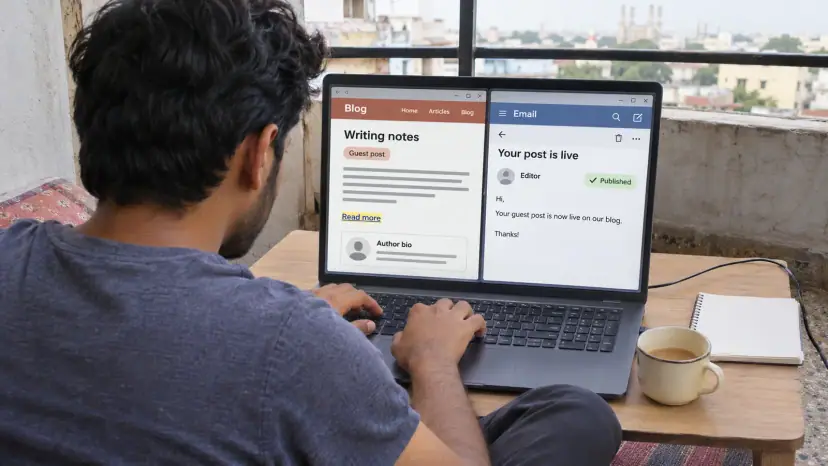
Guest posting means writing an article for another website in your field, under your own name, for that site's readers. Its real value is reach: a new audience, a stronger reputation and working relationships with editors. This guide covers five benefits, how Google views links in guest posts, and how to pitch and write one well.
Editor's note: this article was first published in December 2014, soon after guest blogging for links fell out of favour with Google. It has been rewritten to match Google's current guidance. The advice now treats writing for other sites as a way to reach readers, not as a link building tactic.
In short, a guest post (or guest blog) is an article you write and publish on someone else's website, usually on a subject you know well, with a byline that credits you. When it is done properly, everyone gains: the host gets a useful article, its readers learn something, and you meet people who would not otherwise have heard of you.
Why Guest Posting Is Still Worth Doing
The practice has a mixed reputation because, for a few years, it was used mainly to collect links. In January 2014 Google's Matt Cutts wrote on his blog that guest blogging as a way to gain links had become too spammy and advised people to stop relying on it for link building. In the same post he added that there are still many good reasons to guest blog, naming exposure, branding, increased reach and community.
Those reasons are the ones that last, and they shape the five benefits below. Google's guidance on creating helpful content describes the qualities it looks for as experience, expertise, authoritativeness and trustworthiness, with trust the most important. A thoughtful article on a respected site is one way to show those qualities to real readers, which is where its value lies.

1. Reach a New Audience
The biggest benefit is access to readers you have not reached yet. An established blog in your field already has an audience that trusts it. When you write something genuinely useful for those readers, you are introduced to them with the host's credibility behind you.
Pick hosts whose readers match the customers you want. A logistics software company gains more from one article on a supply chain trade blog than from ten articles on general business sites. Relevance matters more than the size of the host's audience.
2. Grow Your Subscribers and Email List
Reach is only worth something if some of those readers hear from you again. A good guest post usually earns an author bio, and that bio is your chance to invite readers to subscribe to your newsletter, follow you on a platform you actually maintain, or download a resource from your site.
When this post was first written, the advice was to win RSS subscribers. The channel has changed, but the idea has not: earn attention with useful content, then give readers one easy way to stay in touch. Pairing guest articles with a clear content marketing strategy makes sure there is something worth subscribing to when they arrive.
3. Exposure and Brand Authority
Being published on a respected site in your field lends your name some of that site's standing. Readers who see your byline next to work they already trust start to see you as someone who knows the subject.
That effect builds over time. One shallow article does little, but a steady body of useful work across a few good publications makes your name, or your company's, familiar to the people you want to reach. This is a large part of how digital branding for Indian SMEs works in practice: being seen in the right places, repeatedly, with something worth reading.
4. Build a Professional Network
Publishing the article is the start, not the end. Reply to comments, answer questions and keep in touch with the editor. This shows that you care about the community and are not just passing through.
Editors who like working with you invite you back, introduce you to other publishers and remember you when they need an expert comment. Over a year or two, a handful of guest articles can turn into a network of editors, peers and potential clients that keeps producing opportunities long after the articles themselves have aged.
5. Referral Traffic From Interested Readers
Readers who enjoy your article often click through to learn more about you. That referral traffic may be small, but these visitors arrive already interested in your subject. Check your analytics for visits from each host site and see which ones lead to sign-ups or enquiries.
Promote each published article through your own social channels and newsletter. That helps the host, extends the article's life and brings more of the right readers to both sites. Our social media marketing guide for Indian businesses covers how to plan that kind of sharing.
What About Backlinks From Guest Posts?
This is where most advice on the subject goes wrong. Google's spam policies list, as an example of link spam, links with optimised anchor text in articles, guest posts or press releases distributed on other sites. Buying a guest post that carries a link meant to pass ranking credit is also link spam.
In May 2017 Google published a reminder about links in large-scale article campaigns. It said Google does not discourage articles that inform users or educate another site's audience. The problem is articles whose main purpose is to build links at scale. The warning signs it listed include keyword-rich links stuffed into articles, the same or similar content spread across many sites, and writers who do not know the subject. It asked publishers to check whether questionable links in guest articles carry rel="nofollow".
Google's page on qualifying outbound links explains the labels: rel="sponsored" for paid placements and rel="nofollow" where other values do not apply. So treat any link in a guest post as a way for readers to find you, not as a ranking tool. If the host marks it nofollow, that is normal and it still sends readers. Our article on guest post link building and Google's rules goes through the guidance in more detail.
Good Guest Articles vs Risky Ones
The difference between a guest article that builds your name and one that puts your site at risk comes down to intent. Use this as a quick check before you pitch.
| Good practice | Risky practice |
|---|---|
| Relevant, reputable sites in your field | Any site that will accept a post |
| Original, useful articles written by someone who knows the subject | Thin, spun or repeated articles |
| Few links, placed where they help readers | Keyword-rich links, often paid for |
| Goal: readers, reputation and relationships | Goal: links at scale |
| Fits Google's guidance | Listed as link spam in Google's policies |
How to Land and Write a Great Guest Post
A simple, repeatable process keeps the work useful and safe:
- Find relevant, credible sites. Look for blogs your ideal customers already read and that have real editorial standards.
- Study the publication. Read recent articles, note the tone and length, and read the contributor guidelines before you pitch.
- Pitch one specific idea. Propose a topic that fills a gap on their site and serves their readers, with a short outline and a line on why you are the right person to write it.
- Write your best work. Give the host something original that you would be happy to publish on your own site. Do not send an article that already appears elsewhere.
- Keep links natural and few. Link only where it helps the reader, accept the host's link rules, and use the bio to invite readers to connect.
- Promote and engage. Share the article through your channels and reply to comments for the first few weeks.
Common Mistakes With Guest Articles
- Pitching sites outside your field: a large audience that does not care about your subject brings no subscribers and no clients.
- Sending the same article to several sites: Google's 2017 reminder named the same or similar content across many sites as a warning sign, and editors dislike it too.
- Paying for placement without saying so: a paid post with a followed link breaks Google's spam policies, for the buyer and the seller.
- Forcing keyword links into the body: keyword-rich anchor text in guest articles is one of the examples Google gives of link spam.
- Disappearing after publication: ignoring comments wastes the relationship-building that makes the effort worthwhile.
Writing for other sites works best as one part of a wider plan. Our complete SEO guide for Indian businesses shows how content, technical work and earned links fit together.
Conclusion
Guest posting is still worth doing, for the reasons that existed before search engines: reaching new readers, growing an audience of your own, building a name and meeting the people in your field. It is not a shortcut to rankings, and Google treats guest posts written for keyword-rich links as link spam. Pick relevant hosts, write your best work, keep links natural and stay in the conversation afterwards.
Frequently Asked Questions
What is guest posting?
It is writing and publishing an article on another website, usually on a subject you know well, with a byline that credits you. The host gets useful content, its readers learn something, and you reach an audience that may not have found you otherwise. Done well, it benefits all three.
Is guest posting still good for SEO?
Not as a link building tactic. Google's spam policies list keyword-rich links in guest posts as link spam, and Google has asked publishers to mark questionable links in guest articles nofollow. It still helps your business in other ways: new readers, referral visits, a stronger name and relationships with editors.
How do I find good sites to write for?
Start with the blogs and trade publications your customers already read. Check that they publish original articles with real editorial standards, read their contributor guidelines, and study recent posts. Then pitch one specific topic that fills a gap on their site, with a short outline and a note on your experience.
Should a guest post include a link to my site?
A link is fine when it genuinely helps the reader, such as a relevant guide on your site or a link in the author bio. Keep links few and natural, accept the host's rules, and do not insist on keyword anchor text. If the host marks the link nofollow, it still sends interested readers.
How is guest posting different from buying backlinks?
A guest post earns a place on another site because an editor chooses to publish useful work. Buying backlinks pays for links whatever their editorial value, and links bought to pass ranking credit break Google's spam policies. A paid guest post with a followed link counts as a bought link, not as a guest post.
Read next

Long-Tail Query Optimization: A Practical SEO Guide
Most keywords get only a handful of searches each. Find the specific ones in Search Console and customer questions, then answer each group on one clear page.
Read article
SEO Rank Tracking APIs in 2026: Options, Costs and Google's Rules
Search Console's free API, paid SERP APIs and Google's rules on automated queries: what each costs and when to use which.
Read article
How to Track ChatGPT and AI Assistant Traffic in GA4 (2026)
Where ChatGPT, Perplexity, Gemini and Copilot visits appear in GA4, why the numbers undercount, and how to link them to real enquiries.
Read article
Comments
Be the first to share your thoughts on this article.