In this article
- Why mobile-first matters more than ever
- What is app deep linking in advertising?
- The core channels of mobile marketing
- Retargeting: reaching people who already showed interest
- How to build a mobile marketing strategy that converts
- Choosing the right partner in India
- Related Services
- Frequently Asked Questions
Mobile marketing has become the centre of gravity for digital advertising, because the audience that brands chase now spends most of its time inside mobile apps rather than browsing the open web. When Google began letting advertisers send people from an ad straight into a specific screen of an installed app, it confirmed a shift that still defines mobile strategy today: the goal is no longer just a click, it is a frictionless path from intent to action. This article explains what app-linked advertising is, why in-app behaviour matters so much, and how Indian businesses can build mobile marketing that actually converts.
Mobile marketing is the practice of reaching and engaging customers on smartphones and tablets through search ads, social ads, app-based campaigns, deep links and mobile-optimised content, so that the journey from discovery to conversion happens entirely on the device.
Editor's note: This post was first published in 2014, when Google introduced ads that could deep-link from a mobile ad into a specific page inside an advertiser's Android app. We have re-angled it into an evergreen guide to mobile app marketing and in-app advertising; the original news context is preserved here for reference, and the strategy below reflects current, guideline-compliant practice.
Why mobile-first matters more than ever
The single biggest change in consumer behaviour over the past decade is the migration from desktop browsing to mobile apps. People shop, bank, watch video, order food, read reviews and play games inside dedicated apps, and they expect every interaction to be fast and native to the device. For marketers, that means a campaign designed for a desktop landing page is no longer enough; the experience has to feel built for a small screen and a tapping thumb.
This is also why app engagement, not just app installs, has become the real metric of success. Getting a download is only the start; the harder challenge is bringing users back into the app and helping them complete a meaningful action. Ad formats that drop a user directly onto the right screen (a product page, a booking flow, a saved cart) solve exactly that problem.
What is app deep linking in advertising?
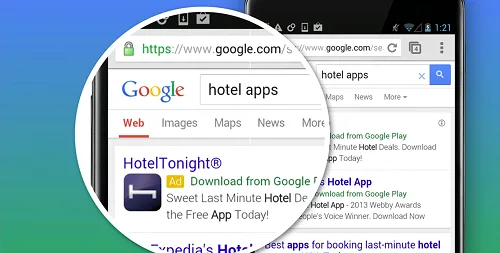
Deep linking is the technology that points an ad or a search result to a specific location inside an app rather than to a generic web page or the app's home screen. Instead of asking a user to install, open, and then hunt for what they wanted, a deep link delivers them straight to the relevant content. Google extended this idea to paid ads so advertisers could route mobile searchers directly into their installed apps, mirroring the deep links that already appeared in organic search results.
For a business, the value is simple: fewer steps mean fewer drop-offs. A restaurant ad can open the reservation screen; a retailer's ad can open the exact product; a travel brand's ad can open the fare it advertised. The closer the ad is to the action, the higher the chance of conversion. Strong mobile app development and clean URL/deep-link structures are what make this possible, so marketing and engineering have to work together.
Web links, app deep links and where each fits
| Destination type | Best used for | Main benefit |
|---|---|---|
| Mobile web page | First-time visitors, no app installed, broad reach | No install needed; widest audience |
| App deep link | Users who already have the app installed | Lands on the exact screen; highest engagement |
| App install ad | Acquiring new app users | Grows the installed base for future deep linking |
The core channels of mobile marketing
A complete mobile marketing programme rarely relies on a single tactic. The strongest results come from combining paid, organic and owned channels so they reinforce one another across the customer journey.
- Mobile search and shopping ads: capturing high-intent demand the moment someone searches, often through a well-run search engine marketing programme.
- Social and video ads: building awareness and re-engaging audiences on platforms such as Facebook and YouTube, where people spend large amounts of mobile time.
- Mobile SEO and app links: making sure your site is discoverable in search and that links to it can open the matching screen in your app.
- Owned channels: push notifications, email and in-app messaging that bring existing users back.
Retargeting: reaching people who already showed interest
One of the most efficient mobile tactics is retargeting: showing relevant ads to people who have already visited your site, used your app, or shown interest in a product. Because these audiences are warmer, retargeting typically earns more engagement per rupee than reaching cold audiences, and it pairs naturally with deep linking: an ad can take a returning user straight back to the cart or screen they abandoned.
Done responsibly, retargeting respects user privacy and frequency limits rather than chasing people aimlessly. Our digital marketing solutions and dedicated PPC expertise are built around this kind of measured, intent-led targeting, and you can go deeper in our PPC and paid marketing complete guide.
How to build a mobile marketing strategy that converts
Technology only pays off when it sits inside a clear plan. Use these steps as a practical framework for any mobile campaign.
- Define the action, not just the click. Decide what a successful outcome looks like (a purchase, booking, sign-up or call) and design the journey backwards from it.
- Match the destination to the user. Send app users to deep links and new users to fast mobile pages or install flows.
- Make the landing experience instant. A slow page or a confusing screen undoes every rupee of ad spend; speed and clarity are conversion features.
- Layer in retargeting. Re-engage people who came close but did not convert.
- Measure end to end. Track from impression to in-app action so you optimise for revenue, not vanity metrics.
If your campaigns send plenty of traffic but few leads, the fix is usually in this chain. Our breakdown of why website traffic doesn't convert into leads walks through the most common gaps.
Choosing the right partner in India
Executing mobile marketing well needs both creative and technical depth: campaign management, app and web development, analytics and ongoing optimisation. For Indian businesses in Delhi NCR, Noida and beyond, as well as those serving global markets, the advantage of an integrated team is that strategy, build and media buying stay aligned. As a digital marketing agency in Noida, Brainguru Technologies helps brands turn mobile attention into measurable action. If you are also planning your roadmap for the year, our guide to internet marketing strategies to focus on is a useful companion read.
Related Services
- Mobile App Development Scalable & Secure Apps
- AI Ad Optimization & Campaign Management
- Search Engine Marketing Services (SEM)
- Hire Dedicated PPC Expert in India
- Android App Development Services in India
- Digital Marketing Solutions | GEO, SEO, SMM Company In India
Frequently Asked Questions
What is mobile marketing?
Mobile marketing is the practice of reaching and engaging customers on smartphones and tablets through channels such as mobile search ads, social and video ads, app campaigns, deep links and mobile-optimised content, so the path from discovery to conversion happens on the device.
What is app deep linking and why does it matter for ads?
Deep linking sends an ad or search result to a specific screen inside an installed app rather than to a generic web page or the app's home screen. It matters because it removes steps from the user journey, which reduces drop-offs and improves engagement and conversions.
Why is mobile-first marketing so important now?
Most consumers now spend the majority of their time inside mobile apps rather than on the open web. Designing campaigns and destinations for the small screen (fast, native and tap-friendly) is essential to capture and convert that attention.
What is retargeting in mobile marketing?
Retargeting shows relevant ads to people who have already visited your site, used your app or shown interest in a product. Because these audiences are warmer, retargeting is often more efficient than reaching cold audiences, especially when paired with deep links back to the screen a user left.
How do I make a mobile campaign actually convert?
Define the real action you want, match each user to the right destination (deep link for app users, fast pages for new users), make the landing experience instant, layer in retargeting, and measure the whole journey from impression to in-app action.
Can Brainguru Technologies help with mobile marketing in India?
Yes. Brainguru Technologies offers integrated digital marketing, paid media and app and web development for businesses in Delhi NCR, Noida and across India, with mobile-first strategy at the core. You can reach the team at +91-8010010000.
Ready to turn mobile attention into measurable results? Whether you need search and paid campaigns, app-ready landing experiences or a full mobile strategy, Brainguru Technologies can help you plan and execute it. Call us at +91-8010010000 or get in touch with our team to get started.
Related Articles
SEO or Google Ads First? A Budget Framework for Indian SMEs
Rented traffic or owned traffic? A practical way to decide between SEO and Google Ads - or how to sequence both - using your own customer value, close rate and cost per click.
Read More
Internet Marketing ROI for Indian SMEs (2026): A Measurement Framework & Calculator
How to measure internet marketing ROI for Indian SMEs in 2026: the 4 numbers to track, attribution traps, 3 hypothetical scenarios & a free ROI calculator. The four numbers every founder must track.
Read More
PPC & Paid Marketing: Complete Guide for Indian Businesses (2026)
Every rupee your business spends on advertising should be accountable. That is the core promise of PPC (Pay-Per-Click) marketing -- you only pay when someone…
Read More
Comments
Be the first to share your thoughts on this article.