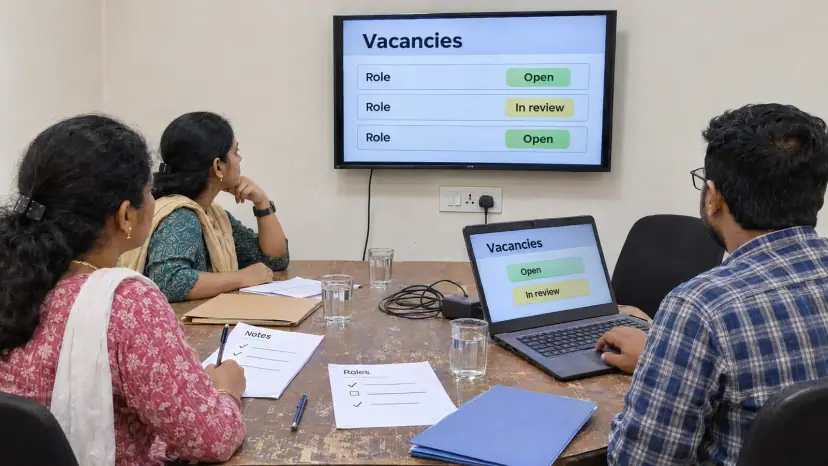
Nagpur recruitment: truthful job descriptions and enquiries reviewed by a recruiter
Candidates in Nagpur may be applying for a local site or for a placement elsewhere in Central India, and the advert has to say which. HR and Recruitment teams serving Nagpur can use this guide to keep job descriptions accurate and have a recruiter review each candidate enquiry. It lays out the information to gather, the local source to use, the work an assistant may take on and the point where a person approves the next step. Each workflow is a planning example, not a client result. Your actual business, data and permissions set the scope.
Nagpur sites and Central India destinations as separate fields
District administration and public services are the subject of Nagpur district resources. A candidate’s Nagpur address and a wider Central India destination belong in different fields. Pick the official reference, and assign the business enquiry, according to the exact operating or pickup site.
Your administrative reference is Nagpur district. It can give you local context, yet it cannot establish hiring demand or commercial availability, and no private business can claim its endorsement. For this workflow, enter the Nagpur site and any Central India destination as separate fields, then match the location to your approved business record. If those disagree, a reviewer resolves it before candidates get directions, coverage information or an interview instruction from a page or assistant.
Details to gather for a Nagpur vacancy brief
Run through these fields as a working brief. Publishing a city name next to a national offer that has nothing to do with it helps no candidate. Keep every statement tied to a source and a reviewer. A detail you do not have should be recorded as a gap and given to a recruiter to chase, never filled by the model.
- Actual work location and work mode: Enter the Nagpur site, list Central India destinations separately and state the work mode, using the true workplace and not the audience you advertise to.
- Approved role description and requirements: Quote the role and requirements as approved, including limits, so applicants judge the real job.
- Employer/agency identity: Identify the employer or the authorised agency behind the vacancy, and treat anything unclear as a review question.
- Permitted candidate information: Set out which candidate details you are permitted to hold, and keep the current approval with the record.
- Application/referral enquiry type: Separate applications from referrals, note the next step requested and pull out misrouted or unsupported requests.
- Recruiter-review owner: Put a name against the recruiter who confirms the answer or action before a next step is offered.
When an illustrative Nagpur request arrives, it needs to clear the location check and the approved role description and requirements check. Only after that may a commercial or professional next step be suggested. Anything that fails is left unresolved in the handoff, which gives your recruiter a concrete question to answer in place of a falsely qualified lead.
What AI can do with vacancies and where recruiters step in
Start from four facts in all recruitment content: the real role, the employer or authorised recruiter, the work location and the application route. With those in place, AI can organise approved vacancy information and highlight questions a candidate has left unanswered. Inventing a job is off limits, and so is implying remote work where the employer requires attendance. Report applications, recruiter-reviewed matches, interviews and accepted offers separately.
Authorised sources and systems are the only ones to connect: an approved knowledge pack, the relevant operational system and, where needed, a CRM or intake route. Every reply about a vacancy should record the source version used. Check access permissions and who can revise content before live candidate data comes into it. A draft, prediction or extracted field gives the reviewer a start, and no commercial commitment follows from it automatically.
Say who owns what. The hiring manager owns the role text and tells the recruiter when a vacancy closes. The recruiter owns the candidate conversation and the status of each application. The HR lead owns the retention rule for CVs. What breaks when no one owns closure is familiar: a filled role stays advertised, candidates keep applying, and the assistant keeps replying as though the job were open. Give the hiring manager a set day to confirm every open vacancy, and have the assistant mark a role as unconfirmed if that date has passed.
Protected traits, CVs and honest workplaces
Never use a protected trait, or a proxy for one, to screen out applicants. Where scores are automated, a recruiter must oversee them and errors must be correctable. Do not put CVs or contact details on public pages, and restrict access to approved reviewers. A Nagpur keyword must not cover up the actual workplace or the employment terms.
Before launch, settle how long a CV is kept after a vacancy closes, who can see it, and how a candidate asks for it to be removed. The sign-up form should say what the details are used for, in line with the DPDP Act 2023. Write the answers down and test the removal route with a dummy record.
Marathi, Hindi and English, local visibility and the hiring funnel
If people need Marathi, Hindi and English, have competent speakers review the terminology, locality names and proposed next step. These are languages to assess with the business, and that is no claim that every candidate uses them or that we supply every translation. Your page and business records should show the same actual address and contact route. Never invent offices or profiles in Nagpur.
Audience location and fulfilment location can differ in Nagpur, particularly when the role sits at a Central India destination, so log both. Let the approved serviceable area guide page content and routing. Follow the stages independently: vacancy enquiry → authorised application → recruiter review → interview → offer/decline. Rejected, cancelled and unsupported requests must stay in the evaluation, because revenue does not come from a click or a conversation.
Good test cases are a closed vacancy, a work-mode mismatch, a wrongly extracted qualification and a request to withdraw an application. Before increasing spend, hold the reviewed outcomes up against your baseline. Job-search queries reveal mismatched intent, and that shows which answer or handoff needs work. Rankings, AI-answer inclusion, lead volume and return on investment are never guaranteed.
Reading list and consultation checklist
Begin with HR & Recruitment solutions for the industry scope, then read AI Resume Screening: Recruiter Oversight, Candidate Privacy and ATS Integration for implementation detail. The article covers a neighbouring workflow, so do not read it as proof of hiring work for a Nagpur client.
You might also look at SaaS and Education & EdTech for Nagpur. To see official references by location, open Nagpur and other city guides.
Ask for a free consultation with these ready: the actual work location and work mode, the approved role description and requirements, approved source material and the deciding reviewer. Nagpur is served from our Noida office, and we claim no branch there. Integrations, scope and on-site work vary with each hiring team, so we discuss them directly.
Resources for this city and sector were last looked at on 5 October 2026, so read current instructions before a campaign changes. Pictures here illustrate the topic only and have not been verified as local offices, candidates or facilities.
In the first weeks, look at the reasons candidates drop out after applying. If many drop out at the work-mode question, the advert is not clear enough at the start. If they drop out after a long silence, the review step needs another owner or a firmer deadline.