AI marketing for healthcare in Kolkata: correct details, checked by staff
A patient who rings the wrong department, or arrives for a slot nobody confirmed, has been let down by bad information. AI marketing for healthcare in Kolkata, in this guide, covers reception answers drawn from approved text, a staff check before any booking is confirmed, honest handling of scheme questions and public pages that respect the medical advertising rules.
The workflows are sketches for planning. They describe no Brainguru client and no result, and any real project starts from what your organisation holds and what it permits.
What the Kolkata Collectorate site covers
For administrative context, open the Kolkata Collectorate site, a Government of West Bengal page with a Bengali edition. Its text names Kolkata as West Bengal's capital, on the eastern bank of the River Ganga, and it lists the Collectorate's sections, among them Domicile, Treasury, Land and Record, RTI and Citizenship. Its quick links point to a separate Kolkata District site, so treat the Collectorate pages as one office's site; the district portal is a separate one.
Nothing there measures demand for care or shows what is commercially available, and the Collectorate vouches for no private hospital or clinic. The locality a patient names and the premises where they will be seen are two different fields, and they can drift apart when a metropolitan audience spans several municipal areas. Each is compared with what the provider has approved on file. A disagreement goes to a named reviewer, and directions, coverage claims and appointment instructions wait until it is resolved.
The helpline panel lists the citizen's call centre on 155300, the child helpline on 1098, the women helpline on 1091 and a crime stopper line on 1090. The emergency wording in your assistant must still come from the provider's own approved text, written before launch, and not from a portal.
Details to hold for each Kolkata patient enquiry
Printing "Kolkata" beside a nationwide offer tells a patient nothing they can act on. The record behind each enquiry needs the fields below, every one traced to a source and a person who approved it. When a field cannot be filled, a staff member hears about it; the model does not invent an answer.
- Facility address and service hours: The premises where care happens, the locality name patients use for it, and the hours approved for that site. Where the audience lives is a separate matter.
- Approved department/service description: The department's approved wording, what it leaves out, and when someone last reviewed it.
- Appointment type and reception contact: First visit, follow-up or test, plus the reception or billing contact who owns it. Gaps are parked for review, not filled.
- Permitted public information source: Which approved document, and which version of it, supports a public sentence. A picture of the Ganga, or the word Kolkata, does not count.
- Non-clinical enquiry category: Hours, booking, directions or a scheme question. Clinical or misdirected messages leave this queue at once.
- Staff escalation owner: The named person who signs off the reply, or the action, before the patient is offered anything.
Every Kolkata request faces two gates in order: is the premises right, and does the approved description cover the request? A request that fails either gate reaches reception marked as an open question, which is far more useful to staff than a lead that only looks ready.
What an appointment assistant may and may not do
The remit covers approved answers on opening hours, how bookings work and how to get through to reception, and nothing else. A request is recorded as a request; it turns into a booking only when a staff member has confirmed it from the live schedule. Symptoms in a message are not interpreted, and an emergency message receives the approved emergency text and a handoff, never a sales follow-up. Clinical files never sit in the reception system; when doctors need medical details, those travel over the provider's secure clinical route.
Limit the connections to what the provider has signed off, for example the approved knowledge pack, the booking system and, where needed, a CRM or intake route. Keep a note of which pack version produced each answer, and test who can read and who can edit before a live patient record is involved. Anything the assistant drafts or extracts helps a reviewer decide; on its own it promises nothing. Our CRM solutions page covers how enquiry records and handoffs can be kept in one place.
Scheme and payment questions at the front desk
An enquiry is sometimes really about payment: does the hospital accept a government health scheme, and for which department? The West Bengal Department of Health and Family Welfare portal, also available in Bengali, carries a State Health Agency section that lists Ayushman Bharat Pradhan Mantri Jan Arogya Yojana (PM-JAY) and Mukhya Mantri Swasthya Bima Yojana (MMSBY), with an "Apply for MMSBY" link, scheme FAQs and a grievances page. Patients who ask may use those names. When we read it on 5 November 2026, its beneficiary panels counted admissions in both government and private hospitals.
The portal endorses no hospital, and the answer to "is my treatment covered here?" has to come from your facility's own current empanelment record, held by whoever runs billing.
A planning example: a caller asks whether a planned procedure is covered under MMSBY. The assistant records the scheme name, the department and a call-back time, then says the billing desk will confirm. It does not say yes, does not estimate a cost and does not ask for card or identity numbers in chat. The billing owner replies from the empanelment record, and the page wording changes only when that record changes. If scheme calls take up much of the desk's day, our page on healthcare call center solutions in India describes how such calls can be routed.
Second opinions and consultations under the NMC code
Publicity by doctors and the soliciting of patients are both limited by the professional code. Before anything goes public, the responsible provider holds it against the rules that apply, and the Code of Medical Ethics Regulations, 2002, published by the National Medical Commission, is among them. Read the current text there and ask the responsible professional to judge the proposal.
Two regulations bear on pages that offer consultations or second opinions. Regulation 3.4.1 says that statements to the patient or their representatives should be made in the presence of the consulting physicians unless agreed otherwise, and that disclosing the opinion to the patient, relatives or friends rests with the medical attendant. A chat assistant should therefore never pass on what a consultant thought, even when a relative asks for "just a quick update". Regulation 4.3 says a consultant should normally not take charge of the case, especially when the patient or friends ask, and shall not criticise the referring physician. A second-opinion page that runs down the first doctor or promises to take over care needs the responsible doctor's review before it goes live.
The code has no clause that names testimonials or rankings, so a Kolkata hospital has to reason from what it does say. What 6.1.1 does is call soliciting patients unethical and rule out boasting of cases, operations, cures or remedies. Patient stories, star ratings and "most trusted hospital in Kolkata" lines therefore reach the responsible doctor as questions, not as finished copy. The scope here is permitted information and help for the desk; open-ended patient-acquisition advertising is outside it.
Bengali and English, Kolkata search and tracking appointments honestly
Both official sites offer Bengali alongside English. Where a provider runs pages or replies in Bengali and English, someone fluent in each should read them for clinical terms, locality names and the next step offered. Whether to run both is the provider's choice; it is not a statement about all patients, and we do not promise to translate everything. Keep one real address and one route for contact consistent across the page and every business listing, and never add offices or profiles to look local.
The people a Kolkata campaign reaches and the place they will be treated can be far apart, so let the approved service area, not the audience, decide what the page says and where requests go. Measure each step on its own, from the first message through the desk's check and its decision to the visit itself. Requests that were refused, cancelled or could not be supported stay in the count, since a conversation earns nothing on its own.
Put five cases through it before launch: an OPD shut for the day, a slot someone else has taken, a sender wanting a diagnosis, a request containing medical records and a scheme question the billing record cannot yet answer. Weigh what reviewers found against the provider's past figures before adding budget, and follow any search term that brings the wrong enquiries back to the answer or handoff it exposes. No ranking, AI-answer placement, lead count or return is promised to any provider.
Requests about patients' own data
Scheme questions bring card numbers, family names and phone numbers into the conversation, so collect only what billing needs and keep it out of the chat transcript where you can. Under the DPDP Rules, 2025 (Gazette, 13 November 2025), the bulk of what a Data Fiduciary must do becomes binding on 13 May 2027, the date set by rule 1(4). Rule 14 is among them. It asks a Data Fiduciary to publish on its website or app how a person can make a request to exercise their rights, what identifier is needed, such as a mobile number or an application reference number, and the period for answering grievances, which may not exceed ninety days. Decide now who at the desk receives such a request and how it is logged.
Other resources and what to bring to a first conversation
The industry view is on AI Marketing for Healthcare. Kolkata teams wanting more on method can open AI Marketing for Healthcare in India: A DPDP-Aware Playbook for Hospitals and Clinics next; it is a general article and points to no Kolkata engagement of ours.
Neighbouring topics for the city are covered in AI Marketing for Insurance in Kolkata and AI Marketing for HR and Recruitment in Kolkata, and Kolkata and other city guides shows the official sources used for each city.
A free consultation is most productive if you bring the premises address and hours, the approved department wording, your current scheme empanelment record if you have one, the documents behind them and the reviewer who can say yes or no. Healthcare projects are delivered from our Noida office; we have no office or branch in Kolkata, and claim none. How far the work goes, what it connects to and whether a visit is needed are decided per provider.
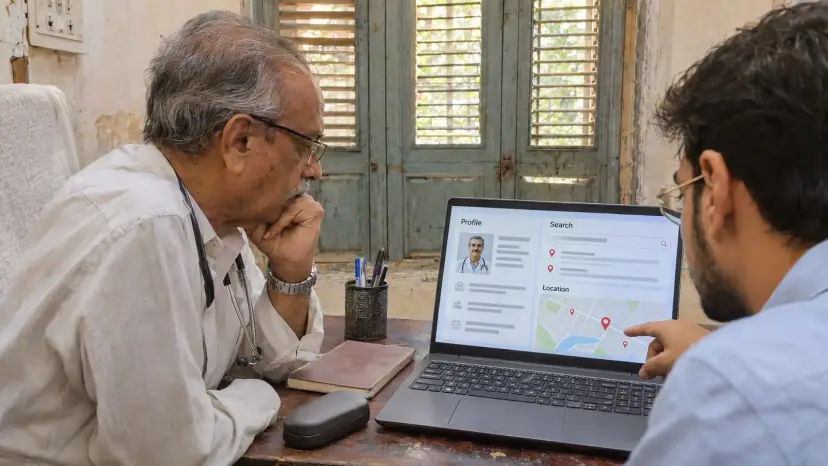
The sources behind this page were first checked on 5 October 2026 and again on 5 November 2026; recheck them before a campaign changes. Where a photograph appears, it is there for the topic and does not depict a real Kolkata office, patient or hospital.