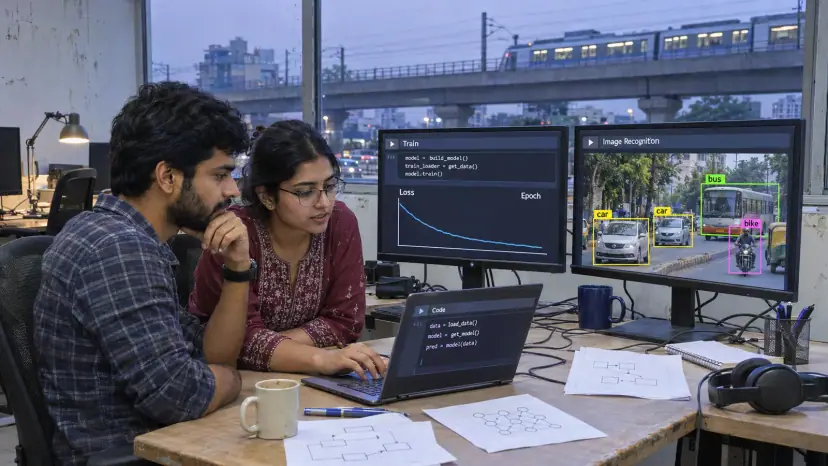
Brainguru is an AI development company in Delhi NCR, based at Bhutani Alphathum, Tower A, Sector 90, Noida, Uttar Pradesh 201305. We build AI applications, chatbots, AI agents, machine learning models and generative AI tools for businesses and organisations across Delhi, Noida, Gurugram, Faridabad and Ghaziabad, and for clients elsewhere in India and abroad.
What businesses in Delhi NCR use AI for
The National Capital Region brings together central government bodies, banks and financial firms, hospitals, retailers, media companies, logistics operators, universities and a large number of startups. Their AI needs differ, but most fall into a few patterns:
- Handling high volumes of enquiries: Chatbots and assistants that answer routine questions in Hindi and English and pass the rest to staff.
- Processing documents: Reading forms, invoices, applications and KYC documents, and flagging exceptions for review.
- Forecasting and planning: Demand, staffing, inventory and cash flow forecasts from historical data.
- Finding risk: Fraud, anomaly and credit risk models for financial services.
- Searching knowledge: Assistants that answer staff questions from policies, manuals and past cases.
- Automating workflows: AI agents that complete multi-step tasks across CRM, ERP and internal tools, with human approval for important steps.
Adoption is now the norm rather than the exception. The Stanford AI Index 2026 reports that organisational adoption of AI reached 88%. The question for most organisations is where AI pays off and how to run it safely.
AI development services for Delhi NCR businesses
Enterprise AI applications: AI features added to ERP and CRM workflows, or new platforms built around prediction, language understanding and automated decisions, designed for reliability, security and growth. Where the AI sits inside a larger product, our software development team in Noida builds the rest of the application.
Machine learning engineering: Predictive models, classification, time-series forecasting, recommendations and anomaly detection, with monitoring and retraining planned from the start. See our AI model development page.
Conversational AI and NLP: Multilingual chatbots, voice assistants, document understanding, sentiment analysis and text generation, with support for Indian languages. Our NLP development services cover this in more depth.
Computer vision: Systems that read images, video and scanned documents for quality checks, retail shelf monitoring, document digitisation and similar uses.
Generative AI: Assistants, report drafting, content tools and knowledge bots built on large language models, with guardrails and review steps. See generative AI solutions.
AI chatbots: Bots for web, mobile and WhatsApp that answer from your own content, connect to back-end systems and hand over to people when needed.
AI strategy and consulting: Readiness reviews, use case selection, data strategy, technology choice and roadmaps, including proofs of concept, through our AI consulting services.
AI agents and process automation: Agents that carry out tasks in procurement, HR, finance, customer service and supply chain, within clear limits.
AI for government, finance and regulated sectors
Many NCR organisations work in regulated settings, where an AI system must be explainable, secure and auditable. A few points matter more here than elsewhere:
- Personal data: The DPDP Rules notified in November 2025 set an 18-month phased compliance timeline, with most duties applying from 13 May 2027. Consent notices, retention, security safeguards and responses to data requests should be designed in, not added later.
- Sector rules: Financial, healthcare and government work carries regulator and contract requirements on data location, outsourcing and audit. Your compliance team should confirm which apply.
- Security: Generative AI brings new attacks. Prompt injection is ranked first as LLM01:2025 in the OWASP Top 10 for LLM Applications.
- Risk management: The NIST AI Risk Management Framework, released on 26 January 2023, is a practical structure for recording risks, controls and owners, even outside the United States.
- Hosting: Sensitive projects may need on-premises or private cloud deployment, and air-gapped environments in some cases.
Incidents are rising as use grows: the 2026 AI Index counts 362 documented AI incidents, up from 233 in 2024. Clear scope, testing and human oversight prevent most problems.
National AI infrastructure you can draw on
Indian organisations have growing public support for AI work. At the India AI Impact Summit in February 2026, the Minister for Electronics and IT announced that India would scale its shared compute capacity beyond the existing 38,000 GPUs with the addition of 20,000 GPUs. For startups and research teams, subsidised compute can change what is affordable to build and test, so it is worth checking eligibility early.
Industries we work with across Delhi NCR
- Government and public sector: Citizen service assistants, document processing and analysis tools.
- Banking and financial services: Fraud detection, credit risk models, customer analytics and reporting automation.
- Healthcare: Appointment and patient communication tools, document processing and decision support, with clinical decisions left to clinicians.
- Retail and consumer goods: Demand forecasting, personalised marketing and supply chain analytics, built on our big data analytics services.
- Real estate: Lead scoring, enquiry handling and valuation support.
- Media and publishing: Content recommendation, audience segmentation and content tools.
- Logistics: Route planning, fleet analytics, warehouse forecasting and shipment updates.
- Education: Adaptive learning, assessment support and student services.
Common mistakes in AI projects
- Starting with the tool: Choosing a model or platform before agreeing the problem and how success will be measured.
- Ignoring data quality: Expecting a model to fix incomplete, inconsistent or out-of-date records.
- Skipping the pilot users: Building without the staff who will use the system every day.
- No plan for running costs: Forgetting model usage, hosting, monitoring and retraining after launch.
- No human checkpoint: Letting a system act on customers, money or records without review in its early months.
How an AI project with us runs
- Discovery: Interviews, process mapping and a data review, so the solution fits a real business goal.
- Data preparation: Cleaning, joining and documenting data, and setting up pipelines that keep it current.
- Prototype: A working prototype on your data, so stakeholders can test the idea before a larger commitment.
- Build in short cycles: Regular demos and course corrections as results come in.
- Deployment: Load, security and user acceptance testing, then release to cloud, on-premises or hybrid infrastructure.
- Monitoring and improvement: Tracking model performance, data drift and user feedback, with retraining when needed.
Whoever you hire, ask to see results on your own data at the prototype stage, with the measures of success agreed before the build starts.
Choosing an AI development company in Delhi NCR
- Problem first: Does the team start from your business problem, or from a tool it wants to sell?
- Evidence: How will the prototype be judged, and will the report include what did not work?
- Data handling: Where will your data be stored and processed, and who can access it?
- Ownership: Who owns the code, models and data at the end of the project?
- Support: Who monitors and maintains the system after launch?
Our office in Sector 90, Noida, is open Monday to Saturday, 9:00 AM to 7:00 PM IST, and a free consultation is the easiest way to start.