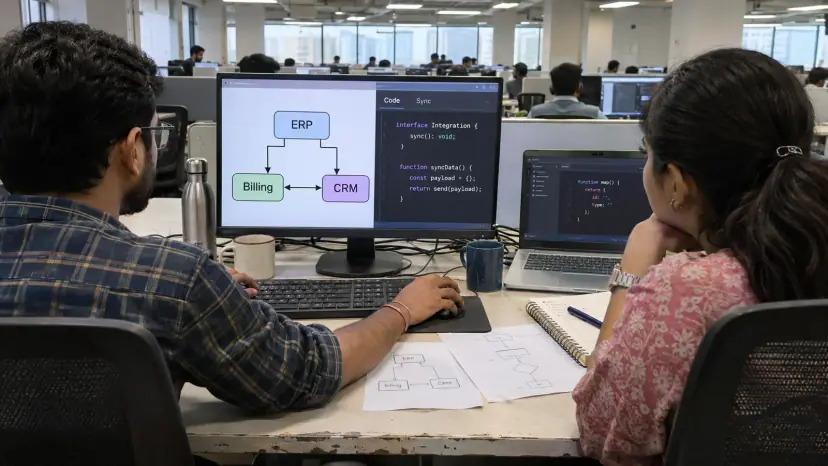
Brainguru is a software development company in Noida, working from Bhutani Alphathum, Tower A, Sector 90. A nearby office can make meetings easier, but the bigger question when you choose a team is how it will learn your workflow, show progress and hand over a system your business can run. This page explains how to have that conversation.
Projects can cover custom web applications, mobile apps, connections between business systems and improvements to products that already exist. See our software development service scope for the broader offering. For a first product with unresolved assumptions, use the startup development brief; replacing a legacy system needs a different discovery and migration plan.
Start with the business process and the system you already have
Bring a walkthrough of the process that needs to change. Identify the people who use it, the records they create, the approvals, the exceptions and the systems that already hold the data. A statement such as "we need a CRM" does not say whether the problem is lead capture, assignment, reporting or integration. A good proposal connects each feature to the problem it solves.
For an existing application, an initial review should establish repository access, deployment steps, dependencies, integration contracts and known failure cases before anyone recommends a rewrite. A staged improvement can keep valuable business rules that a full replacement would lose. The decision depends on the actual system, not on its age alone.
Many users will reach the system on a phone. DataReportal's Digital 2026 India report counted 1.03 billion internet users in India in October 2025, an internet penetration rate of 70.0 percent. Field staff, customers and suppliers often work on mobile connections that are slower than office broadband, so test key screens under those conditions.
Noida collaboration: agree access and responsibilities
Discuss whether discovery and reviews will be remote, or whether an office meeting is useful. Appointments and any site access must be confirmed in advance. Our Noida office does not mean we have offices in other cities, or that on-site support across the NCR is included.
- Product owner: Name the person on your side who approves acceptance and scope changes.
- Users: Decide which users take part in workflow review, testing and training.
- Accounts: Assign ownership of infrastructure, data access, third-party accounts and vendor approvals.
- Rhythm: Record the review cadence, communication channels and how a blocked decision is escalated.
This arrangement matters more than a promise that every project follows the same sprint length. A release can stall because a payment provider, an internal stakeholder or a data owner has not given a required approval, even when development is otherwise complete.
Choosing a software development company in Noida
Give every vendor the same brief and ask each to state its exclusions. Compare deliverables and assumptions, not just developer counts or a technology list. Our Noida software-company buyer's checklist expands the evaluation process.
- Scope: Which user journeys, screens, reports, roles and integrations are included?
- Migration: Who maps the fields, reconciles records and approves the cutover?
- Quality: What functional, security and performance evidence will be supplied?
- Operations: Who deploys, monitors, restores a backup and responds after launch?
- Commercial terms: Which licences, hosting, support, taxes and change requests cost extra?
Ask how the vendor itself handles security, too. In IBM's 2025 Cost of a Data Breach research for India, the average cost of a breach reached INR 220 million, and third-party vendor and supply chain compromise was the initial cause of 17% of breaches, second only to phishing at 18%. A software partner with access to your code and data is part of that supply chain.
Security duties under the DPDP Rules
If the system will hold personal data of people in India, the Digital Personal Data Protection Act, 2023 applies. Its main duties start on 13 May 2027 under the DPDP Rules, which were published in the Gazette on 13 November 2025. Rule 6 sets out reasonable security safeguards that a Data Fiduciary must take, including for processing done on its behalf by a Data Processor:
- Protection of data: Measures such as encryption, masking or tokens.
- Access control: Control over access to the computer resources used.
- Logs: Logging, monitoring and review of access to personal data, with logs and data kept for one year to support investigation, unless another law requires otherwise.
- Continuity: Measures such as backups so processing can continue after a compromise.
- Contracts: A provision in the contract between the Data Fiduciary and the Data Processor for reasonable security safeguards.
When a development partner hosts or supports your system, these points belong in the scope and the contract, not in a later change request. Your legal adviser confirms how the Rules apply to you.
Illustrative project: replace a spreadsheet approval workflow
A business wants requests submitted online, reviewed by an operations manager and exported to an existing finance system. Discovery should establish request fields, approval rules, rejection reasons, edit permissions and the finance export format. The first release can then be tested on one complete request journey, including duplicate submissions and rejected records.
An acceptance check might require that a submitter cannot approve their own request, a reviewer can see the relevant history, and a repeated export does not create a second finance entry. Access checks like these matter: broken access control is number one in the OWASP Top 10:2025, which found some form of it in 100% of the applications tested. These are illustrative criteria, not a customer case study. The exact rules must come from the business before the system is built.
Choose a delivery workstream that matches the problem
- Web application development for browser-based portals, workflows and dashboards with defined access roles.
- CRM development in Noida for sales or service processes that need assignment, history and integrations.
- API development when existing systems need a reliable data exchange rather than another user interface.
- Cloud services for deployment, migration or operational improvements; confirm the actual infrastructure and access scope.
- QA and testing to define repeatable release evidence and regression coverage.
- Security testing to check access rules, data exposure and dependencies before launch.
Technology choices should follow the required workflows, maintenance skills and integration limits. A framework name does not prove security, scale or suitability. For sensitive or regulated data, document the requirements with the responsible specialist and make their implementation and review part of the scope.
Plan migration and handover before go-live
For a replacement system, agree a mapping from old records to new fields, a reconciliation report, an authorised test dataset and a rollback decision. Trial the migration without changing the live source, then let the data owner approve any differences. Do not treat the first successful import as proof that totals, relationships and historical permissions are correct.
Handover should include the source repository, build instructions, configuration ownership, database migrations, deployment steps and backup and restore guidance. Record third-party licences and account owners. Agree any warranty, maintenance, response time and emergency contact commitments in the contract; a development engagement alone should not imply unlimited operational cover. If you want release pipelines and hosting run as an ongoing service, see DevOps as a Service.