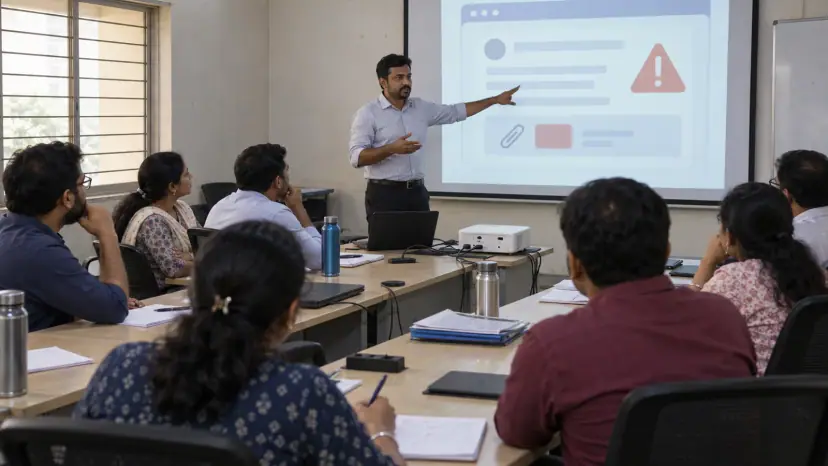
Social engineering services test whether attackers could trick your staff into handing over passwords, money or access, and then help you close those gaps. Brainguru runs controlled phishing, phone and SMS simulations, trains employees to spot and report scams, and helps you set simple verification rules, so people become a stronger line of defence.
What is social engineering?
Social engineering is any attack that works by manipulating people rather than breaking technology. The attacker poses as someone you trust, such as a supplier, a senior manager, a bank or the IT helpdesk, and creates a reason to act quickly. The aim is a password, a payment, a file or a click on a malicious link.
- Phishing: Fake emails or websites that imitate trusted brands or colleagues to steal logins or deliver malware.
- Spear phishing and business email compromise: Targeted messages, often from a real or look-alike account, asking finance staff to change bank details or pay an urgent invoice.
- Vishing: Phone calls from someone claiming to be a bank, a regulator or IT support.
- Smishing: SMS and chat messages with fake delivery, payment or account alerts.
- Pretexting: A made-up story, such as an auditor needing records today, used to justify an unusual request.
- Baiting and quid pro quo: Offers of free downloads, gifts or help in return for an action.
- Tailgating and physical impersonation: Following staff through a secure door, or posing as a vendor or technician to get inside.
Why social engineering is a serious business risk
It is still one of the main ways attackers get in. In India, IBM's Cost of a Data Breach Report 2025 found that phishing was the top initial attack vector, behind 18% of breaches, and that the average breach cost INR 220 million.
The losses can be large. The FBI's Internet Crime Complaint Center 2025 report, which covers complaints made in the United States, listed phishing and spoofing as the most reported crime type, with 191,561 complaints. Business email compromise drew 24,768 complaints but reported losses of $3.05 billion, second only to investment fraud.
Attackers are moving to phones. Verizon's 2026 Data Breach Investigations Report says people have got better at spotting phishing emails, and that 40% higher click rates now make mobile devices a favourite target, through fake texts and scam calls. Training that covers only email leaves a gap.
Regulators see the same pattern. The Australian privacy regulator's Notifiable Data Breaches report for July to December 2024 recorded 115 breaches caused by social engineering or impersonation, out of 404 caused by malicious or criminal attacks, plus 84 caused by phishing that compromised credentials.
Our social engineering services
Risk assessment: We review what an attacker could learn about your organisation from public sources, such as staff names, email formats and supplier relationships, and which roles and processes are most exposed, such as finance, HR and the helpdesk.
Phishing simulations: We send realistic, pre-approved phishing emails to staff and measure who opens, clicks, enters details and, most importantly, who reports the message. Results show which teams need help, not which individuals to blame.
Vishing and smishing tests: With your written approval, we test how staff respond to phone calls and text messages that ask for passwords, codes or payments, which is where many real attacks now happen.
Pretext scenarios: We test how teams handle unusual requests, such as a "new supplier" changing bank details or a "senior manager" asking for gift cards, and whether they follow the verification steps you have set.
Awareness training: Short, practical sessions and e-learning teach staff to spot warning signs, verify requests through a second channel, use multi-factor authentication properly and report anything suspicious quickly. For wider staff skills, see our corporate training programmes.
Policy and process design: We help you write simple rules that make social engineering harder: call-back checks for payment changes, identity checks at the helpdesk, approval limits and a clear way to report a suspicious message.
Incident response support: If someone has already been tricked, we help contain the damage: reset accounts, check mailboxes for forwarding rules, review what was accessed and work out whether the incident must be reported. Our security operations team can monitor for follow-up activity.
How a social engineering engagement works
- Agree scope and rules: We agree in writing which techniques, teams and dates are in scope, who knows about the test and how sensitive data will be handled.
- Baseline test: A first round of simulations shows how staff respond today.
- Training: Staff who clicked see a short explanation straight away, and wider training follows.
- Process fixes: We recommend changes to payment, helpdesk and access processes based on what the test found.
- Repeat and compare: Later rounds use new scenarios, so you can see whether reporting goes up and risky actions go down.
Running simulations responsibly
Social engineering tests involve real people, so they need care. We advise you to:
- Get approval: Senior management and, where needed, HR and legal should approve the plan before it starts.
- Avoid cruel lures: Do not use fake bonuses, layoffs or personal emergencies that upset staff and damage trust.
- Protect the data: Treat results as personal data, keep them only as long as needed and share them in summary form. Staff results deserve the same care as customer data.
- Reward reporting: Praise people who report a test message. A culture where people speak up quickly matters more than a perfect click rate.
Simple defences that make a big difference
- Multi-factor authentication: A stolen password is far less useful when a second factor is needed.
- Call-back rule for payments: Any change to bank details is confirmed by calling a number already on file, never one in the email.
- Email authentication: SPF, DKIM and DMARC records make it harder to fake your domain.
- Registered sender IDs: TRAI's rules require business SMS to go out under registered headers, which helps customers tell your real messages from fakes. See our transactional SMS service for business messaging.
- One-click reporting: A report button in the mail client gets suspicious messages to the right team in seconds.
For smaller businesses, our article on cybersecurity for Indian SMEs covers these basics alongside technical controls.
Why choose our social engineering services?
- People-first approach: We measure exposure and build habits, without naming and shaming individuals.
- Realistic scenarios: Tests are based on the kinds of attack your sector is likely to face, across email, phone and SMS.
- Process, not just training: We fix the payment and helpdesk steps attackers rely on.
- Clear reporting: Results are shown by team and trend over time, with practical next steps.