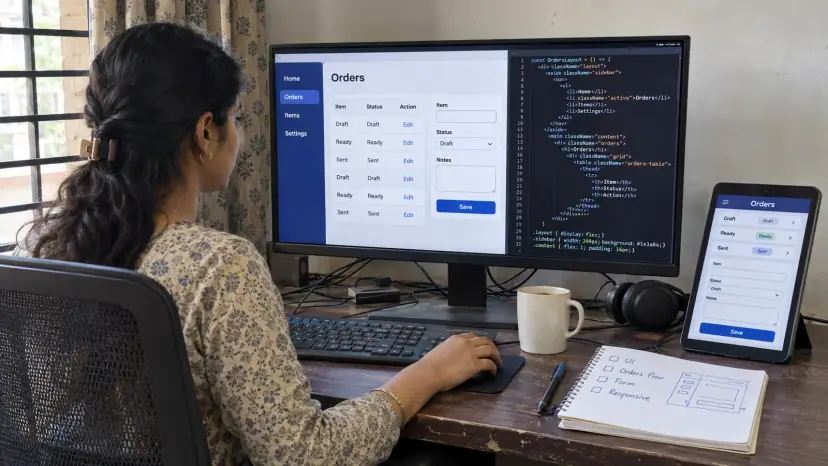
Custom web application development means building browser-based software around your own processes instead of bending your business to fit an off-the-shelf product. Brainguru designs, builds, tests and supports web applications for startups, small businesses and enterprises: customer portals, dashboards, internal tools, SaaS platforms, custom CRM and ERP systems and progressive web apps.
When does a custom web application make sense?
Ready-made software is often the right answer. It is quicker to start and someone else maintains it. A custom application is worth considering when:
- Your process is your edge: The way you quote, schedule, approve or deliver is what sets you apart, and generic tools would flatten it.
- Too many workarounds: Staff copy data between spreadsheets and several tools every day.
- You need one view: Customers, orders, stock and finance live in different systems that do not talk to each other.
- You are building a product: The software itself is what your customers pay for, as in a SaaS business.
- Licences no longer add up: Per-user fees across many tools cost more than owning a system that fits.
Web applications also reach people easily. DataReportal's Digital 2026 India report counted 1.03 billion internet users in India in October 2025. A browser-based app works for all of them on any device, with no app store in the way.
What we build
- Customer portals: Accounts, orders, bookings, documents, payments and support in one place.
- Internal tools and dashboards: Approvals, scheduling, inventory, field operations and reporting.
- SaaS platforms: Multi-tenant products with sign-up, billing, roles and admin tools. See our SaaS application development page.
- Custom CRM and ERP systems: Built around your sales, service and operations steps.
- E-commerce and marketplaces: Catalogues, carts, payments, seller tools and order management.
- Progressive web apps: Web apps that install on a phone's home screen, load quickly and can work offline for key tasks.
- APIs and integrations: Connections to payment gateways, accounting, messaging and the tools you already use.
Our approach to web application development
- Discovery: We learn your goals, your users and how work flows today, and agree what success looks like.
- Scope and first release: We split the product into a first usable release and later phases, so you see value early.
- Design: Wireframes and a clickable prototype let users try the flow before code is written.
- Build in short cycles: Working software every one or two weeks, with demos so you can change priorities early.
- Testing: Automated tests on every change, manual checks of key journeys, and performance and security testing before launch.
- Launch: Automated deployment, monitoring and a plan to roll back if something goes wrong.
- Support and growth: Fixes, security patches, framework upgrades and new features as your needs change.
Technologies we work with
We choose the stack for your project rather than forcing it into ours. Widely used technologies have more maintained libraries and a larger pool of developers, which matters when you need to hire or hand over later. In the Stack Overflow 2025 Developer Survey, 66% of respondents used JavaScript, 43.6% used TypeScript and 55.6% used PostgreSQL, the most used database in the survey.
- Front end: React, Angular and Vue.js, for responsive interfaces that work on phones, tablets and desktops.
- Back end: Node.js, Python, PHP and .NET, chosen by the type of work and the skills you can hire.
- Databases: PostgreSQL and MySQL for structured data, MongoDB where a flexible document model fits better, and Redis for caching.
- Cloud: AWS, Microsoft Azure and Google Cloud, with automated builds and deployments.
For founders weighing these choices, our guide on how to choose the right tech stack for a startup explains the trade-offs.
Security and compliance in custom applications
Security has to be designed in, not added at the end. Broken access control is ranked first in the OWASP Top 10:2025, which reports that 100% of applications tested had some form of it. The fix is simple to state and easy to forget: check permissions on the server for every request, for every role.
Keeping software up to date matters just as much. The Verizon 2026 Data Breach Investigations Report found that 31% of breaches start with software vulnerabilities, so patching frameworks and libraries is part of support, not an optional extra. Regular security testing finds what code review misses.
Compliance depends on your users and data. In India, the Digital Personal Data Protection Act, 2023 applies to personal data, with its main duties starting on 13 May 2027 under the DPDP Rules. Card payments bring PCI DSS, European users bring the GDPR, and US health data brings HIPAA. We design data handling, consent, logging and access control around the rules that apply to you.
Performance on real devices
Many business users open web apps on mid-range phones over mobile data. The HTTP Archive Web Almanac 2024 found that 43% of websites had good Core Web Vitals measured with Interaction to Next Paint, which means most sites still feel slow to respond. We set performance budgets, test on real phones and slower networks, and load heavy features only when they are needed.
What affects the cost of a custom web application?
We do not publish prices, because two applications with the same name can differ several times over in effort. These factors drive the estimate:
- Features and workflows: The number of user journeys and how many rules, approvals and exceptions each one has.
- User roles: Each role adds screens, permissions and tests.
- Integrations: Each external system adds work, more so when its API is poorly documented.
- Design depth: A custom design system takes longer than adapting a proven component library.
- Data migration: Moving and cleaning data from old systems is often underestimated.
- Security, compliance and scale: Sensitive data, audit trails and high traffic add design and testing effort.
- Support after launch: Hosting, monitoring, upgrades and new features.
The surest way to control cost is a smaller first release. Build the core journey, put it in front of users, and let real use decide what comes next.
Questions to ask any custom web application development company
- Ownership: Who owns the source code, the cloud accounts and the domain?
- Testing: Which tests run automatically, and what is checked by hand before each release?
- Releases: How is code deployed, and how quickly can a bad release be rolled back?
- Handover: What documentation will we get, and could another team take over?
- People: Will we speak directly with the developers doing the work?
We are happy to answer each of these in a free consultation. We work with clients in India and abroad, with delivery from our Noida office.
Explore our development services
- Web App Development: Customer portals and internal tools planned around user journeys, roles and integrations.
- Mobile App Development: Full-cycle Android and iOS apps, with native, cross-platform and hybrid options.
- API Development: Custom and RESTful APIs, platform integration, security and authentication.
- Website and Portal Development: Custom and CMS-based websites and interactive web portals.
- Frontend Development: Custom web interfaces and single page applications built around the user experience.
- Backend Development: Custom server-side systems, APIs, cloud backends and database management.
- Cross-Platform App Development: One mobile codebase for several platforms, using Flutter and React Native.
- Full Stack Development: Front-end and back-end work combined into scalable, secure applications.
- Software Development: Custom software across web, mobile and enterprise platforms, from startups to large organisations.