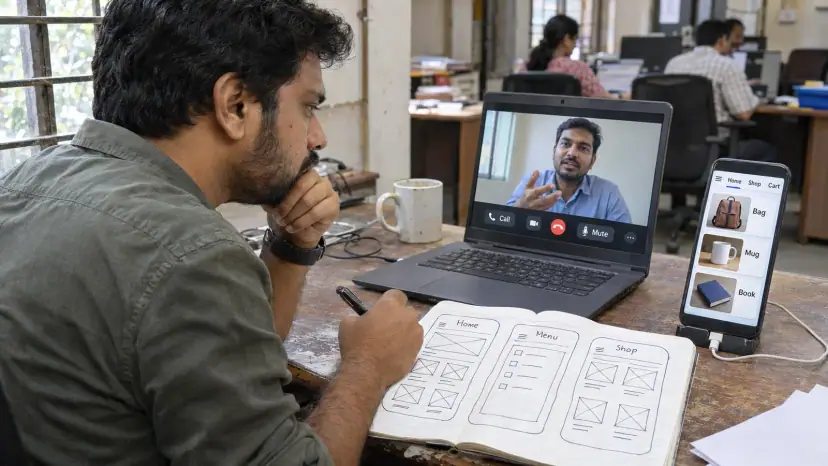
When you hire app developer talent through Brainguru, you get developers who build iOS, Android and cross-platform apps for your business, from the first plan to the app store and beyond. This page explains what an app developer does, how to choose the right setup, what affects cost and how our development process works.
Why hire an app developer?
A mobile app gives customers a faster way to buy, book, track or get support, and gives staff tools that work in the field. But a good app takes more than code. It needs clear planning, careful design, testing on real devices, and updates to keep up with Apple and Google's rules. A skilled developer, or a small team, covers all of this.
In India, Android is where most of your users will be. StatCounter's figures for October 2026 put Android at 94.84% of mobile operating system market share in India and iOS at 5.1%. If you sell abroad, the balance can be very different, so the platform choice should follow where your customers are.
App development services you can hire us for
Custom app development: Apps built around your business goals, users and existing systems. We start by understanding what the app must do for your customers or staff, then plan only the features that serve that purpose.
iOS and Android development: Native apps in Swift for iOS and Kotlin or Java for Android when you need the best performance or deep device features. For more detail, see our Android app development service.
Cross-platform apps: Flutter and React Native let one codebase run on both platforms, which often saves time for business apps. Our cross-platform app development page explains when this fits.
UI and UX design: Wireframes, prototypes and final screens designed so that users can complete tasks quickly. Design is tested with real users before development starts, when changes are cheapest.
Enterprise and business apps: Apps that connect to your CRM, ERP, inventory or HR systems, with secure sign-in and role-based access for different staff.
AI features in apps: Search, recommendations, chat assistants and document scanning built on AI models, added where they solve a real problem for your users.
What app stores require today
Both stores change their rules regularly, and an app that is not kept up to date can be blocked from new users. A developer you hire should know these rules and plan for them.
- Google Play target API level: According to Google's target API level requirement, from 31 August 2026 new apps and app updates must target Android 16 (API level 36) or higher to be submitted to Google Play, with some exceptions for Wear OS, Android TV and other device types. Existing apps must target Android 15 (API level 35) or higher to stay available to new users on newer devices.
- Android developer verification: Google's developer verification page says protections for users installing apps from participating stores began on 30 September 2026 in Brazil, Indonesia, Singapore and Thailand, with a global rollout continuing in 2027. Complete your developer verification early so your apps are not affected as it expands.
- Apple account deletion and privacy: Apple's App Review Guidelines (5.1.1) say that an app that lets people create an account must also let them delete it within the app, and that every app must link to a privacy policy both in App Store Connect and inside the app.
In India, apps that collect personal data also need to plan for the Digital Personal Data Protection Rules, 2025, whose main duties come into force on 13 May 2027: clear notices, security safeguards and a way for users to exercise their rights.
Ways to hire an app developer
There is no single right model. The best one depends on how clear your requirements are and how long the work will last.
- Project-based: A defined scope, timeline and set of deliverables. Good for a first version with clear requirements.
- Dedicated developer or team: Developers who work only on your product, month to month. Good for products that will keep growing. See our dedicated resources options.
- Hourly or time and materials: You pay for the time spent. Good for small changes, support and work whose scope is still unclear.
- Freelancer: Can be cheaper for small jobs, but you take on the work of vetting, managing and replacing them, and there is often no one to review their code.
The app development process
- Requirements and planning: We agree the users, the core tasks the app must handle, the platforms and how success will be measured, then write a roadmap.
- UI and UX design: Wireframes and clickable prototypes, tested with a few real users before code is written.
- Development: Work in short sprints with a demo at the end of each, so you can see progress and change direction early.
- Testing and quality assurance: Functional, performance and security testing on a range of real devices and OS versions. Our mobile app testing team covers this stage.
- Launch: Store listings, screenshots, privacy details and submission to the App Store and Google Play, or rollout in your company's device management system.
- Support and updates: Bug fixes, OS and store updates, analytics review and new features after launch.
Skills to look for when you hire an app developer
- Platform knowledge: Swift and SwiftUI for iOS, Kotlin and Jetpack Compose for Android, or Flutter and React Native for cross-platform work.
- Backend and APIs: Most apps need a server, a database and APIs. Ask who builds and maintains them.
- Security: Secure storage of tokens and personal data, safe handling of payments and protection of API keys.
- Testing habits: Automated tests and testing on real devices, not only on emulators.
- Store experience: Apps they have published, and how they handled rejections from app review.
- Communication: Clear updates, honest estimates and early warning when something will take longer.
Questions to ask before you hire
- Can you show apps you have built that are live in the stores?
- Who owns the source code, the developer accounts and the cloud accounts? (You should.)
- How will you handle store rule changes such as new target API levels?
- How do you test on real devices, and which ones?
- What happens after launch: who fixes bugs, and how quickly?
- How will you protect user data and meet the DPDP Rules?
Common mistakes when building an app
- Too many features in version one: Launch with the few features that matter most, then add more based on real use.
- Skipping design testing: Problems found in a prototype cost far less to fix than problems found after launch.
- No plan for updates: Store rules and operating systems change every year. Budget for maintenance from the start.
- Accounts in the developer's name: Keep app store, cloud and analytics accounts in your company's name.
- Ignoring low-end devices: In India many users have budget Android phones and patchy networks. Test on them.
What affects app development cost?
We share an estimate after a free consultation. The main drivers are the platforms (iOS, Android or both), the number of screens and features, the backend and integrations needed, design complexity, security and compliance requirements, the engagement model, and the support you need after launch. For a deeper look at estimates, read our guide to mobile app development cost for startups.