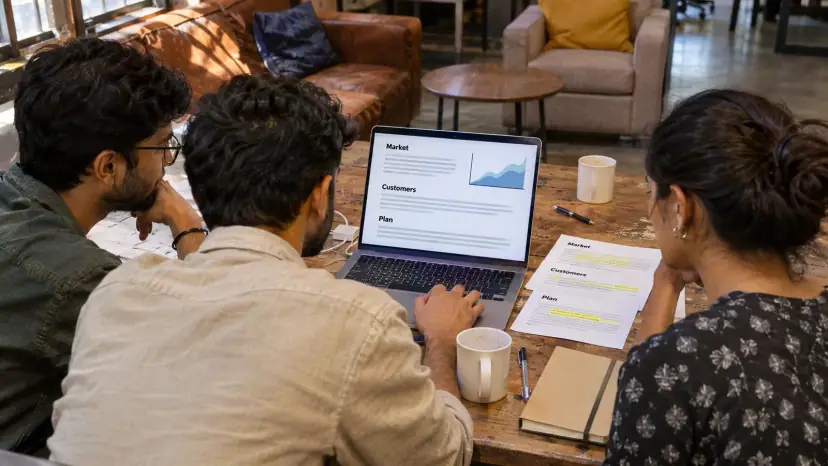
An AI-powered business plan for startups uses AI tools to speed up the research and number work behind a plan: market sizing, competitor tracking, financial scenarios and risk checks. Brainguru combines that speed with analysts who check every source and assumption, so founders get a plan that is quicker to build, easier to update and grounded in evidence.
Why business plans still matter
A business plan is not only for investors. Writing one forces founders to state who the customer is, how the product reaches them, what it costs to win each customer and how long the money lasts. Many weak ideas are caught at that stage, before any code is written.
Competition for attention and funding is real. According to a Government of India release of April 2026, more than 55,200 startups were recognised by DPIIT in financial year 2025-26, up 51.6% on the previous year, and the total crossed 2.23 lakh as of 31 March 2026. A clear, well-supported plan helps yours stand out among them.
Traditional plans have two common weaknesses. Research takes weeks and is out of date by the time the plan is finished, and financial projections rest on a single optimistic path. AI helps with both, as long as a person checks the output.
What goes into an AI-powered business plan for startups
Market analysis
- Market sizing: AI tools gather data from government statistics, industry reports, news and search trends, and produce top-down and bottom-up estimates that analysts then check against the original sources.
- Trend spotting: Language models summarise large volumes of articles, research and discussion to find trends that could affect your market over the next three to five years.
- Customer pain points: AI reads reviews and forum discussions about existing products to find unmet needs your startup could address.
- Geographic opportunity: Demographic and economic data help rank the cities or regions to enter first.
- Demand signals: Search volume and other indicators give an early view of demand for your product category.
Financial projections
Projections are where plans most often go wrong. AI helps ground them:
- Comparable companies: Public information on businesses with similar models and stages informs realistic assumptions.
- Revenue scenarios: Instead of one path, the model shows base, slow and fast cases with different adoption and pricing assumptions.
- Cost benchmarks: Your planned cost structure is compared with typical patterns in your sector to flag assumptions that look too low.
- Unit economics: Different prices, acquisition channels and retention rates are tested to find a workable model.
- Cash flow sensitivity: Thousands of scenarios show which assumptions matter most for your runway, so you can explain your risks clearly.
Competitor intelligence
- Competitor tracking: Websites, job postings, patents, press releases and social media are monitored for changes in strategy.
- Pricing: Public pricing is tracked across products and regions to inform your own position.
- Feature comparison: Product pages, reviews and announcements keep a comparison matrix current.
- Market share estimates: Web traffic, app downloads and social following give rough proxies for relative share, labelled as estimates.
- Gaps: Negative reviews and feature requests across competitors show where you could be different.
Risk assessment
- Market risks: Downturns, regulation, technology shifts and changes in customer behaviour, each rated for likelihood and impact.
- Operational risks: Bottlenecks and failure points seen in similar businesses.
- Regulatory watch: Proposed rules that could affect your model, such as data protection duties under the Digital Personal Data Protection Act, 2023, which start on 13 May 2027.
- Competitive threats: New entrants, substitutes and how incumbents might respond.
Where AI helps and where it does not
Founders are already using AI tools. The Stanford AI Index 2026 reports that generative AI reached 53% population adoption within three years. That makes it easy to produce a plan in an afternoon, and just as easy to produce one full of confident errors.
AI is good at gathering, summarising and calculating. It is poor at knowing whether a statistic is current, whether a source is reliable, or whether your sales team can really close ten deals a month. Language models also invent figures and citations when they lack data. In our process every number in the final plan links back to a source an analyst has opened, and every assumption is written down so you, and an investor, can challenge it.
AI also cannot supply the parts only founders can: why this team, why now, and what you have learned from real customers. Evidence from even a handful of customer conversations is worth more than a large market estimate.
Deliverables
- Business plan document: Executive summary, company description, market and competitor analysis, product, marketing and sales strategy, operations, team, financial projections and funding needs.
- Financial model (Excel): Three to five year projections with scenarios, unit economics and sensitivity tables, with every assumption explained.
- Market research report: Charts, trend analysis, customer segments and opportunity mapping, with sources listed.
- Competitor dossier: Profiles of your key competitors with features, pricing, positioning and an assessment.
- Risk register: Each risk with likelihood, impact, mitigation and the signals to watch.
- Executive summary: A short standalone summary for first investor contact.
- One-page overview: A single-page visual summary for events and introductions.
If you also need a deck, our startup pitch deck development service turns the plan into slides.
What investors look for in the numbers
Funding is available for prepared founders. The same April 2026 government release reports that under the Fund of Funds for Startups, more than Rs. 7,000 crore had been disbursed to over 135 Alternative Investment Funds by the end of FY 2025-26, which had invested more than Rs. 26,900 crore in over 1,420 startups. Under the Startup India Seed Fund Scheme, the entire Rs. 945 crore corpus has been committed to 219 incubators.
Whoever is reading, the same questions come up:
- Customer acquisition cost: How much it costs to win a customer, by channel, with evidence.
- Retention: How long customers stay and how much they spend over that time.
- Runway: How many months the cash lasts in the slow case, not only the base case.
- Use of funds: What the money buys and which milestone it reaches.
- Assumptions: Which numbers are measured and which are guesses.
Our process
1. Discovery: Working sessions with the founding team on vision, business model, positioning and goals. We collect existing documents and data.
2. Research and analysis: AI tools speed up market research, competitor analysis and benchmarking. Analysts review and check each finding.
3. Financial modelling: Our analysts build the model using the checked benchmarks and market data, and present first projections for your review.
4. Drafting: Writers prepare the plan, combining research, projections and your strategic story.
5. Review and refinement: Revisions based on your feedback, then a final quality check. The number of review rounds and the timeline are agreed in the proposal.
What the work can cover
Scope is agreed and quoted after a free consultation. Depending on your stage, the work can cover:
- A first plan: a business plan, a basic financial model and a market overview.
- A fuller plan: a full business plan, a detailed financial model, AI-assisted market analysis and a competitor review.
- Preparing to raise funds: all of the above, with the plan carried into a pitch deck.
Common mistakes in startup business plans
- Top-down market size only: "One percent of a huge market" is not a plan. Show a bottom-up estimate from real customer numbers.
- Hockey-stick revenue with flat costs: Growth needs people, marketing and support. Costs should rise with it.
- No competitor section: Every customer has an alternative today, even if it is a spreadsheet.
- Unchecked AI output: Figures and sources that cannot be traced damage trust quickly.
- Building before validating: Test demand with a small first version. Our guide on how to build an MVP for a startup covers how.