Surat travel and hospitality: getting destination facts right and handing over bookings cleanly
Most mistakes in a travel reply come from mixing things up: your property with the traveller’s destination, or an official page with your own package. Travel and Hospitality teams serving Surat can use this guide to avoid that. It tells you what to collect, which local sources help, what an assistant may do and at what point a person approves the next step. Nothing here reports a Brainguru client result, since these workflows are planning examples. Any service from us is scoped to your actual business, data and permissions.
Your Surat facility and the customer’s destination are different things
Locality and service information comes from the Surat district administration. Treat Surat city, your actual operating facility and a customer’s destination as three separate details. A district resource is good for checking administrative context, but it cannot prove the quality or authenticity of what a business sells.
You can begin with Surat district. It supports administrative context and does not establish market demand, commercial availability or an endorsement of a private business. List the Surat facility and the customer’s destination separately, and then check the location against your approved business record. If the record and the entry differ, a reviewer sorts this out before the page or assistant gives directions, coverage information or an appointment instruction.
A second official page, How to Reach, gives local context for visitors. After reading it, check the operator’s current access arrangements. It tells you nothing about hotel availability, a commercial package or a transfer commitment.
Information to gather before replying to a Surat traveller
Use this list as the working brief for each enquiry, not a city name beside an unrelated national offer. Attach a source and a reviewer to every statement. A gap in the information is logged and given to a person, because the model is not there to assume.
- Property or operator address: Give the facility’s real Surat address, kept apart from the customer’s destination. Your advertising area does not belong in this field.
- Destination and access-information source: Say where your destination and access details came from, so a traveller’s question can be checked against that source.
- Room or package identity and inclusions: Specify which room or package is meant and exactly what it includes. Anything uncertain goes to the reviewer.
- Live availability source: Point to wherever current dates are held. Neither a photograph nor a city name confirms a room or a place is free.
- Traveller request and access needs: Capture what the traveller asked for, their dates and any access needs, and redirect requests that were misrouted.
- Booking-review owner: Make one person responsible for confirming the answer before a next step is offered.
Think of a Surat request as an example. It needs to get through the location check and the destination and access-information check before anyone proposes a commercial next step. When it does not, the problem goes into the handoff as unresolved. Your booking team sees a clear question and not a falsely qualified lead.
Keeping official information and package details apart
A useful reply depends on knowing the real accommodation or operator location, the dates and the current availability. AI is able to organise questions about an approved package or property, and a person confirms before the business commits to a booking. Official destination information has to stay separate from the operator’s commercial inclusions and access instructions. A page that names a city attraction has not shown a hotel partnership, an entry entitlement or an included transfer.
Use only those sources and systems that the business has authorised, such as an approved knowledge pack, the relevant operational system and a CRM or intake route if needed. Each answer should show which source version it came from. Before you use live guest data, run a test of access permissions and of who can change the content. Drafts, predictions and extracted fields are for reviewers to use and are never a commitment to a guest.
Limits on travel and access claims
Please do not make up travel times, permit availability, accessibility features or guaranteed entry. Quote cancellation and refund terms from current material the operator has approved. An itinerary that depends on a permission or a site’s opening arrangements should be rechecked with the operator and the official source before you confirm it.
The Gujarat Tourism site shows a hotel registration form and a registration module for tour guides, operators and similar providers. You can see them on the Gujarat Tourism site. Whether a given registration applies to your operation is a question for you and your adviser. What matters for marketing is narrower: if a page calls a hotel or operator registered or approved, the pack should hold a current document that says so, with the date it was last checked. The tourism site itself does not endorse any private business, and a listing there is not proof of demand.
Gujarati and English, local search and the booking stages
If some of your audience needs Gujarati and English, ask competent speakers to review the terminology, locality names and proposed next step. You and the business can assess these as options. They do not mean every guest uses them or that Brainguru provides every translation. The real address and contact route should be identical on your page and in your records, and made-up offices or profiles should never be used to seem local.
Surat may be where your audience lives but not where the service is delivered, so record the two locations separately. Use the operator’s approved serviceable area when you write pages and route enquiries. Check progress at each stage: destination enquiry → dates/inclusions checked → quote reviewed → booking confirmed → cancellation/completion. Rejected, cancelled and unsupported requests must stay in the evaluation, because a click or a conversation does not bring in money.
Try a closed attraction, sold-out dates, a request for an accessibility feature and an itinerary outside the operator’s area. Compare reviewed results with the business’s own baseline before you put more money in. Mismatched intent in search queries tells you which answer or handoff to fix. Rankings, inclusion in AI answers, lead numbers and return on investment are outside what we can guarantee.
Next steps for Surat operators
You will find the scope of this industry work in Travel & Hospitality solutions. For implementation detail, read AI Consulting for Indian Enterprises (2026): What It Should Actually Deliver. Since it explains a related workflow, it is not evidence that we have a Surat client engagement.
Other Surat planning guides are Restaurants & Food and Entertainment & Media. You can also use Surat and other city guides to compare supported information and official references.
When you ask for a free consultation, have your property or operator address, your destination and access-information source, approved source material and the reviewer who can decide the next step to hand. We deliver from Noida, our documented office, with no Surat branch claimed. Scope, integrations and on-site work are looked at for each business.
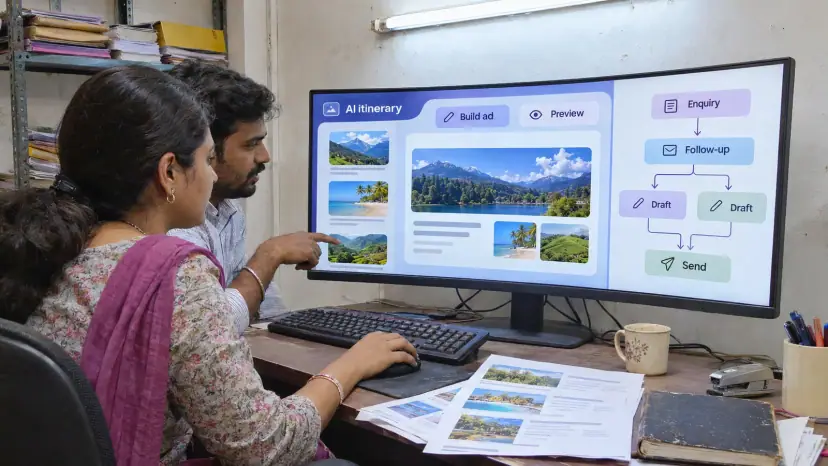
We looked at these resources on 5 October 2026, so check current instructions again before you change a campaign. Photographs show the topic only, and they are not verified pictures of local offices, guests or facilities.