Qualifying demos and proving product activation for Chennai SaaS teams
For a SaaS business, a demo request is only a start, and the proof comes when a user activates the product and completes the task. This guide helps SaaS teams serving Chennai plan for demo qualification and activation evidence. It lays out what to collect, which local source to consult, what an assistant may do and where a person approves the next step. Treat these SaaS workflows as planning examples, which do not report Brainguru client results. Our scope depends on your actual business, data and permissions.
Chennai audiences versus the exact operating address
Administrative and public-service information comes from the Chennai district portal. A Chennai customer audience is one thing, and the exact operating address used for a visit, collection or delivery is another. Check that address's district entry before you direct a customer to an official office.
Use Chennai district for local administrative context, and go no further with it, since it cannot establish market demand, commercial availability or endorsement of a private software company. Put the Chennai operating address and the collection point in different fields, then match them to the approved business record. If they differ, a reviewer must clear that up first; only then can a product page or assistant give directions, coverage information or an appointment instruction.
The Chennai SaaS enquiry brief
A page with a city name beside an unrelated national offer says nothing about your product, so work from these fields. Keep the source and reviewer attached to each product statement. If something is unavailable, log the gap and send it to a person, and do not allow the model to assume a feature exists.
- Supported product use case: Name the task the product supports, and note the Chennai operating address and collection point where relevant, using the real address and not the advertising audience.
- Buyer organisation and intended users: Say which organisation is buying and who will use the product, with limits and the current reference for that offer.
- Integration/data prerequisites: List the integrations and data the use case requires; anything you cannot confirm stays a question for review.
- Approved feature and limitation documentation: Keep the current approved version with the record, because a screenshot, photograph or city name proves no feature.
- Demo/trial request: Note which was requested and what it needs next, and split off requests that are unsupported or misrouted.
- Product or sales-review owner: Identify the product or sales person who can confirm the answer before a next step is offered.
An illustrative Chennai request needs to pass the location check and the buyer organisation and intended users check before anyone suggests a commercial or professional next step. If it fails, it travels as unresolved in the handoff, and your team has a concrete question to answer and no falsely qualified lead on its hands.
Tying search queries to supported product tasks
Good SaaS marketing links a search query to a task the product supports, not to a list of loosely related features. The assistant's part is to fetch the current product guide, work out integration requirements and suggest the right demonstration path. Count a demo request, a completed demo, a trial activation and a paid account as separate events. When the product does not support a requested integration, tell the prospect about that limitation before asking them to start a trial.
Connections are limited to authorised sources and systems: an approved knowledge pack, the relevant operational system and a CRM or intake route where needed. Note the source version behind each product answer. Test access permissions and who can revise the content before you involve live customer data. Reviewers may use a draft, prediction or extracted field as an aid, but none of them counts as an automatic commercial commitment.
Roadmap, logo and adoption claims to leave out
Roadmap items must not appear as released features, and a local customer logo cannot serve as evidence without permission. A city-targeted SaaS page is an audience guide and does not prove a local office, a regional product licence or guaranteed adoption. Billing and cancellation information has to stay in line with the current product terms.
Tamil and English content, listings and activation metrics
If your audience needs Tamil and English, get competent speakers to review product terminology, locality names and the proposed next step. Weigh these options with the business, as they do not claim every customer uses them or that we supply every translation. Your actual address and a consistent contact route should appear across the page and business records, without extra offices or profiles to simulate local presence.
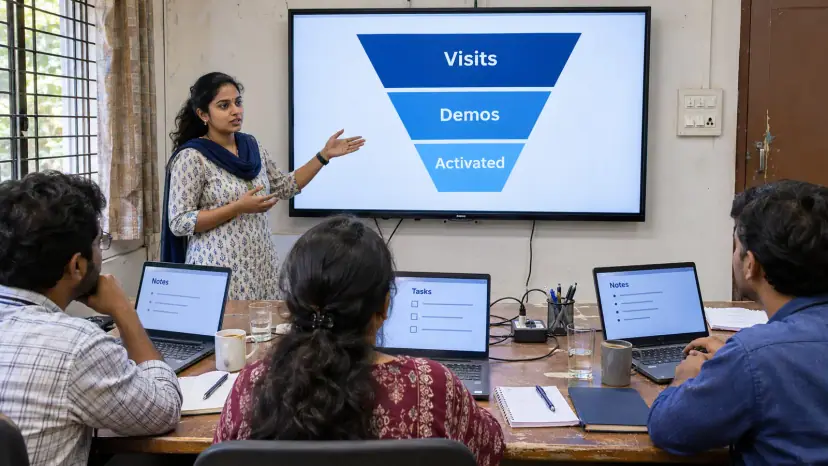
Keep your audience location in Chennai separate from wherever the service is fulfilled. Product page content and enquiry routing should reflect the approved serviceable area. Track each stage independently: use-case enquiry → qualified demo → trial started → target task completed → paid activation. Rejected, cancelled and unsupported requests stay in your evaluation, since a click or conversation is not revenue and neither is an unfinished trial.
Your test set should contain an unsupported integration, a missing prerequisite, a trial that never finishes the task and a cancelled account. Compare the reviewed outcomes with your own baseline before raising spend on acquisition. Read search queries for mismatched intent, then improve the product answer or handoff involved. We give no guarantee of rankings, AI-answer inclusion, lead volume or return on investment for a SaaS product.
One demo request, from enquiry to activation
This is a planning example, not a customer story. A finance manager asks for a demo and mentions that her team needs the product to read exports from the accounting software they already use. The approved feature document lists that integration as unsupported.
The assistant says so plainly and does not offer a workaround it cannot document. It records the use case, the buyer organisation and the number of intended users, and it passes the enquiry to the sales reviewer marked as a prerequisite gap. The reviewer decides between three outcomes: decline, offer a demo of the tasks that are supported, or log the integration as a product request. Whichever happens, the record shows it.
If a demo does go ahead, set the activation task before it starts. For her team it might be one completed reconciliation. A trial that never reaches that task is a separate result from a trial that was never opened, and the two need different follow-ups.
Next reading for Chennai SaaS teams
Industry scope is laid out in SaaS solutions, and SaaS Marketing Services India: From MVP Launch to Scale (2026) gives implementation detail. Because it explains a related workflow, you cannot treat it as evidence of a Chennai client engagement.
Other Chennai planning tasks include Startups and HR & Recruitment. For comparing supported information and official references, there is Chennai and other city guides.
Book a free consultation with your supported product use case, your buyer organisation and intended users, approved source material and the reviewer who can decide the next step. Delivery is handled out of our Noida office, and we make no claim to a Chennai branch. Product scope, integrations and any on-site work are discussed case by case.
Our team checked the local and sector resources on 5 October 2026, so recheck current instructions before making campaign changes. Photographs are illustrative topic images and are not verified photographs of local offices, customers or facilities.