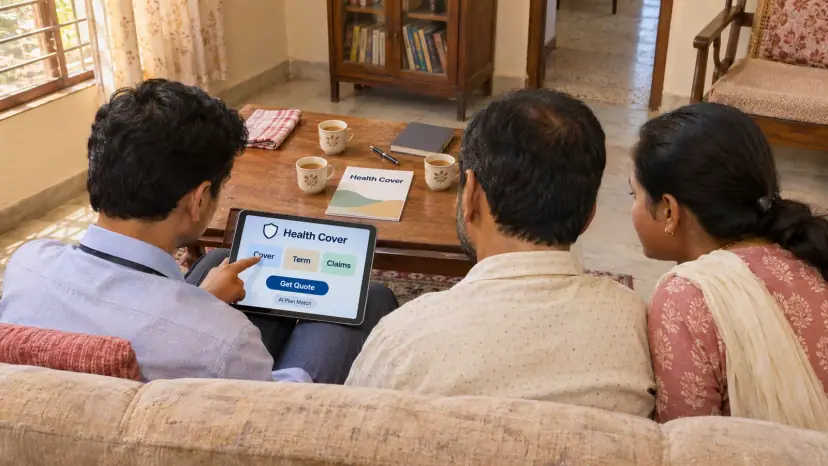
Chandigarh insurance enquiries: work out the route first, score the lead later
A single campaign inbox can hold a prospective buyer, a policyholder who needs renewal help and someone with a claim question. Call all three sales leads and you get poor follow-up and campaign reports that mislead. For Chandigarh insurers and authorised intermediaries, this guide offers a practical routing brief: approved policy education, separate service queues and a documented handoff to the person who can answer.
We scope marketing technology and insurance AI workflows from our Noida office. What follows is an illustrative design. It is not insurance advice, a claim to a local branch or a customer case study. Product recommendations and policy decisions stay with the responsible authorised provider.
Name Chandigarh, Mohali and Panchkula clearly
Chandigarh is a Union Territory, whereas a wider tricity campaign may also reach Mohali in Punjab and Panchkula in Haryana. Hold locality, city and state or Union Territory in separate fields, so an appointment route never gives a false picture of the provider's premises. Chandigarh Administration works as a local administrative reference and does not certify any insurer, policy or private adviser.
Show the provider's real business identity and contact route, and make clear how the audience location differs from where a meeting or service takes place. No Chandigarh keyword should give rise to a made-up branch. Any in-person appointment area you support must come from the provider's approved records.
Four routes in place of a single insurance lead form
- New-policy enquiry: Capture the product category asked about, the preferred contact route and permission for the stated follow-up, and leave suitability and detailed assessment to the authorised team.
- Renewal or policy servicing: Send the person to the insurer's approved service process, because an existing policyholder updating an address is not a new sale.
- Claim question: Give the approved claims contact or authenticated service route, and keep medical records, identity documents and policy attachments off any general marketing form.
- Complaint: Explain the provider's grievance route and link to official escalation information, making sure a message of dissatisfaction never sets off a promotional nurture sequence.
Each queue needs its own owner and its own response content. A good assistant asks what kind of help is needed, retrieves the current approved explanation and passes unresolved questions into the handoff. It has no business collecting a full financial or medical history just to decide which team gets the request.
Tie every policy explanation to an approved document
Each explanation should travel with its insurer, product name, document version and review owner. Put benefits and relevant exclusions side by side, and never let a campaign headline suggest universal coverage. When a question calls for interpretation or the current source is missing, a person answers. The policy document always outranks a generated summary.
For consumer reference, link to IRDAI and its grievance redressal guidance. That guidance describes going to the insurer's grievance mechanism and the official Bima Bharosa route. Leave current eligibility and procedural details with the official source, and do not promise a resolution on a marketing page.
A common mistake is to treat the adviser or agent's licence as something checked once at onboarding. It happens because the check is a form to be filed. Ask the provider who confirms that each intermediary named on a page holds a valid licence, how often, and where the record is kept. The page should stop naming an intermediary when the check lapses.
An illustrative case: a renewal advert draws a claim complaint
Someone replies to a renewal advert asking why a claim was rejected. The campaign source can stay attached for attribution, but the request type moves to complaint or claims support. The assistant gives the approved contact route, offers no unsupported reading of the rejection and keeps the record out of the new-policy sales queue. The accountable team notes the eventual service outcome separately.
Advertising figures depend on this distinction. Count that complaint as a qualified renewal lead and the campaign's performance looks better than it was, while the person's question goes unanswered. A handoff can be a good service outcome without being a sale.
Permission, languages and handing off safely
Agree what permission you capture for each channel and purpose, and give the team a way to honour opt-outs. A service enquiry must not quietly turn into permission for unrelated promotions. Use approved follow-up wording, and ask the provider to confirm before launch how current communication requirements apply.
Hindi, Punjabi and English may be useful options, though audience needs should be assessed first. Competent reviewers check exclusions, product names and service instructions, because a translation that loses a qualification can change what an insurance explanation means. Keep a record of the approved version behind each answer.
Think about a shared phone number. A renewal reminder goes to a number that belongs to a family member of the policyholder, who replies asking to stop messages and mentions a recent death in the family. The assistant must stop the reminders, avoid any sales wording, and hand the case to the servicing team, which knows what the provider requires to update the policy record. The person who replied should receive one short, polite message and nothing else.
Acceptance tests for a Chandigarh insurance enquiry pilot
- An out-of-date policy document is left out or clearly sent for review.
- Someone asking for guaranteed settlement gets no promise of approval.
- A complaint goes to the grievance route and never into a promotional sequence.
- The appointment record keeps a Mohali or Panchkula address accurate.
- Sensitive attachments are pointed to the provider's approved process and kept out of the marketing inbox.
Count correctly routed requests, successful handoffs, unresolved questions and opt-outs next to product enquiries and authorised sales outcomes. The claims document-processing guide deals with a separate back-office task, so do not confuse it with settlement or acquisition.
Who owns each queue, and what to watch first
Four queues need four owners, and they should be named people, not teams. The sales lead owns new-policy enquiries. A servicing manager owns renewals and changes. The claims contact owns claim questions, and the grievance officer owns complaints. When one person covers two queues informally, the faster queue wins and the other one waits, often the complaint, which is the one that most needs a careful reply.
In the first weeks, compare how many messages the assistant sorted into each queue with how many the owners moved afterwards. Frequent moves from sales to complaints would suggest the campaign wording is inviting claim disputes, and the advert should change before any budget does. Write down, before launch, what you would do if one queue filled much faster than expected, such as pausing the advert while the owner clears the backlog. If the owners seldom move anything, the sorting is working and the next question is how fast each queue replies. A queue whose replies come late should be staffed before it is promoted.
Getting a Chandigarh insurance campaign brief ready
Come with the provider's approved product material, queue owners, supported appointment locations, follow-up wording and anonymised examples of mixed enquiries. Marketing strategy helps set the campaign objective, while Chandigarh BFSI planning and Chandigarh healthcare planning cover neighbouring reader tasks.
You can talk through the workflow in a consultation or browse the Chandigarh city-guide directory. Delivery is from our Noida office, and any on-site scope is agreed individually. Photographs are illustrative, and references were reviewed on 12 October 2026.