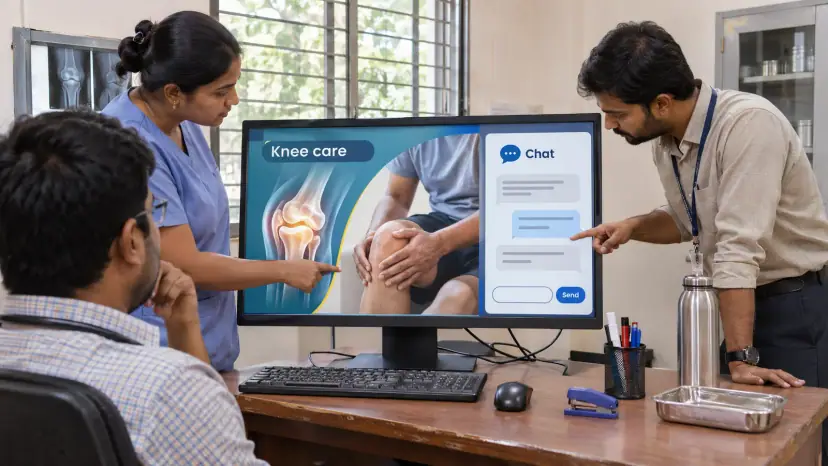
AI marketing for healthcare in Pune, starting at reception
Before a patient travels across Pune district, they want two facts: is the department open, and is there really a slot? AI marketing for healthcare in Pune, in this guide, is the work of getting those facts right, with answers drawn from approved text, a staff check on every request and pages that respect the medical advertising rules.
The examples are for planning. They are not drawn from Brainguru client work and report no results. What we would build depends on your facility, the records it keeps and what it allows a vendor to touch.
What the Pune district portal records
Start with Pune district, the Government of Maharashtra portal for the district, written mainly in Marathi. Its summary panel gives an area of 15,643 sq km, 16 talukas, 3 cantonment boards and two municipal corporations, Pune and Pimpri-Chinchwad by the names in its quick links. It lists Marathi, Hindi and English as the district's languages.
Those figures show why Pune district resources describe an administrative area, not one marketing neighbourhood. Use the portal for administrative context about the area and for nothing more. It says nothing about how many patients want care or which services are on sale, and it endorses no private practice.
The helpline strip on the home page lists an ambulance number, 108, and the disaster management control room on 1077, among other lines. Keep them for reference. The emergency reply your assistant sends should be wording the facility wrote and approved before launch, and the assistant stops once it has sent it. The portal also links to a chatbot for the Collector's office. Whatever that tool covers, a clinic's assistant should be held to a narrow job: administrative answers from approved text, and nothing clinical.
Which town, corporation area and site in Pune district
With two corporations, three cantonment boards and sixteen talukas in one district, "Pune" on its own tells a patient very little. Each enquiry record should name the town, the locality and the operating site, and say whether the site lies within Pune or Pimpri-Chinchwad corporation limits, in a cantonment area or in a taluka outside both. Advertising across the city gives you no basis for an unverified claim that the whole district is covered.
Put the Pune locality, town and operating site on the facility record and hold them against the approved business record. A mismatch is a job for a reviewer. Until it is settled, neither the page nor the assistant gives directions, says which areas are covered or tells anyone where to report for an appointment.
The brief behind a Pune appointment enquiry
A national offer with "Pune" pasted in front of it helps nobody. Build the page and the assistant from the six fields below instead, and keep a note of where each line came from and who approved it. A blank field is flagged to staff; the model never guesses what a clinic or department does.
- Facility address and service hours: The real site, its corporation or cantonment area and its approved hours. Patients act on all three, so all three are checked.
- Approved department/service description: Doctor-approved text for each department, including what it excludes and a last-reviewed date.
- Appointment type and reception contact: Which kind of visit the request is for, and which desk or person deals with it. Unknowns stay blank until someone reviews them.
- Permitted public information source: The dated document each public line rests on. A photograph of Shaniwar Wada or the word "Pune" is not a source.
- Non-clinical enquiry category: An administrative label such as hours, directions or booking. Anything clinical, or sent to the wrong place, is taken out of this queue.
- Staff escalation owner: The person who picks up whatever the assistant cannot handle and decides what happens next.
Two checks run first on every Pune request: is this the right site, and does the approved description cover what is being asked? Only then is a next step offered. If either check fails, the handoff says so plainly, and reception gets a single question to answer rather than an enquiry that looks qualified but is not.
A late-evening message from a parent
This is an illustration, not a real case. A parent writes to the clinic's page after closing time. They ask whether a children's doctor can see their son tomorrow, and mention that he has had a fever for two days.
The assistant may give the approved hours and the way to reach reception. It may not judge whether the child can wait, and it does not offer a slot. It tags the message as an appointment request that mentions a symptom and holds it for the front-desk lead. The parent is told that a staff member will reply when reception opens, and is given the facility's approved emergency wording in case things get worse. Next morning the lead checks the live schedule, confirms or declines, and records the outcome against the same enquiry.
What the appointment assistant may and may not do
The assistant's job is narrow: approved answers on opening hours, how appointments are arranged and how to reach the desk. It logs a request but never calls it a booking, because only a staff member who has looked at the live schedule can confirm one. A message that mentions symptoms or an emergency gets no guesswork about causes and no marketing follow-up. The front-desk knowledge pack and patients' clinical records are kept apart, and medical details the care team needs move through the facility's secure clinical channel.
Give the assistant access to three things at most: the approved knowledge pack, the booking system, and a CRM or intake route if the facility already runs one. Store, with each answer, the version of the pack it came from. Try out reading and editing rights on dummy records before a real patient's details are involved. Drafts, predictions and extracted fields are aids for the reviewer, and none of them commits the facility to anything. Our page on AI chatbot development explains how such an assistant is built and connected.
Settle ownership early. One workable split: the front-desk lead owns the timetable and the confirmation step, a named doctor or the facility owner signs off public wording, and whoever runs the website owns page changes. One failure to guard against is a change in OPD timings that reaches the notice board but not the knowledge pack, so the assistant keeps quoting old hours. Make updating the pack part of the same task as changing the timetable. If you send appointment reminders by SMS or voice, as our voice and SMS campaign page describes, they draw on the same timetable and carry no promotion.
Visiting hours, referrals and records in the NMC code
Doctors' publicity and the soliciting of patients both have limits. The doctor responsible for a facility should read each proposed public line against the professional rules, starting with the Code of Medical Ethics Regulations, 2002 , as hosted by the NMC, and decide whether it can go out. That page carries the code as amended up to 8 October 2016; read it again before you publish.
Two parts of the code fit a Pune appointment desk. Regulation 2.1.1 asks a physician to make visits at the hour indicated to patients, and allows a physician to refer a patient elsewhere when the ailment is outside the physician's range of experience, while in an emergency the physician must treat. So the hours a page or assistant gives must be the hours the doctor keeps, and a decision to send a patient to someone else is the doctor's, never the assistant's. Regulation 1.3.4 asks that efforts be made to computerize medical records for quick retrieval. Chat logs are not those records, and the assistant should not become a back door into them.
A Pune clinic hoping the code spells out a rule on testimonials or rankings will be disappointed: neither word is in it. What it has instead is regulation 6.1.1, which calls soliciting patients, directly or indirectly, unethical and forbids a physician to boast of cases, operations, cures or remedies, or to allow reports of them to appear in print. That is reason enough to put review widgets, star ratings and any "top clinic in Pune" banner to the responsible doctor as a question first. The ground this guide covers is a Pune facility's permitted public information and the work of its front desk; drawing in patients by any means is not part of it.
Marathi, Hindi and English on Pune pages
Marathi, Hindi and English are the three languages the district portal names. If the facility serves patients in Marathi or Hindi as well as English, have a fluent speaker check each version for medical terms, place names and the next step it offers. Which versions to run is the facility's decision. Running a version in a language is not a claim that all patients read it, and Brainguru is not offering to translate everything. One true address and one contact route should appear everywhere, on the page and in business listings; extra offices or profiles in Pimpri-Chinchwad or anywhere else, created to look local, are not acceptable.
Search, appointment stages and testing
A search made in one part of the district may be about a site in another, so record the searcher's area and the site separately, and let the facility's approved service area decide what the page promises and where a request is sent. Then follow each request from the moment it arrives, through the staff check and the yes or no, to whether the patient turned up. Keep the declined, cancelled and unsupported ones in the totals, because a chat is not income.
Run four awkward cases before going live: the OPD you list is closed for the day; the slot requested has been booked by someone else; the sender wants to know what is wrong with them; and an X-ray report arrives as an attachment. Hold the reviewed results against the facility's own earlier figures before spending more, and treat search terms that bring the wrong patients as a sign that an answer or handoff needs work. Rankings, a place in AI answers, a number of enquiries and a return on spend are not things we promise.
Enquiry details and the DPDP Rules
The parent's message above already holds a name, a mobile number and a child's age. Collect only what reception needs, and tell the person what each detail is for. The DPDP Rules, 2025 are dated 13 November 2025 in the Gazette, and rule 1(4) defers most Data Fiduciary duties to 13 May 2027, a gap of eighteen months. Rule 3 falls in that group. The notice must make sense on its own, give an itemised description of the personal data and the purpose in clear and plain language, and explain how the person can withdraw consent as easily as it was given, use their rights and complain to the Data Protection Board. A short notice beside the booking form is a sensible place to start.
Further reading for Pune healthcare teams
For what the service covers across the sector, see AI Marketing for Healthcare. For a worked method, Pune teams can consult AI Marketing for Healthcare in India: A DPDP-Aware Playbook for Hospitals and Clinics; that piece sets out an approach, not a Pune project of ours.
If your planning reaches beyond healthcare, see AI Marketing for Insurance in Pune as well as AI Marketing for HR and Recruitment in Pune. The official pages behind each city guide are listed in Pune and other city guides.
To get the most from a free consultation, arrive with the site address and its corporation or cantonment area, the hours, the doctor-approved department wording, the documents behind it and the name of whoever signs off. Pune projects are handled from our Noida office: we have no Pune branch and do not pretend to have one. What the work covers, which systems it touches and whether anyone needs to visit are worked out facility by facility.
Source check: first done on 5 October 2026, repeated on 5 November 2026. Rules and portal pages change, so look again before you alter anything a patient will read. Pictures here are there to illustrate the subject; do not read them as photographs of an actual office, patient or facility in Pune.