Starting AI marketing for healthcare in Patna with the appointment point
AI marketing for healthcare in Patna should start with one practical question: where, and when, will this patient actually be seen? This guide sets out the details reception needs, the district pages worth checking, the narrow job an assistant can do and the point where a member of staff takes over the next step.
The workflows below are planning examples. They report no Brainguru client results, and any project is scoped to the provider's own situation, data and permissions. Nothing here is medical advice, and the doctor responsible for a facility decides what its public pages say.
Patna district facts that change how a facility page reads
According to the Patna district portal, Patna is Bihar's capital and lies on the Ganga's south bank. It lists 6 sub-divisions and 23 blocks, and a citizen's call centre on 155300. In a district that size, someone searching for "Patna" may live a long way from the facility, so a page should name the real appointment point and never suggest that it serves the whole district.
The portal's menus carry district information and service directories, among them a telephone directory, helplines and public utilities. That is administrative context and nothing more. A facility page should not cite the portal as proof of demand for care, of commercial availability or of approval for any private provider.
The portal's Hospital page is a second local reference. When we reopened it on 3 November 2026 it listed two government hospitals: Nalanda Medical College and Hospital on Kankarbagh Main Road, and Patna Medical College Hospital (PMCH) on Ashok Rajpath. It is a public list, not a ranking or a booking system, and it certifies nothing about any clinician's advertising. Use it to check how road names and landmarks are spelt, then take hours and contacts only from the provider's approved reception record.
What reception records for each Patna enquiry
Nobody books an appointment because a national offer has the word Patna pasted on it. The record below is what reception actually works from. Each line carries its source and the name of whoever checked it, and a blank stays blank until staff fill it, because the model must not guess.
- Facility address and service hours: Give the street address, say whether it is in Patna city or elsewhere in the district, and list the hours that appointment point keeps.
- Approved department or service description: Paste in the department text the responsible doctor signed off, the limits of that service and when someone last confirmed it.
- Appointment type and reception contact: Record the kind of appointment being sought and the reception contact who handles that kind. Gaps go to review.
- Permitted public information source: Attach the approved document behind each public line, with its current version. A photograph of the building does not make information permitted.
- Non-clinical enquiry category: Classify the request as administrative, note the step it asks for and what reception needs to answer it, and flag for staff anything clinical or sent to the wrong desk.
- Staff escalation owner: Name which staff member checks the reply before any next step reaches the patient.
Take an illustrative case. A message asks whether a clinic "near PMCH" can see someone on Saturday. The assistant cannot assume which site that means. It logs the landmark, the day and the department, marks the location check as unresolved and hands reception a specific question, so staff never inherit a lead that only looks qualified.
Questions the assistant may answer, and where it stops
Opening hours, how appointments are arranged and how to reach reception are fair questions for an assistant working from approved answers. A request is still only a request: a staff member checks the live schedule before any slot is confirmed, and the assistant says so plainly. Symptoms or an emergency in a message change the rules: no attempt at diagnosis, and no promotional sequence. The assistant replies with the provider's approved emergency wording, then flags the message for a person straight away.
Nothing the provider has not cleared gets linked. In practice the authorised list is an approved knowledge pack, the operational system the answers rely on and, if reception wants one, a CRM or intake route. Log which version of a source each reply used, and test access permissions and editing rights before live patient data is involved. Drafts, predictions and extracted fields help the reviewer; none of them is a commitment to the patient. If you are weighing up a chat assistant for this, our AI chatbot development page explains how such projects are scoped.
Enquiry forms and the DPDP Rules
Before go-live, check what the enquiry form tells a patient about how a phone number will be used and who sees it, since personal data gathered by a form falls under the Digital Personal Data Protection Act, 2023. Ask only for what reception needs to reply: a name, a contact number and the department. Keep symptoms out of free-text boxes where you can, decide how long enquiry records are kept, and name the person who answers when a patient asks what was stored.
Rule 1(4) of the DPDP Rules, 2025 (Gazette, 13 November 2025) holds back the main Data Fiduciary duties for eighteen months, until 13 May 2027. Among them are the notice to the person under rule 3, security safeguards under rule 6 and breach intimation under rule 7. A Patna clinic that builds its form now can set out, in simple terms, why each detail is asked for and how a patient can have it corrected or withdrawn, well before that date.
What the NMC code lets a Patna facility publish
The rules here bite on two things: how a doctor or facility advertises, and any attempt to solicit patients. Every proposed public line for a Patna facility goes to the responsible provider, who weighs it against the applicable professional rules and the NMC ethics resources. The page used here, hosted by the NMC, is the Code of Medical Ethics Regulations, 2002, an independent reference on medical ethics for registered practitioners.
Under Regulation 6.1.1, a physician may not solicit patients, directly or indirectly, and may not boast about cases, operations, cures or remedies. Two other regulations are more useful to a marketing team, because they describe what may be shown:
- Institution advertisements: A nursing home, private hospital or other institution run by a physician may, under Regulation 7.12, place a lay-press advertisement, but only with its name, the kind of patients it admits, its training and facilities, and its fees.
- Registration number: Regulation 1.4.1 asks every physician to display the registration number given by the State Medical Council or the Medical Council of India in the clinic and on prescriptions, certificates and money receipts.
The regulations do not mention patient testimonials or doctor rankings by name. Whether a review widget, a "most trusted in Patna" banner or a ranked list of doctors fits within them is a question for the responsible doctor, and the safe default is a page that keeps to the details regulation 7.12 lists. Our work here stays with permitted information and administrative help; unrestricted patient acquisition is outside it.
Hindi, Magahi and English checks before each appointment
The district portal lists Hindi and Magahi as the district's languages. Where patients need Hindi and English, or Magahi, a fluent speaker of each should read the terminology, the locality names and the next step before anything is published. Which languages matter is for the provider to judge with us; we do not assume every patient uses them, and we do not claim to translate everything ourselves.
The page, the local search listing and the business record should share one real address and one contact route, and nobody should add offices or profiles to simulate a wider presence. Patients searching in Patna may be seen somewhere else, so keep the patient's location apart from the place of care and route enquiries by the provider's approved serviceable area.
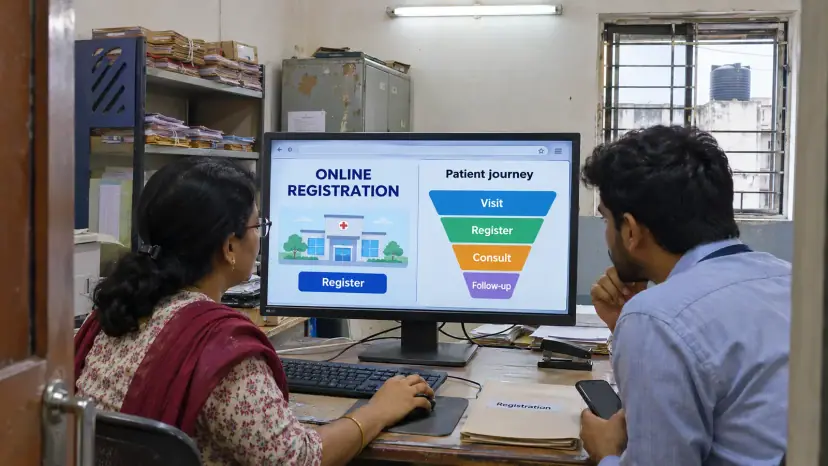
Follow each stage on its own: appointment requested, staff checked, confirmed or declined, then attended or cancelled. Rejected and unsupported requests belong in the count, because a click or a chat is not a patient seen. Before launch, test a closed department, a full schedule, a message asking for a diagnosis and a request with medical records attached. Do not raise spending until reviewed results beat the provider's own baseline. Nobody on our team promises search rankings, mentions in AI answers, enquiry numbers or returns.
Where Patna providers can read next
The scope of our healthcare work is set out on AI Marketing for Healthcare, and the article AI Marketing for Healthcare in India: A DPDP-Aware Playbook for Hospitals and Clinics walks through implementation in more depth. Read it as a description of a related workflow; it is not evidence of a Patna client engagement.
Two other Patna planning tasks have guides of their own: AI Marketing for Insurance in Patna and AI Marketing for HR and Recruitment in Patna. Patna and other city guides show the official references used for each city.
For a free consultation, bring the address and hours of each appointment point, the department wording your doctor approved, the sources behind it and the reviewer who decides the next step. Clinic and hospital projects run from our Noida office, and we claim no Patna branch. How far integrations go is settled separately for each provider.
We first checked these local and sector references on 5 October 2026 and reopened each one on 3 November 2026; read them again before a campaign is altered. The images on this page illustrate the topic only, and none shows a Patna office, patient or facility.