The front desk job behind AI marketing for healthcare in Mumbai
A Mumbai caller may need just three facts: the timing, the address and whether a slot is free. AI marketing for healthcare in Mumbai should get those right and leave every booking decision with staff. This guide covers what to record, which official portal to use, how far an assistant may go and who approves the next step.
Read every workflow as a planning example; none reports a Brainguru client result. Services are scoped around the actual practice, its data and its permissions, and the responsible doctor signs off anything published.
Mumbai City, the suburbs or the wider region?
The Mumbai City district runs its own administration. Its portal does not cover every place that is marketed under the Mumbai Metropolitan Region name. Before a civic contact or property record goes into a Mumbai campaign, work out the real suburb or district.
For that, go to the Mumbai City district portal, run by the Mumbai City district administration of the Government of Maharashtra. Its home page is in Marathi. It notes that the city was officially Bombay until 1951, gives the district's area as 157 sq km with one municipal corporation, and its notices refer to revenue divisions such as Parel-Sewri, Malabar Hill and Girgaon. It also lists the citizens' call centre, 155300, and the Aaple Sarkar Seva Kendra centres. Treat all of this as administrative background: it says nothing about how many patients want a service or what is offered commercially, and no private practice carries its endorsement.
State whether the facility address is in Mumbai City, the suburbs or the wider metropolitan area, then compare that answer with the approved business record. A practice in a western suburb, for example, should not borrow a Mumbai City civic contact. If the two records disagree, a reviewer decides which is right before the page or assistant offers directions or an appointment instruction.
Setting up the brief for a Mumbai facility
A national offer with "Mumbai" pasted next to it does nothing for a patient. Build the brief below instead, with a source and a reviewer behind every statement. If a detail is missing, say so in the record and send it to a person, because a model must not assume anything about a practice.
- Facility address and service hours: Give the street address, stating whether it is Mumbai City, suburban or wider metropolitan, along with the hours approved for that branch.
- Approved department or service description: Copy the approved description of the department or service with its limits, word for word; do not paraphrase what the provider has cleared.
- Appointment type and reception contact: Write down which type of appointment the patient wants and which reception contact at that branch deals with it.
- Permitted public information source: Hold the current approved source for each public statement; a picture of the building proves very little.
- Non-clinical enquiry category: File the query under an administrative category, and direct anything clinical away from this flow.
- Staff escalation owner: Identify who on the staff steps in when a question goes beyond reception information, and who covers weekends.
Here is a planning example. A message arrives at nine on a Saturday night asking whether a named specialist sees patients on Sundays at the suburban branch. The assistant must not guess from last month's page. It records the branch, the day asked and the specialist's name, tells the sender that reception will confirm during opening hours, and places the case in a Monday queue with the source version attached. The reception lead owns that queue and clears weekend items before new calls; if nobody owns it, the patient may wait for days and book elsewhere.
Hours and arrangements for the assistant, clinical matters for the care team
Within approved answers, the assistant can cover opening hours, how appointments work and how to contact reception. A request and a confirmed slot are different things, and only staff, looking at the live schedule, can turn one into the other. A message about symptoms or an emergency never becomes a promotional sequence or an attempted diagnosis; it gets the provider's approved emergency wording and goes straight to a person.
The business decides what gets connected, and we link nothing else: an approved knowledge pack, the relevant operational system and possibly a CRM or intake route. Clinical records never sit in the reception tool; when the care team needs medical details, they move through a secure channel the provider has approved. Save the source version behind each answer, and test permissions and editing rights before live patient data is used. A draft or a prediction can speed up a reviewer, but it never commits the practice to anything.
Agents, registration numbers and the NMC code
For doctors, self-promotion and the soliciting of patients both fall under the code's restrictions. Each proposed public line goes to the responsible provider, who checks it against the professional rules in force, starting with the NMC ethics resources. For an independent reference, the National Medical Commission hosts the Code of Medical Ethics Regulations, 2002; confirm the current text before each campaign.
Two regulations matter for a multi-branch Mumbai practice that buys leads or lists named doctors:
- No touts or agents: Under regulation 7.19, a physician may not procure patients through touts or agents. Any paid lead scheme, referral partner or listing that is paid per patient brought in should go to the responsible doctor before it starts.
- Registration number: Regulation 1.4.1 wants the registration number from the State Medical Council or the Medical Council of India on show in the clinic and printed on every prescription, certificate and money receipt. Ask the responsible doctor whether the specialist's profile page should show it as well.
You will not find the words testimonial or ranking in the code, but it forbids boasting of cases, operations, cures or remedies. One mistake to avoid is drafting titles and descriptions from competitor wording, which quietly brings in words such as best or top-ranked. Keep a list of words the practice will not use, and have the responsible doctor read every title and snippet. Everything here concerns permitted information and reception support, not unrestricted patient acquisition.
Saturday-night messages and data duties
The Saturday message in the example holds a name, a phone number and perhaps a hint of a condition. Collect no more than reception needs for the Monday call-back, say in plain words why the details are needed, and offer a way to have them corrected or withdrawn.
Mumbai practices can date the DPDP Rules, 2025 from their Gazette issue of 13 November 2025. Rule 1(4) starts the main Data Fiduciary duties eighteen months later, on 13 May 2027, among them the notice, security safeguards and breach intimation. A Mumbai practice with several branches should decide now who owns the enquiry log at each one.
Marathi, Hindi and English, search and sensible measures
If the practice serves people who read Marathi, Hindi or English, ask a fluent reviewer in each language to check the medical terms, how localities are spelled and the next step offered. Which of them a practice needs is for the provider to decide with us; listing them is no claim that every patient uses them or that Brainguru provides every translation. Keep one real address and one contact route across the page, the local search listings and the business records, and never fabricate offices or profiles to seem local.
Patients searching from one part of Mumbai may be served at another, so log the audience location and the branch location as two fields. Log four stages as separate fields: requested, checked by staff, confirmed or declined, and attended or cancelled. Declined and unsupported requests still count in the evaluation, since a chat is not revenue. Test a closed department, a full Sunday, a diagnosis request and a message with records, and compare reviewed outcomes with the provider's own baseline before raising spend. We make no promise of a ranking, AI-answer inclusion, leads or a return on investment.
In the first weeks, read the unresolved and declined requests before the confirmed ones. If one reason keeps appearing, such as a wrong branch or an old hours entry, fix the source record before touching any copy. If most unresolved cases come through one channel, change that channel's route first.
Further material and what to prepare
What our healthcare work covers, sector-wide, is on the AI Marketing for Healthcare page. Implementation is the subject of AI Marketing for Healthcare in India: A DPDP-Aware Playbook for Hospitals and Clinics; written as general guidance, that piece discusses a related workflow and is not proof of a Mumbai client engagement. Practices weighing a weekend chat assistant can read how AI chatbot development is scoped.
Mumbai planning also extends to AI Marketing for Insurance in Mumbai and AI Marketing for HR and Recruitment in Mumbai. The directory of Mumbai and other city guides is there if you want to weigh up the official references behind each city.
To prepare for a free consultation, gather each branch's address and hours, the approved department text, your source material and the reviewer who decides the next step. Delivery happens from our Noida office, and there is no Mumbai branch to claim. Integrations are agreed branch by branch.
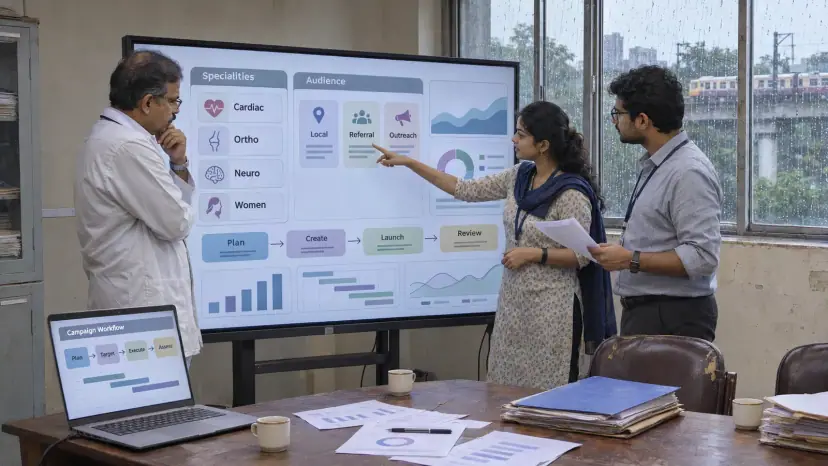
We first read these resources on 5 October 2026. On 3 November 2026 we opened them again, and the district portal then showed a last update of 2 November 2026; look at them again before any campaign change. None of the photographs is a verified image of a Mumbai office, patient or facility; they are there to illustrate.