AI marketing for healthcare in Chennai: one address, one checked answer
A patient who asks about an appointment needs a correct answer and a staff member who has checked it. AI marketing for healthcare in Chennai, as this guide treats it, means approved answers on hours and booking, a clear line between a clinic and a sample collection point, and pages that keep within the medical advertising rules.
Each example that follows is a planning aid; Brainguru client results are not what it reports. Scoping is based on your actual organisation, its data and the permissions it grants.
What the Chennai district portal records
Consult Chennai district first. The Government of Tamil Nadu portal, available in Tamil and English, calls Chennai the capital city of the state and lists Tamil and English as the district's languages. Its administrative panel shows an area of 426 sq km, 3 revenue divisions, 16 taluks and 122 revenue villages, one corporation with 15 zones and 200 wards, and 16 assembly and 3 Lok Sabha constituencies.
Those figures give local administrative context. They cannot establish market demand or commercial availability, and the portal does not act as an endorsement of a private provider. Your Chennai audience and the exact address used for a visit or a sample collection are different things, so keep them apart. Hold the operating address and any collection point as distinct details, note the zone and taluk for each, and match them with the approved business record. Any difference goes to a reviewer, and the page and assistant give no directions, coverage information or appointment instruction until it is resolved.
The helpline panel lists the State Control Room on 1070, the Collectorate Control Room on 1077, police on 100, fire and rescue on 101 and an accident help line on 108. The assistant's emergency reply should still be the provider's approved instruction, written in advance; the portal's list is for reference.
A hospital list that marks government and private entries
Another local reference is Hospitals. Use it for administrative checks such as a road name or a pincode, and take reception details from the provider's own approved record. It runs to three pages, showed a last update of 3 November 2026 when we read it on 5 November 2026, and gives each entry an address, a phone number and usually a category. Government entries include the Government General Hospital on Poonamallee High Road, Park Town, the Govt Kasturba Hospital for Women in Triplicane and the Govt Multi Super Speciality Hospital at the Omandurar Govt. Estate.
The category column is what matters here. It shows that an official list separates public from private facilities, and your own pages should be just as plain about what kind of facility you are. Being on the list says nothing about free slots, places no facility above another and approves nobody's advertising. The portal's news also carries a schedule of voluntary blood donation camps run by the Chennai District Govt Blood bank; a private facility should not present such public programmes as its own.
What reception and marketing should record for a Chennai enquiry
Replace the habit of putting a city name beside a national offer with these fields. Each statement stays linked to its source and reviewer, and a missing detail is referred to a person, never assumed by a model.
- Facility address and service hours: Enter the Chennai operating address with its zone and taluk, any collection point, and the hours the provider has approved.
- Approved department or service description: the department text the doctor approved, its limits, and any document a patient must bring if the description says so.
- Appointment type and reception contact: Note whether it is a first visit, a review or a test, and which reception desk owns it; anything unsure is left for review.
- Permitted public information source: the dated, approved document behind every public line. A photograph of Marina Beach or the city's name is not one.
- Non-clinical enquiry category: Class the enquiry as non-clinical, note the next step requested and separate clinical or misrouted messages.
- Staff escalation owner: Name the desk member who picks up anything the assistant cannot handle and approves the reply before the patient sees it.
One enquiry followed from first message to handover
This is a planning example, not a record of a real patient. A woman messages in Tamil on a Friday evening. She asks whether her father can see a physician on Saturday and whether he needs a referral letter first.
The assistant sorts this as an appointment request. It quotes Saturday hours only if the approved record carries them, and says nothing about a referral unless the department's approved description covers it. It tells her reception will confirm, then passes the message to the named escalation owner with two open points: Saturday availability and the referral rule. When the desk opens, reception checks the live schedule, replies and records whether the slot was confirmed, declined or never answered. If the referral question keeps returning, the gap is in the approved description, and the reviewer fixes the source rather than letting the assistant guess.
Keeping the appointment assistant out of clinical territory
Within its reach are approved questions on opening hours, how appointments work and contacting reception. A request is logged and stays unconfirmed until a staff member has checked the live schedule. Symptoms in a message mean no guessing at causes and no marketing follow-up. An emergency in a message means the approved emergency wording goes out straight away, and the assistant hands over without adding anything.
Connections are limited to sources and systems the provider has authorised, such as the vetted answer sheet, the diary system and any CRM or intake route already in use. Front-desk data is kept separate from clinical records, and any medical information the care team needs goes through a secure clinical channel. Each reply should carry a note of the source version it drew on, and reading and editing rights are tried out on test data before a real patient's details arrive. If you are weighing what such a build involves, our page on what drives AI chatbot development cost explains the factors involved, and AI chatbot tools for business compares common options.
Attendants, consent and the NMC code
Restrictions apply to doctors' publicity and to the solicitation of patients. Nothing is published until the responsible provider has held it up against the professional rules in force, with the NMC ethics resources on that list. The Code of Medical Ethics Regulations, 2002, as published by the National Medical Commission, is the independent sector reference: read its current text, and ask the responsible professional how it applies to what you plan.
Two regulations suit a Chennai front desk. Regulation 1.6 says a physician shall not employ an attendant who is neither registered nor enlisted under the Medical Acts in force to attend, treat or operate on patients where professional skill is needed. A chat assistant, a coordinator or a call agent therefore gives administrative answers only, never advice that needs a clinician. Regulation 7.16 asks for written consent before an operation, from the patient or, as the case may be, a spouse, parent or guardian. A booking made through a chat is not that consent, and the page should never suggest it is.
Search the code for 'testimonial' or 'ranking' and nothing comes up. What regulation 6.1.1 does rule out is any boast about cases, operations, cures or remedies, and it calls the soliciting of patients unethical, so testimonial carousels, ratings and "leading hospital in Chennai" lines go to the responsible doctor as questions. The ground covered here is what a facility may say in public and how its desk is supported, and nothing beyond that.
Tamil and English, local search and the stages to measure
The portal gives Tamil and English as the district's languages. Where patients need Tamil and English, fluent reviewers should read both versions for terms, place names and the next step offered. The provider decides which to offer; offering them is not a statement about every patient, and we do not undertake every translation ourselves. The page and business records must show the actual address and one consistent contact route, with no extra clinic offices or profiles added in other zones to appear local.
Keep where the Chennai audience is separate from where the service is delivered, and let the approved service area govern page content and routing. Give each stage its own count: the request, the desk's check, the confirmation or refusal, and whether the patient came. Rejected, cancelled and unsupported requests stay in, because a message thread is not revenue.
Five test cases belong before launch: a department that is closed, a slot already filled, a request for a diagnosis, a referral-letter question and a message carrying medical records. Compare reviewed outcomes with the business's own baseline before raising spend, and use mismatched search intent to find the answer or handoff that needs work. No clinic gets a promise from us about ranking, AI-answer inclusion, lead volume or return on investment.
Enquiry data and the DPDP Rules
A Friday-evening message can hold a name, a phone number and a parent's age. Take only the fields reception works with, give each a one-line reason, and offer a clear route to correct or withdraw them. Under the DPDP Rules, 2025, which were notified on 13 November 2025, rule 1(4) brings most Data Fiduciary duties into force on 13 May 2027. Rule 10, on verifiable consent for children's data, is among them, so plan now how the desk handles a booking made for a child.
Next steps for Chennai healthcare teams
For the industry-wide scope, open AI Marketing for Healthcare. A related workflow is set out step by step in AI Marketing for Healthcare in India: A DPDP-Aware Playbook for Hospitals and Clinics; it is about method, and no Chennai client engagement lies behind it.
Two Chennai guides cover nearby ground: AI Marketing for Insurance in Chennai and AI Marketing for HR and Recruitment in Chennai. The Chennai and other city guides index records the official sources behind each city page.
A free consultation goes best when you have the facility address with its zone, any collection point, the hours and department text as approved, the documents they come from and the person who signs off next steps. Delivery is from our Noida office, with no Chennai branch, and we would not pretend otherwise. How far the work goes, which systems it touches and whether anyone visits are settled for each facility separately.
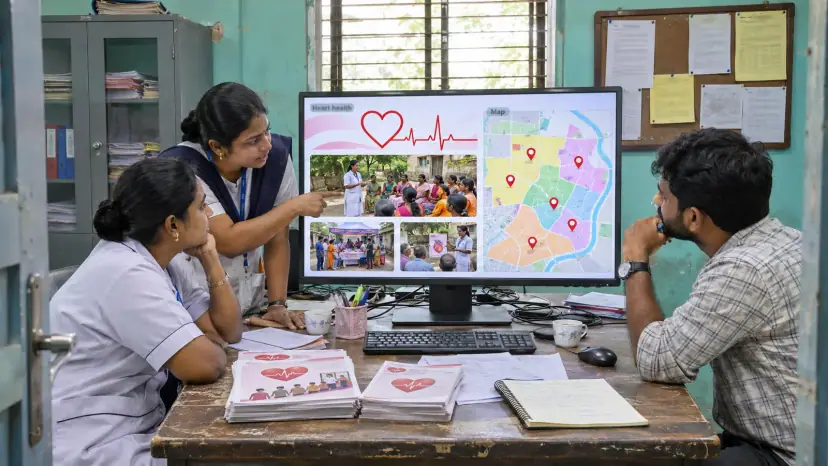
Chennai and sector sources: read 5 October 2026, reread 5 November 2026. Look at current instructions before changing a campaign. Photographs on this page are general illustrations, not pictures of local offices, patients or facilities.