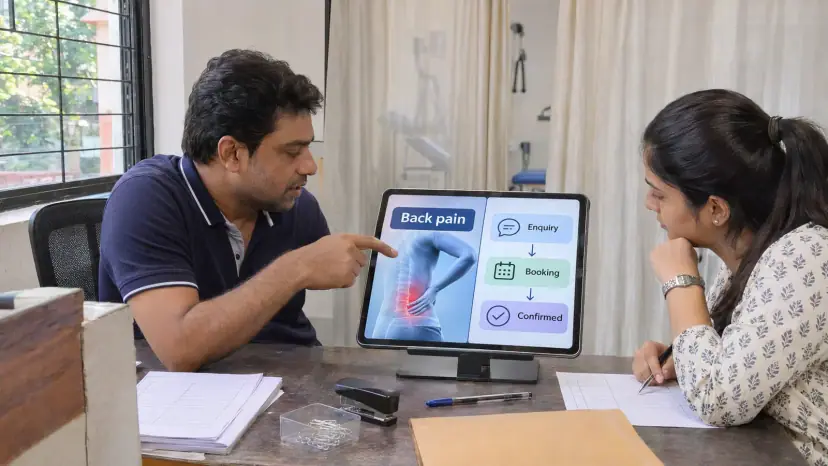
A practical start to AI marketing for healthcare in Bhubaneswar
People who contact a Bhubaneswar clinic usually want two answers: when is it open, and how do I book? AI marketing for healthcare in Bhubaneswar should make those answers accurate and keep staff in charge of every booking. Below are the fields to record, the official profile to check, the assistant's limits and the moment a person approves.
The examples are for planning and report no Brainguru client results. Services are scoped to your facility, its data and its permissions, and the doctor in charge decides what the public sees.
The city address and Khordha district are separate records
The official profile of the Bhubaneswar Municipal Corporation places the city in Khordha district. Keep the operating address in the city apart from the wider district, and do not let an audience across Odisha suggest that a single site covers the state.
Refer to the Bhubaneswar Municipal Corporation profile first. It sets out the civic picture: 186 sq km, 67 wards and 46 revenue villages, with the corporation's office at the ICOMC Tower, Unit-IX, on Janpath. It also lists 390 AMA buses and the Bhubaneswar One helpline, 1929, toll-free. Those are civic facts, useful for directions and spellings. As a source it covers civic administration only: it says nothing about demand for care or commercial availability, and it endorses no private clinic or hospital.
This healthcare workflow needs two separate entries, the Bhubaneswar site and the wider Khordha district, and both should be compared with the approved business record. With 67 wards in the city, a patient may name a ward or a nearby landmark instead of a street, so keep the facility's ward and nearest well-known landmark in the record too. A reviewer settles any mismatch before the page or assistant gives directions or appointment instructions. Bus directions belong on the page only if reception has checked the route.
What goes in the Bhubaneswar front-desk brief
Use the brief below in place of a city name glued onto a national offer. Each field shows its source and the person who reviewed it. Where something is unknown, write the gap down and pass it to staff; the model has no permission to assume.
- Facility address and service hours: Enter the Bhubaneswar site with its ward, the wider Khordha district and the current hours, keeping to the address where care is actually given.
- Approved department or service description: Use the department text the responsible doctor approved, its limits and the version date. Do not let the assistant rephrase it.
- Appointment type and reception contact: Record the type of appointment and the reception contact who handles it, and keep anything unclear as a review question.
- Permitted public information source: Note the approved source for anything you publish about the facility. A photograph or city name is never a source.
- Non-clinical enquiry category: Mark the enquiry as a non-clinical matter, such as hours or booking, and move clinical messages out of this route.
- Staff escalation owner: Say which staff member handles escalations and confirms the reply before the patient hears about a next step.
Take an example from a Tuesday morning. A caller asks in Odia whether the eye department is open on Saturdays and whether she can bring her father's old reports. The assistant gives the published Saturday hours only if the hours record is current. It tells her that reports go to the care team through the clinic's approved channel, not a chat window. Reception books or declines after checking the live schedule, and the hours question and the records question are handled apart.
Where the assistant's job ends in a Bhubaneswar clinic
Its whole job is a short list of approved topics: opening hours, appointment arrangements and the route to reception. A request becomes a slot only after staff have checked the live schedule. A message about symptoms or an emergency never leads to an attempted diagnosis or to promotional messages; the assistant shows the provider's approved emergency wording and alerts a person.
Connect only the sources and systems authorised by your facility, that is, the pack of approved answers, the operational system in question and a CRM or intake route if one is needed. Clinical records stay out of the reception system, and medical information travels through the clinic's secure clinical channel. Trace each answer to a recorded source version, and test access and editing rights before live patient data goes in. Reviewers may lean on a draft, a prediction or an extracted field, but none of these commits the clinic to anything.
Decide before launch who answers when the assistant stops. A handoff that lands in a shared inbox nobody watches is worse than having no assistant. Name a reception lead for weekday hours and a deputy for the rest, then test the route by sending a message at an awkward time. If replies come later than the page says, change the page first.
Specialist titles, boasting and the NMC code
Patient solicitation and medical professional advertising are both restricted. Every proposed public statement needs the responsible provider's review against the applicable professional rules, and the NMC ethics resources are part of that check. For an independent sector reference, the NMC hosts the Code of Medical Ethics Regulations, 2002; check it for current wording before each campaign.
The eye department in the example raises the two rules a Bhubaneswar facility page could trip over:
- Specialist claims: Under regulation 7.20, nobody may be called a specialist on a profile unless the physician holds a special qualification in that branch. Before a profile says "eye specialist" or anything like it, the responsible doctor confirms the qualification behind the word.
- Boasting: A physician may not, under Regulation 6.1.1, boast about cases, operations, cures or remedies, or seek publicity for their skill, qualifications, achievements, specialities or honours.
Neither regulation uses the words testimonial or ranking. Whether a ratings badge, a "most procedures in Bhubaneswar" claim or a page of patient comments would breach them is for the responsible doctor to decide, before design starts. Everything here concerns what may be published and how reception is supported; open-ended patient acquisition is not the subject.
Form fields and the DPDP Rules timetable
The caller in the example offered her father's reports. That is health data about someone who did not write in. Ask only for what reception needs, give a plain notice of the use, and offer a way to correct or withdraw the details. Records the clinic did not ask for should not sit in an enquiry log.
The date that matters is 13 May 2027, when most Data Fiduciary duties under the DPDP Rules, 2025 begin. That eighteen-month gap comes from rule 1(4), counted from the Gazette publication of 13 November 2025. Bhubaneswar providers can settle retention periods and a named contact for data requests well before then.
Odia, English and what the search terms reveal
Bring in competent speakers when people need Odia and English: one pass for terminology and locality names, another for the next step proposed. Treat the languages as options to assess with the provider; we do not claim all patients use them or that Brainguru supplies every translation. The page, the local search listings and your business records should all carry the same single address and contact route. Adding offices or profiles as a stand-in for local presence does more harm than good.
Keep Bhubaneswar audiences and the place where care is delivered as separate facts, and let the approved serviceable area guide content and routing. Treat the stages as four separate counts: requests, staff checks, decisions to confirm or decline, and visits or cancellations. Leave rejected and unsupported requests in those counts; a click is not a patient. Before more spend, test four cases (a department that is closed, a slot nobody can have, a request for a diagnosis and a message with reports attached), then compare reviewed outcomes with the provider's own baseline. Ranking, AI-answer inclusion, a number of leads and a return on investment are not things we promise.
Early on, compare what people typed with what they wanted. Phrases that mix Odia and English names for a department may show that the approved description uses a term patients do not. Fix the description with the reviewer before touching ads or listings.
Following up from Bhubaneswar
Read AI Marketing for Healthcare for the scope of our healthcare work, and the playbook AI Marketing for Healthcare in India: A DPDP-Aware Playbook for Hospitals and Clinics when you reach implementation. It is general material on a related workflow, not a record of work for any Bhubaneswar client. Clinics that already keep enquiries in a CRM may find CRM solutions useful background.
We also have Bhubaneswar guides for AI Marketing for Insurance in Bhubaneswar and AI Marketing for HR and Recruitment in Bhubaneswar. For other cities, Bhubaneswar and other city guides put the official references side by side.
Before a free consultation, collect the facility address with its ward, the service hours, the department wording the doctor approved, the documents behind it and whoever has the final say on next steps. Work is delivered from our office in Noida, with no Bhubaneswar branch claimed. How much integration a project needs is decided for each facility on its own.
The first check of local and sector resources was dated 5 October 2026; they were reopened on 3 November 2026, and current instructions should be confirmed again before campaign changes. The photographs illustrate the topic; none is a verified view of a Bhubaneswar office, patient or facility.