AI marketing for healthcare in Agra, for residents and visitors alike
An Agra clinic may hear from residents and from people in the city for a day or two. AI marketing for healthcare in Agra should give both the correct hours and building, leave each booking to staff and respect the medical advertising rules. Here is what to record, which official pages to read and where the assistant stops.
Every workflow on this page is an example to plan with, and no Brainguru client result is reported here. Whatever we would scope depends on your actual organisation, its data and the permissions it grants.
Agra district: administrative facts, not a guide to demand
Agra district comes first, for local administrative context. Per the Government of Uttar Pradesh portal, Agra is a Yamuna city; Lucknow, the state capital, is 378 km away to the east, and New Delhi 206 km to the north. It also lists 6 tehsils, 15 blocks, 690 gram panchayats and 47 police stations across 4027 sq km. It names Hindi as the district's language. Among its citizen services is online ticket booking for monuments, a sign that the portal serves visitors as well as residents.
None of that measures demand for care or commercial availability, and the portal is not an endorsement of a private business. What it does help with is the shape of an enquiry. A monument, a hotel address and a clinic's registered premises are three different records. Log the facility's premises in one field, and the place a visitor is staying or sightseeing in another, then compare the premises with the approved business record. If the two records conflict, a reviewer resolves it first; until then the page and assistant say nothing on directions, coverage or appointments.
The helpline panel lists ambulance numbers 102 and 108, the Police Control Room on 112 and the CM Help Line on 1076. Which emergency number, if any, appears in the assistant's emergency reply is for the provider to approve; the portal list is not a script.
The Hospitals page: ten names to spell correctly
The local Hospitals directory is an administrative reference with addresses and pincodes. When we read it on 5 November 2026 it listed ten entries, among them the District Hospital and S.N. Medical College, both on M.G. Road with the pincode 282002, and it showed a last update of 3 November 2026. Use it to check how a public body names a place or a road, not to judge which provider a patient should choose.
It cannot show live appointments, and being listed does not certify anyone's advertising. Reception details still come from the provider's own approved record, and a private facility should never suggest a link with a government hospital simply because both appear on the same list.
Building the Agra enquiry brief
Complete these fields as a working brief before an assistant answers anyone. Every statement carries a named source and a named reviewer, and a missing fact is passed to a person instead of being assumed by the model.
- Facility address and service hours: Record the premises, pincode and approved hours, with a visitor's hotel or sightseeing location in its own field.
- Approved department or service description: the wording the doctor approved for the department, what it does not offer, and when it was last checked.
- Appointment type and reception contact: Note whether this is a first visit or a follow-up, and which desk keeps that diary; unconfirmed details stay as review questions.
- Permitted public information source: for each line shown to the public, the approved document that is current today, since a photograph of the Taj Mahal beside your logo permits nothing.
- Non-clinical enquiry category: Class the message by purpose: hours, booking, directions, documents. Unsupported or misrouted requests go on a separate path.
- Staff escalation owner: The person on staff who receives escalated cases and signs off an answer or action before it goes out.
Take two messages that look alike. A visitor staying near Tajganj asks for tomorrow's reception hours. A resident asks for a follow-up date after a recent visit. The first needs the approved hours and a route in. The second needs a staff member who can see the patient's record, and the assistant should not try to answer it. One early sorting question, whether this is a first visit, sends each message to the right person.
Where the assistant stops in Agra
An appointment assistant can answer approved questions about opening hours, how appointments are arranged and how to reach reception. It logs a request; a staff member checks the live schedule and only then confirms. When a message describes symptoms, the assistant offers no opinion on them and does not move the person into a sales sequence. If the message signals an emergency, the provider's approved emergency instruction goes out at once, and the assistant writes nothing further.
Only what the organisation authorises gets connected, typically its approved answers, the operational system holding the schedule and a CRM or intake route where reception needs one. Reception data and clinical records are kept apart, and medical details travel to the care team over a secure clinical channel and no other route. Every answer should point back to the version of the source it came from, and rights to read or edit content are tried on dummy data before any real patient writes in. Teams that have not built such a tool before can read our walk-through on how to build an AI chatbot for business.
Referral commissions and the NMC code
Medical professional advertising and patient solicitation are restricted. Before anything is published, the responsible provider checks it against the professional rules in force, with the NMC ethics resources part of that check. The NMC's own site carries the independent sector reference, the Code of Medical Ethics Regulations, 2002. Ask the responsible professional to confirm how its present text applies before a campaign starts.
In a city where hotels, guides and drivers meet visitors every day, regulation 6.4.1 deserves attention. It bars a physician from giving, soliciting or receiving any gift, gratuity, commission or bonus for referring, recommending or procuring a patient, and from splitting or rebating fees. Regulation 6.4.2 applies the same rule to specimens or material sent for diagnosis. So a paid "send us your guests" arrangement, or a referral fee to whoever brings in samples, is a matter for the doctor and the facility's advisers before any marketing plan includes it.
The code does not mention testimonials or rankings by name. Regulation 6.1.1 rules out boasting about cases, operations, cures or remedies and names the soliciting of patients as unethical, so visitor reviews, star ratings and "most trusted" lines are questions for the responsible doctor first. Our subject here is permitted information and administrative support, not open-ended advertising to acquire patients.
Hindi, English and approved spellings
The portal names Hindi as the district language. If enquiries arrive in other languages, decide with the provider which ones the facility supports, and if the audience needs Hindi and English, have competent speakers review the terms, locality names and proposed next step in each. That is a choice for the facility to make; it is no claim that every patient uses those languages or that we supply every translation.
Locality names also turn up in several spellings, so keep a short list of the forms reception has approved and use it for matching. The page, the listings and the business records should all carry the same real address and contact route, with no extra offices or profiles added to look present across the city.
Counting what happens to each request
Where a visitor is and where care is given are two separate facts; the page text and the routing of enquiries both follow the approved service area. Track four stages on their own: the request, the desk's check, the confirmation or refusal, and the visit or cancellation. Rejected and unsupported requests stay in the figures, since a click from a hotel lobby is not a kept appointment.
Before launch, send trial messages about a closed department, a slot already taken, someone asking for a diagnosis and a message carrying medical records. Spend goes up only once reviewed outcomes are better than the organisation's own baseline, and where search queries bring the wrong intent, fix the answer or the handoff. We cannot promise a healthcare provider rankings, AI-answer inclusion, lead volume or a return on investment.
An Agra-specific check for the first month: tag messages that mention a hotel or a monument, and see how many needed a staff member. If most of them ask about the same thing, such as whether a department sees walk-in visitors, write an approved answer for it rather than spending more on traffic.
Enquiry data and the DPDP Rules
A single visitor message can hold a phone number, a hotel name and travel dates together. Ask only for what reception uses, say plainly what each detail is for, and show how to correct or withdraw it. The DPDP Rules, 2025 were published on 13 November 2025, and they say in rule 1(4) that most Data Fiduciary duties wait eighteen months, starting on 13 May 2027. Rule 8, on erasure and time periods, is among them, so decide how long you keep messages from visitors who never booked.
Related reading and preparing for a consultation
AI Marketing for Healthcare sets out what the industry service covers. For a related workflow at greater length, Brainguru published AI Marketing for Healthcare in India: A DPDP-Aware Playbook for Hospitals and Clinics: a method only, with no project recorded for an Agra client. If enquiries already reach you on WhatsApp, our note on the use cases of WhatsApp chatbots in India covers that channel.
Agra also has planning guides on AI Marketing for Insurance in Agra and AI Marketing for HR and Recruitment in Agra, and Agra and other city guides lets you compare the official references used for each city.
A free consultation is more useful if you bring four things: the facility's address and hours, the department wording its doctor approved, the papers behind that wording and the person whose sign-off settles the next step. Delivery runs from Noida, and no Agra branch is claimed. Scope and integrations are weighed for each facility on its own.
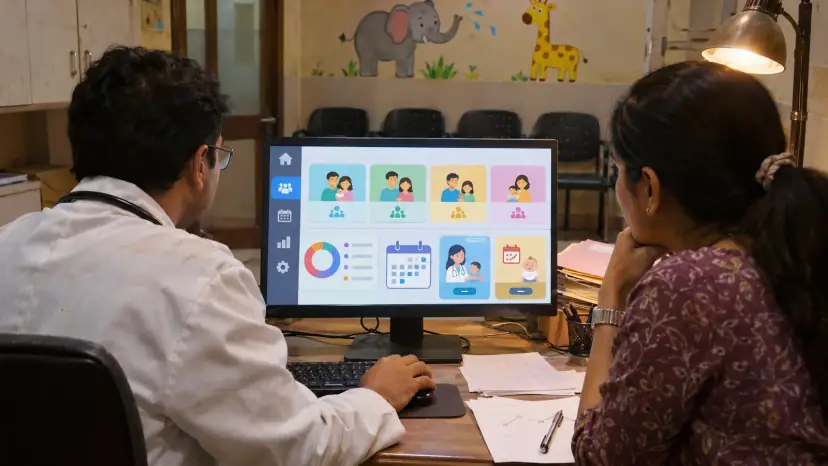
Our reading of these local and sector resources took place on 5 October 2026, with a repeat reading on 5 November 2026. Review what applies now before any campaign change. The photographs illustrate the subject in general; they were not taken at any Agra office or facility, and they show no patient.