What AI marketing for education and EdTech in Delhi should cover
AI marketing for education and EdTech in Delhi works when a family gets the right campus, the right academic session and a quick route to a counsellor. This guide is for admissions and marketing teams. It sets out what to record, which official pages to check, how far an assistant may go and where a person decides.
It is planning material only and reports no Brainguru client result. We scope services around your actual institution, data and permissions, and nothing here promises an admission, a seat, an exam result, a rank or a placement.
Placing a Delhi campus among 13 revenue districts
Begin at the Delhi Revenue Department, the Government of NCT of Delhi site that states Delhi is divided into 13 revenue districts. Each one is headed by a Deputy Commissioner, with Sub Divisional Magistrates and Tehsildars below that office. Read it for how the city is administered; it says nothing on demand for courses or commercial availability, and it vouches for no private institute.
Matching a campus address to its office is done through the department's menu, which offers a Find Your Locality tool, a district-wise village list and pages for District Offices and Sub division Offices. Write down the revenue district and the locality for every centre. A centre outside Delhi gets its own entry with its own source, rather than sitting under a Delhi heading.
The same department issues income, OBC, domicile and SC-ST certificates and offers Apply Online and Application Status pages. If your admission form asks applicants for one of these certificates, point families to the department instead of explaining its process in your own words, because your copy will date and theirs will not.
The enquiry record for each Delhi applicant
An applicant needs facts about one programme at one address, not a city name added to a national offer. Build every enquiry around the fields below. Each answer should trace back to an approved source and a named reviewer, and a missing detail is logged and passed to a person instead of being filled in by the model.
- Campus address and delivery mode: Give the revenue district and locality of the campus that actually teaches the course, and say whether the course runs on site, online or both.
- Course and academic-session identity: Name the exact programme and the session it belongs to, so an old intake is never described as the current one.
- Approved eligibility and fee-information source: Cite the approved document for eligibility and fees with its date, and leave anything it does not cover as a question for admissions to review.
- Recognition evidence: Keep the approval or recognition document that applies to the programme with the record, so a reviewer can see it before any claim is published.
- Adult contact or parent/guardian channel: Establish whether the writer is an adult applicant, a parent or guardian, or someone who says they are under eighteen, and route a minor's message through the parent channel.
- Admissions-review owner: Name the counsellor or admissions officer who confirms the reply before any next step reaches the family.
An enquiry that fails one of these checks stays open in the handoff. The counsellor then receives a precise question, such as which session a parent means, rather than a lead that only looks qualified.
Where the assistant stops and the counsellor starts
An assistant on a Delhi admissions page can answer from an approved course guide, notice which details are still missing and draft a short summary for the counsellor. It keeps four events apart: a course enquiry, a counselling appointment, a submitted application and a confirmed enrolment. Someone asking about an online programme must not be quietly booked for a campus visit because their search mentioned the city.
Connections should be limited to sources and systems the institution has authorised: the approved knowledge pack, the admissions system counsellors already use and a CRM or intake route if necessary. Record which version of a prospectus produced each answer. Test permissions, and who can change the content, before any live applicant data flows. A draft or a predicted score helps the counsellor and never commits the institution to a seat, a fee or a date.
Here is a planning example. A parent writes in Hindi late in the evening, asking whether a diploma that ran last session is open again and what it costs. The assistant checks the session first, finds no approved notice for the new intake and says so in Hindi. It offers a callback from admissions the next working day and does not repeat last year's fee. The counsellor replies from the current records, and nobody has to withdraw a figure afterwards.
Recognition: what the UGC site lets families check
For recognition questions, the sector reference outside your institution is the University Grants Commission. Its home page, opened on 5 November 2026, carries an alert that students and parents can verify the authenticity of higher educational institutions before taking admission, using the lists under its HEIs menu. That menu includes Central, State, Deemed to be and State Private Universities, and a list of fake universities.
The commission's office is on Bahadur Shah Zafar Marg in New Delhi, but nobody needs to visit it: the checks are on the website. A sensible Delhi page tells families that the lists exist and lets them look for themselves. Read the current regulations and notices each time you plan a claim, and have the responsible professional at your institution judge whether they apply to the programme in question.
Then hold firm limits. Publish no recognition, accreditation, placement rate, salary figure or closing date that your records cannot show. Do not use student testimonials, topper photographs or rank claims. Do not write "seats filling fast" unless the admissions office counts the seats and a person keeps the figure current.
Children's data under the DPDP Rules
Some Delhi enquiries may concern school pupils or students who are not yet adults. The Gazette carried the DPDP Rules, 2025 on 13 November 2025, and most Data Fiduciary duties in them apply from 13 May 2027, eighteen months on. Rule 10 is among them. Under it, an institution needs technical and organisational steps for getting verifiable consent from the parent ahead of any processing of a child's personal data, plus due diligence confirming that whoever claims to be the parent is an identifiable adult.
Adulthood, in the Rules, begins once a person has completed eighteen years. They also list educational institutions in the Fourth Schedule, but only for tracking and behavioural monitoring for the institution's educational activities or for the safety of enrolled children. Marketing is not in that list. In practice, design forms so a pupil's details reach a counsellor through a parent's contact, explain in simple words why the details are being collected, and make withdrawing just as easy. Sample notice wording is in the DPDP Act 2023 checklist for digital marketers.
Hindi and English pages, listings and fair measurement
English and Hindi are both available on the Revenue Department portal. If the institution publishes in Hindi and English, competent speakers should review course names, locality names and the next step. Settle this with the institution, since we do not assume every family uses these languages or that Brainguru will supply every translation.
Keep the real campus address and one contact route identical on the website, on the local search listing and in the institution's records. Never create extra listings to look present in districts where nothing is taught. Where a Delhi student is searching from and where the course is delivered may differ, so record them separately.
Count five things separately in Delhi: enquiries, counsellor reviews, applications, admission decisions and enrolments. Rejected, withdrawn and unsupported enquiries stay in the figures, because a chat is not a fee paid. Before launch, test a wrong campus, an expired admission notice, a question about an unrecognised course and a message from a minor. Compare the reviewed results with your own baseline before raising spend. We make no promise of rankings, AI-answer inclusion, enquiry volume or return.
Questions to put to any provider
Find out who signs off every published sentence, and where the sign-off is kept. Then ask about the moment an applicant uploads a mark sheet or an identity document, and how long it is kept. Ask whether phone, WhatsApp and website enquiries reach the same counsellor queue, and which numbers will be reported to you. A provider that reports only clicks has missed most of the stages above.
Further reading and preparing for a conversation
The industry view is on AI Marketing for Education. Delivery questions are taken up in AI Consulting for Indian Enterprises (2026): What It Should Actually Deliver, a piece on a related workflow rather than on any Delhi client. For the software side of learning platforms, see Education Technology Solutions.
Our other Delhi planning pages include AI Marketing for SaaS in Delhi and AI Marketing for HR and Recruitment in Delhi. A side-by-side view of their official references is at Delhi and other city guides.
A free consultation goes best if you bring the campus address and revenue district, the delivery mode, the course and academic-session identity, the approved prospectus and the name of whoever approves replies. Work is delivered out of Noida, and no separate Delhi branch is claimed. Scope and integrations are discussed case by case.
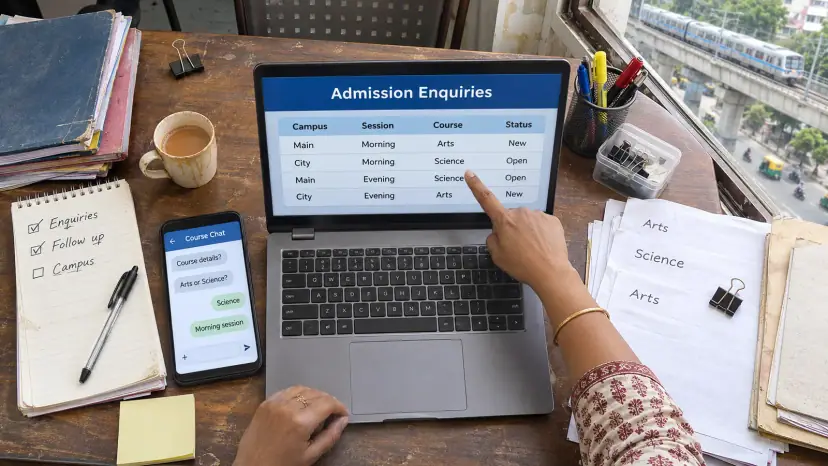
The Delhi sources in this guide were opened on two dates: 5 October 2026 and, a month later, 5 November 2026. Look at the current instructions once more before a campaign changes. Images here illustrate the topic and are not verified photographs of any local office, student or campus.