AI marketing for education and EdTech in Bangalore, kept accurate
A prospective student asks about a course, and a counsellor has to stand behind the reply. AI marketing for education and EdTech in Bangalore should make that exchange accurate and quick. This guide is for education and EdTech teams serving Bengaluru (Bangalore) who want that enquiry handled properly: what to collect, which pages to read and when a person approves.
The workflows are planning examples. None is a reported Brainguru client result, and any service is scoped around your actual institution, data and permissions. No part of it promises admission, marks, ranks or placement.
Which Bengaluru locality, which taluk
Check Bengaluru Urban district for local administrative context. The portal is an administrative source: it says nothing about demand for courses or commercial availability, and it endorses no private institution. The home page gives the district as 2,196 sq km with 5 taluks, 20 hoblis, 588 villages and 6 urban local bodies, and links a Subdivision and Blocks page under Administrative Setup.
Its Town Municipal Council menu names Yelahanaka (as the portal spells it), North, East, South and Anekal. Labelling an audience "Bengaluru" therefore says little about which authority covers a campus. The district's official name is Bengaluru Urban District, and a Kannada version of the site is offered. Use Bengaluru when you match official records, and leave the established Bangalore URL as it is.
Your record should hold the Bengaluru locality and its taluk or subdivision, which you then match to the approved business record. When the two do not match, the case is held for a reviewer, and no directions or visiting times are given until it is resolved. Among the portal's departments, Public Instruction and Women and Child Welfare both appear, a reminder that school-age audiences sit inside a public system with its own rules.
The enquiry brief for a Bengaluru campus or course
Work from a brief, not from a city name beside a national offer. Anything you tell an applicant should name its source and the counsellor who reviewed it. Details nobody can confirm are noted as open and handed to a colleague.
- Campus address and delivery mode: State where the campus actually is, or that the course is taught online, because applicants need to know where teaching happens.
- Course and academic-session identity: Specify the exact course and session, since details from another intake could mislead an applicant.
- Approved eligibility and fee-information source: Point to the approved prospectus or fee notice for eligibility and fees, and send anything it does not settle to review as a question.
- Foreign partner evidence: If a programme involves a university abroad, keep the agreement and the recognition position on file before any page mentions the partner.
- Adult contact or parent/guardian channel: Note who is writing (the applicant as an adult, or a parent or guardian), what they want next and what helping them requires.
- Admissions-review owner: Name the admissions person in Bengaluru who confirms each answer or action before it reaches the applicant.
In an illustrative case, a request clears two checks, location and then course and session, before any fee or seat is mentioned. A failed check is flagged in the handoff, so admissions has a concrete question and no applicant is wrongly marked as qualified.
What AI does before the counsellor steps in
First establish the campus, course and delivery mode; only then offer a next step. Before the counsellor steps in, the assistant can bring up the approved course guide, list what the applicant has not yet said and write a short handoff note. Asking, booking a counsellor, applying and enrolling are four separate records in Bengaluru as anywhere else. Nobody interested in an online programme should be quietly assigned to a campus.
Connect nothing beyond what the institution has authorised: an approved knowledge pack, the relevant admissions system and a CRM or intake route if required. Record the source version each answer drew on, and test editing rights before live applicant data is used. Any draft or prediction is help for the counsellor, never a commitment.
Consider one example for planning. A parent writes in Kannada about a diploma course and asks whether admission is open this year and whether a hostel is available. The assistant checks the date on the approved admission notice. If that session has passed, it says it cannot confirm and flags the counsellor. The hostel question comes from a different source, so it is answered separately or passed on. The handoff note records the course, the language and the callback time the parent chose, and nothing else about the child.
Foreign tie-ups and recognition claims
For Bengaluru programmes, the independent sector reference to read first is the University Grants Commission. When we opened its home page on 5 November 2026, one listed item was a public notice dated 25 July 2025 on collaborative agreements with foreign-based educational institutions or providers not recognised by the UGC. It also listed the UGC regulations of 2025 on recognition and equivalence of qualifications from foreign educational institutions, and an Equivalence Portal.
For a Bengaluru institution promoting a twinning, joint or international pathway, that is the place to start reading. Look at the current instructions again, and ask the responsible professional to judge how they apply to what you propose. Until they have, the page names no foreign partner and makes no claim about how a qualification will be treated.
Nobody should invent recognition, placement rates, salary outcomes or deadlines for a Bengaluru page, and student testimonials stay off it. A common mistake is leaving last intake's fee PDF on the site because nobody is sure it can be removed. Put the session in every file name, and have the admissions owner retire each document on a date agreed at the start of the intake.
Parent consent for Bengaluru applicants
Decide with your legal adviser how your forms will capture a parent's consent before any of them goes live. Most Data Fiduciary duties under the DPDP Rules, 2025 take effect on 13 May 2027, eighteen months after the Gazette published the Rules on 13 November 2025.
Before a child's personal data is processed, rule 10 asks for the parent's verifiable consent. The rule's illustrations turn on whether the parent is already a registered user. If the parent is, the Data Fiduciary checks the reliable identity and age details it already holds. If not, it checks identity and age details issued by an entity entrusted by law or the Government, or a virtual token mapped to them, and the parent may share those details through a Digital Locker service provider. An admissions chat should therefore collect a pupil's details only once the parent route is clear.
Kannada, English, Bengaluru search and admissions stages
Where the audience needs Kannada and English, competent speakers review terminology, locality names and the proposed next step. Which of them to offer is a decision for the institution; we make no claim that every applicant reads both, or that Brainguru translates everything. Show the same true address and contact route on the page and in business records, and do not add offices to appear local.
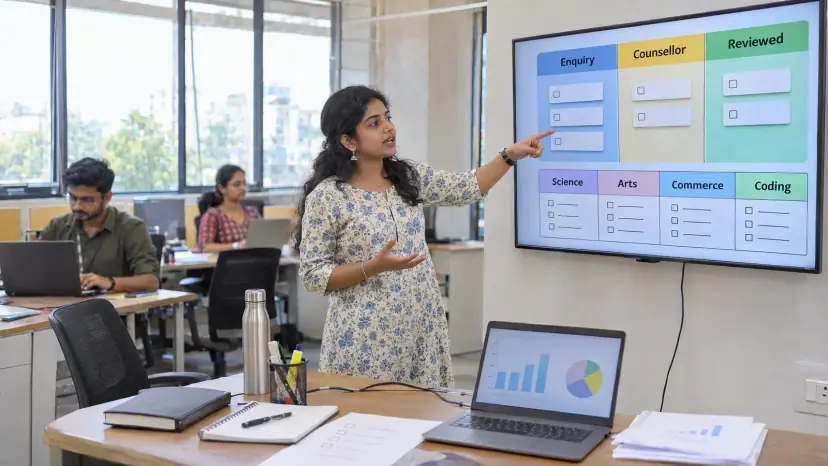
An applicant's location in Bengaluru (Bangalore) may differ from where the course is delivered, so log them separately. Report enquiries, reviews, applications, decisions and enrolments as five separate numbers, and leave rejected, cancelled and unsupported requests in them.
Use four test cases: a different campus, an expired admission notice, a foreign-partner claim with no record and a message from a minor. Set reviewed outcomes against the institution's own baseline before increasing spend. Rankings, AI-answer inclusion, enrolment leads and return on spend are outcomes we never promise.
In the first weeks, note which questions counsellors keep answering by hand. If most enquiries are for a course you do not run, the targeting and page wording need to change, not the assistant.
Reading and next conversations
Read AI Marketing for Education for the wider sector picture. The how-to side is in AI Consulting for Indian Enterprises (2026): What It Should Actually Deliver, written about a related workflow and not about any Bengaluru (Bangalore) client. Founders of learning platforms may prefer AI Stack for EdTech Startups or the EdTech startup acquisition playbook.
Two more guides for this city cover software firms, AI Marketing for SaaS in Bangalore, and hiring teams, AI Marketing for HR and Recruitment in Bangalore. To set their official references side by side, open Bengaluru (Bangalore) and other city guides.
When you come for a free consultation, please bring the actual campus address and delivery mode, the course and session identity, approved source material and the reviewer who decides the next step. Delivery comes from our Noida office, and we claim no Bengaluru (Bangalore) branch. How far scope and integrations should go gets agreed with each institution.
Local and sector resources were last reviewed on 5 November 2026, after a first check on 5 October 2026, and instructions should be rechecked ahead of any campaign change. Photographs on the page are illustrative and do not depict verified local offices, students or facilities.