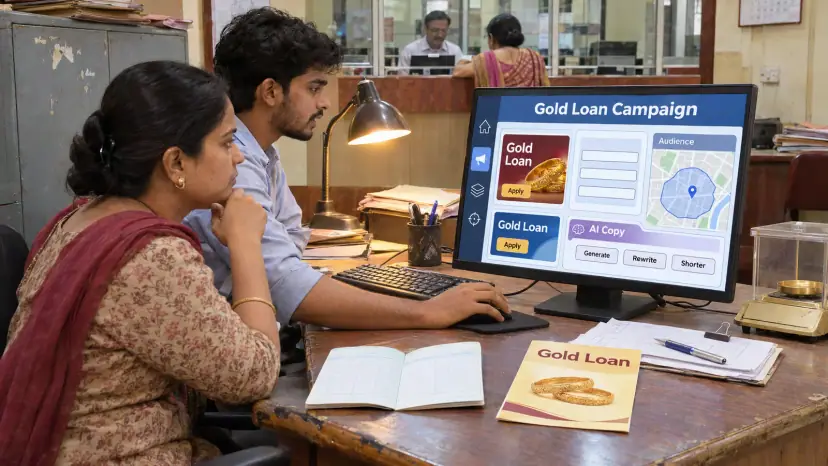
AI marketing for BFSI (Banking and Finance) in Delhi: the branch question first
AI marketing for BFSI (Banking and Finance) in Delhi starts when a customer asks what a loan or account needs and which branch deals with it. BFSI (Banking and Finance) teams need that answer to come from approved information, and any application to reach a reviewer. This guide covers the records, the official sources and where staff take over.
The workflows below are planning examples, not Brainguru client results. Nothing here is investment, credit or insurance advice, and the regulated entity decides what its public pages say. A project is scoped around the institution's real data, systems and permissions.
Thirteen revenue districts, one address per branch
The first reference is the Delhi Revenue Department. Its site, the Department of Revenue, Government of NCT of Delhi, says Delhi has 13 revenue districts. A Deputy Commissioner leads each one, supported by an Additional District Magistrate, Sub Divisional Magistrates, Tehsildars and a Sub-Registrar. A city that splits this way gives a branch page plenty of room to be wrong: "Delhi" alone does not tell a customer which office will see them.
The Revenue Department's district resources show which office covers a given Delhi address. Its menus carry District Offices, Sub division Offices and Sub Registrar offices, villages listed district by district, and a tool called Find Your Locality. Record each branch's revenue district and locality, then match the result to the approved business record. A mismatch goes to a reviewer before anyone publishes directions, opening hours or an appointment step.
The portal helps with administrative context only. It does not establish demand for a product or commercial availability, and it is no endorsement of a private lender or provider. Use it to check spelling and district boundaries, and nothing more.
What the branch record holds for each Delhi enquiry
A city name next to a national offer does not answer anyone. The fields below turn a page into something a customer can act on. Each product statement carries its source and a reviewer, and a gap in the record stays a gap until a person fills it, because guessing has no place in financial information.
- Regulated provider identity: Name the regulated entity that offers the product, so nobody mistakes it for a software vendor, an agent or a comparison site.
- Actual branch or service channel: Give the revenue district and locality of the branch, or name the digital channel, using the operating address rather than the advertising audience.
- Approved product-information version: Note the approved version each answer draws on and its date. An expired sheet or a missing detail stays a review question.
- Eligibility information source: Point to the current approved source on eligibility, charges and documents. A Delhi address on a page settles none of them.
- Application enquiry type: Say whether the customer wants a branch visit, a digital application or help with an existing account, and record the next step they asked for.
- Authorised reviewer: Identify the officer authorised to confirm the reply or action, and nothing reaches the customer before that officer does.
Take a message that names only a landmark, such as "near the Sub-Registrar office". The assistant should not pick a branch for the customer. It logs the landmark, the product and the request, marks the location as unconfirmed and hands staff one clear question, so nobody inherits a lead that merely looks qualified.
What the assistant may explain, and what it leaves to staff
An assistant earns its place by finding approved product explanations and routing the enquiry to the right channel. A branch appointment and a digital application are separate journeys, so keep them apart. Someone asking about a loan gets the current approved document list and a handoff when eligibility or charges need confirming. Marketing tools must not decide on lending, and a general enquiry form must not gather a full financial file.
Wire in nothing the lender has not authorised. In practice that means an approved knowledge pack, the operational system that holds the answer and, where one is needed, a CRM or intake route. Each reply should log the source version it used. Test access and editing rights on dummy data before live customer records go in. Drafts, predictions and extracted fields help the reviewer; they commit the institution to nothing. Our AI chatbot development page explains how such an assistant is scoped.
RBI rules that shape a Delhi loan page
A page may not hint at RBI backing for a private service, may not promise that a loan will be approved and may not turn a quoted return into a commitment. The Reserve Bank of India is the independent sector reference here. Its official website keeps separate lists of Master Directions, Amendment Directions and Circulars Withdrawn, a sign that instructions are revised over time: check the current ones and ask the responsible compliance officer how they apply to what you propose.
For finance companies, one useful text is the Reserve Bank of India (Non-Banking Financial Companies - Responsible Business Conduct) Directions, 2025, which also cover housing finance companies. Banks have their own version in the RBI's Master Directions list. Three paragraphs of its Fair Practices Code bear directly on a loan page:
- Paragraph 11: loan application forms carry the information that affects the borrower's interest, so terms can be compared with another lender's, and they list the documents to submit.
- Paragraph 12: every loan application gets an acknowledgement, preferably stating the time frame for deciding it.
- Paragraph 15: borrowers get notice of any change in terms, including interest rates and charges, and changes take effect only prospectively.
Paragraph 15 points at the usual Delhi mistake: a stale advertisement. A campaign is approved, the product terms change, and old wording keeps running. Give one named person in product or compliance the duty to retire or re-approve every live ad, page and assistant answer when a product sheet changes, and keep a dated record of each approval and withdrawal. An assistant can send the acknowledgement that paragraph 12 describes, but only with the wording and time frame the lender has approved.
Enquiry forms under the DPDP Rules
Because a loan enquiry form gathers personal data, it falls under the Digital Personal Data Protection Act, 2023. Its companion, the DPDP Rules, 2025 were entered in the Gazette on 13 November 2025; eighteen months on, from 13 May 2027, rule 1(4) puts most Data Fiduciary duties into effect. They include the notice under rule 3, security safeguards under rule 6 and the rights of Data Principals under rule 14.
Ask only for what the first reply needs: a name, a phone number and the product of interest. Do not ask for identity numbers, salary details or account numbers in a chat. Those belong in the lender's own application journey, where notice and storage are already settled. Write a plain notice of what the details are for, offer a way to withdraw or correct them, and name the person who answers when a customer asks what was kept.
Hindi and English, search and what to measure in Delhi
The Revenue Department site itself runs in English and Hindi. If Hindi and English are both needed for your customers, competent speakers should check financial terms, locality names and the proposed next step before anything goes live. There is a regulatory reason too: under paragraph 10 of the NBFC Directions, every communication to a borrower goes in the vernacular or another language that borrower follows. Which languages to support is for the institution to decide with us; nobody should assume every Delhi customer reads both, and we do not offer to translate every document ourselves.
Publish one real address and contact route on the page, in the local search listing and in business records, and do not add offices or profiles to look more local. A customer's location in Delhi can differ from where the service is delivered, so capture both and route by the approved service area.
Follow each stage on its own: information request, branch or channel matched, reviewer contacted, application started. A cancelled or refused request is still a data point, because a chat is not a loan. Before launch, test an expired product sheet, a request for an approval the assistant cannot give and a customer who wants account servicing rather than a new product. Compare reviewed outcomes with the institution's own baseline before adding spend. Search rankings, AI-answer inclusion, lead numbers and returns are not something we promise a Delhi lender.
Further reading and a consultation
See AI Marketing for Fintech for the industry scope. Our article AI Marketing for Fintech in India: A Compliance-Ready Playbook, also ours, walks through implementation for a related workflow, without describing or proving any Delhi client. For the data side, read DPDP Act 2023 for Digital Marketers in India: The 2026 Compliance Checklist.
Nearby planning tasks in Delhi have their own guides: AI Marketing for Fintech in Delhi and AI Marketing for Insurance in Delhi. Official references for other places sit under Delhi and other city guides.
Before a free consultation, have ready the name of the regulated provider, the revenue district or service channel for each branch, the approved product sheets and the reviewer who decides the next step. All delivery is from our Noida office, with no Delhi branch claimed. How far integrations and site visits go is decided with each institution.
Every local and sector resource above was opened for this guide on 5 October 2026, and each was read once more on 5 November 2026. Rules and instructions change, so verify them again before altering a campaign. The pictures are illustrations; none of them is a photograph of a Delhi branch, customer or office.