In this article
If you're building an Indian startup in 2026 and you've been told you need a ₹2L/month AI marketing stack to compete, it's worth questioning that. A practical working stack for an early-stage Indian startup can be assembled for under ₹25,000 a month, including AI tools, distribution, analytics, and WhatsApp. This guide lays out how to think about each layer.
This is a practical 2026 guide to the best AI marketing tools for Indian startups at the lean budget tier: what to consider buying, what to skip, and what each tool actually does for an Indian-context business. Indicative prices in ₹ (always check current pricing), real workflows, and the upgrade path when you graduate to higher tiers.
Why ₹25,000 Is a Useful Benchmark
For an early-stage Indian startup (pre-revenue to a few crore in ARR, with a small 3 to 10 person team), roughly ₹25,000/month is a budget that can buy genuine leverage without overspending on tools you'll outgrow or never use. Below this, you tend to hand-code everything in spreadsheets and burn founder time. Above this, you're often buying capability you don't yet need.
The principle behind this stack: every tool should earn its place by saving more than its cost in either money or founder-time. No vanity tools. No "we use AI" badges that don't move the needle.
The 7 Layers of the Working Stack
A complete AI marketing operation has 7 functional layers. Each needs to exist; the question is just how cheaply you can satisfy each at your stage.
Layer 1: Strategy and Research
Where you think, brief, and develop the angle. This is the highest-leverage layer because everything downstream amplifies it.
Tools worth considering:
- ChatGPT (paid plans from around ₹1,500–₹2,500/month per seat, check current pricing): daily driver for research, briefs, frameworks, content drafting
- Claude Pro (around ₹1,800/month per seat, check current pricing): strong for long-form analysis, document review, careful writing
- Perplexity Pro (around ₹1,800/month, check current pricing): research with sources, faster than manual searching
Many Indian startups default to ChatGPT for everything. A pattern that often works better: ChatGPT for ideation and drafts, Claude for the longer analyses, Perplexity when you need cited research.
Layer 1: roughly ₹2,500–₹4,500/month
Layer 2: Content and Creative
Where ideas become assets: copy, images, videos, audio.
Tools worth considering:
- Midjourney (around ₹800–₹2,400/month depending on plan, check current pricing): visual assets for ads, social posts, hero images
- Canva Business (around ₹3,000–₹4,000/month for a small team, check current pricing): finishing, brand templates, batch design
- Synthesia (entry tiers roughly ₹2,000–₹4,000/month, check current pricing): AI video for explainers and product demos. Only needed if your motion includes video
- ElevenLabs (around ₹400–₹1,800/month, check current pricing): AI voiceover for regional-language audio and video
Most early-stage Indian startups can start with just ChatGPT + Midjourney + Canva. Synthesia and ElevenLabs become more useful when you start producing regional-language video content; see our AI in Marketing India: Tools guide for a deeper breakdown.
Layer 2: roughly ₹4,500–₹8,000/month
Layer 3: SEO and GEO
Where you become discoverable in both Google and the new answer engines (ChatGPT Search, Perplexity, Claude, AI Overviews).
Tools worth considering:
- Rank Math Pro (the PRO plan is billed annually and works out to roughly ₹1,000/month or less, check current pricing): WordPress SEO + schema + sitemap. Very useful if you're on WordPress
- SE Ranking or Ahrefs (lighter plan) (Ahrefs Starter is around ₹3,000/month; SE Ranking's entry plan is around ₹10,000/month, check current pricing): keyword research, rank tracking, basic backlink intel
- Brainguru free tools: the free schema markup generator and meta tag generator, zero cost, save you hours
The free Brainguru tools handle schema and meta tags. Rank Math handles on-page. Ahrefs Starter or SE Ranking handles tracking. You generally don't need the full Ahrefs or Semrush tiers at this stage; those are higher-cost tools designed for bigger operations.
Layer 3: roughly ₹4,000–₹11,000/month
Layer 4: Paid Media (AI-Optimised)
Where you scale acquisition through paid channels. The tools here mostly come bundled with the ad platforms themselves.
Tools worth considering:
- Meta Advantage+ (free, bundled with Meta Ads spend): AI-optimised audience and placement targeting
- Google Performance Max (free, bundled with Google Ads): multi-channel AI-driven campaign type
- Pencil AI or an alternative (around ₹2,500–₹6,000/month, check current pricing): creative variant generation specifically for paid ads
The two big platforms have made native AI optimisation free; you just need to feed them quality creatives and conversion signals. Tools like Pencil AI can accelerate creative production for ad variants. Beyond that, heavier third-party AI ad tools tend to be enterprise-priced and overkill for this stage.
For a complete paid-media playbook, see PPC & Paid Marketing: Complete Guide for Indian Businesses.
Layer 4: roughly ₹0–₹6,000/month (excluding media spend)
Layer 5: Email + WhatsApp
Where you own your audience. Often the highest-LTV channel for Indian startups.
Tools worth considering:
- Mailmodo (entry tiers roughly ₹2,500–₹6,000/month, check current pricing): India-built email tool with AMP email support and AI subject-line testing
- AISensy (around ₹2,500–₹5,500/month, check current pricing): WhatsApp Business API tool aimed at Indian startups, typically cheaper than enterprise alternatives
- Klaviyo (pricing scales with contacts, check current pricing): if you're D2C / Shopify-centric, this is often the better fit
Pick one email tool and one WhatsApp tool. Most early-stage Indian startups don't need both Mailmodo and Klaviyo; pick by motion: Mailmodo for B2B/SaaS, Klaviyo for D2C/eCommerce.
Layer 5: roughly ₹5,000–₹11,500/month
Layer 6: Analytics and Attribution
Where you understand what's working. Cheap or free at this stage.
Tools worth considering:
- GA4 (free): the analytics standard
- Google Tag Manager (free): event tracking + tag deployment
- Looker Studio (free): dashboarding
- Brainguru free UTM builder (free): consistent UTM tagging across the team
- Microsoft Clarity (free): heatmaps, session recordings
The free tier of measurement covers most of what an early-stage startup needs. You can usually skip heavier paid attribution platforms until you're operating at much larger scale.
For consistent UTM tagging that won't break your analytics, set up your team to use our free UTM link builder: it enforces a naming convention and helps prevent the case-sensitivity bugs that can corrupt GA4 reports.
Layer 6: ₹0/month
Layer 7: CRM + Automation
Where leads, customers, and pipeline live.
Tools worth considering:
- HubSpot Starter (paid tiers from around ₹1,200/month per user, check current pricing; a free tier also exists): capable starter CRM, popular with B2B SaaS startups
- Zoho One (around ₹3,000/month per user, check current pricing): a bundle that includes CRM plus many other apps; often the cheapest full-stack option for Indian SMEs
- Salesmate or Freshsales (around ₹2,000–₹3,500/month per user, check current pricing): India-built CRMs, especially for high-volume motions
The right CRM depends on your motion more than your stage. Pick based on what feels natural and ship.
Layer 7: roughly ₹2,400–₹6,000/month for 2 users
An Illustrative ₹25K Stack for a Sample Startup
The following is a hypothetical, illustrative example only, not a real client. It shows how the layers might combine for a small Indian B2B SaaS startup. Treat the numbers as planning estimates and verify current pricing before committing.
| Layer | Example Tool Picks | Indicative Monthly Cost (₹) |
|---|---|---|
| 1. Strategy | ChatGPT (1 seat) + Claude Pro (1 seat) | ~4,000 |
| 2. Content | Midjourney Standard + Canva Business | ~5,800 |
| 3. SEO | Rank Math Pro + Ahrefs Starter | ~4,000 |
| 4. Paid Media | Pencil AI starter (only when running paid) | ~3,000 |
| 5. Email + WhatsApp | Mailmodo entry tier + AISensy entry plan | ~5,000 |
| 6. Analytics | GA4 + GTM + Looker + Clarity (free) | 0 |
| 7. CRM | HubSpot Starter (2 seats) | ~2,400 |
| Total | ~₹24,200 |
An operating stack along these lines can let a lean team produce content at a steady cadence, run paid and organic in tandem, track activity, and manage pipeline through to closed-won.
What You Likely DON'T Need at This Stage
Tools you'll often be pitched that you can usually skip for now:
- Salesforce: typically overkill until you have a sizeable marketing team and much larger revenue
- Adobe Creative Cloud: Canva + Midjourney cover most design needs for a small team at a fraction of the cost
- Heavy attribution platforms (Triple Whale, Northbeam, RockerBox, and similar): these make more sense at much larger scale
- Full Ahrefs / Semrush: these are designed for SEO agencies and big content teams; a lighter tracking tool is usually enough at this stage
- Marketo, Pardot, Eloqua: enterprise marketing automation platforms; a starter CRM usually does what you need
- Custom data warehouse (Snowflake, BigQuery): premature until you have multiple data sources at scale
The Upgrade Path
When you outgrow the lean stack, here's where additional spend tends to earn leverage:
Toward a mid tier
- Upgrade your CRM for better automation (e.g. HubSpot Professional)
- Add Synthesia + ElevenLabs for video at scale
- Upgrade Mailmodo or Klaviyo to a higher tier as your list grows
- Add a dedicated heatmap tool (e.g. Contentsquare, which now includes Hotjar) if Clarity isn't enough
Toward a higher tier
- Add proper attribution: a dedicated platform or an in-house dashboard
- Add specialised SEO: full Ahrefs or Semrush
- Add an advanced CRM: HubSpot Enterprise or Salesforce
- Add programmatic SEO infrastructure (custom builds)
For a deeper breakdown of upgrades, see our AI Marketing Automation Guide for Indian Businesses.
Thinking About ROI
The stack only pays back if it drives outcomes, so it helps to model your own numbers rather than rely on generic claims. A simple way to frame it: estimate your average customer LTV and your blended CAC, then work out how many additional customers per month you'd need to cover the tool cost plus the opportunity cost of the founder/operator time the stack consumes.
Payback timelines vary widely by business model, sales cycle, and execution quality. B2B SaaS motions often have longer cycles than D2C, where paid ads and WhatsApp can shorten purchase decisions, but actual results depend entirely on your specific funnel, and there are no guaranteed outcomes.
Model your own numbers with our AI marketing ROI calculator and the AI cost calculator.
Frequently Asked Questions
Can I really run a startup's marketing on around ₹25,000/month?
For the tools, it's feasible. The bigger cost is human time: even with great tools, you'll need one or two people putting in real hours. Tools amplify good operators; they don't replace them. Think of the budget as the leverage layer on top of your operational time, not as a complete cost.
Which is better: ChatGPT or Claude for marketing work?
Both have strengths. ChatGPT is often quick for ideation, briefing, and short-form. Claude tends to be strong for long-form analysis, document review, and careful writing where tone matters. A common workflow uses both at lower subscription tiers rather than one at the top tier.
Do I need both Meta Advantage+ and Google PMax?
It depends on your motion. D2C often gains traction on Meta first, Google later. B2B SaaS often does better on Google first, with Meta for retargeting later. Test one at a time with enough data (a few weeks each) before judging.
Which WhatsApp tool: AISensy, WATI, or Gupshup?
For many early-stage Indian startups, AISensy is a reasonable starting point: it tends to be affordable at the startup tier, has a clean interface, and handles the standard WhatsApp Business API flows. WATI is comparable. Gupshup is generally enterprise-oriented and may be more than you need at the lean tier. Compare current pricing and features before deciding.
Should I buy Canva Pro or Adobe Creative Cloud?
For most small teams, Canva Pro. Adobe makes more sense when you have a dedicated designer already trained on it, and even then a lot of output for a small team can come from Canva + Midjourney.
Is Mailmodo a good fit for Indian startups?
For many B2B SaaS and B2C startups, yes. Mailmodo is built in India and supports AMP (interactive) emails. Compare it against alternatives like Mailchimp on current pricing and the features you actually need.
When should I upgrade beyond the lean stack?
When you're consistently hitting tool limits (too many contacts in your email tool, too many users in your CRM, hitting generation caps, and so on). Don't upgrade preemptively. Upgrade when you feel the pinch regularly.
The Bottom Line
For Indian startups in 2026, a budget in the region of ₹25,000/month can buy a real, functional AI marketing stack. It's not the most powerful stack available, but it's a disciplined one that lets a lean team compete on output quality with much larger competitors.
A common mistake founders make is either underspending (trying to do everything manually and burning founder hours) or overspending (paying for enterprise tools they won't use). The middle path is more boring, more disciplined, and usually more effective.
For a custom evaluation of your stack at your stage, talk to our AI marketing solutions team, or reach out via our contact page or on +91-8010010000.
Where Brainguru Can Help
Tools are only half the problem; the other half is wiring them together so the data actually flows. See best AI marketing tools for startups for our current shortlist, AI marketing solutions for managed implementation, and AI marketing pricing for what an engagement costs. Two of our free tools help before you commit: the AI cost calculator and the AI marketing ROI calculator.
Related Articles
Best CRM for Indian Startups in 2026: HubSpot vs Zoho vs Salesforce vs Freshworks vs LeadSquared (Honest Review)
Honest 2026 comparison of the 5 CRMs Indian startups actually use: HubSpot, Zoho, Salesforce, Freshworks, LeadSquared. With pricing, integrations, and use-case recommendations.
Read More
AI Automation Services in India
AI Automation Services in India: How Businesses Are Saving Cost, Time & Scaling Faster in 2026 In 2026, AI automation is no longer a “future trend” -it has…
Read More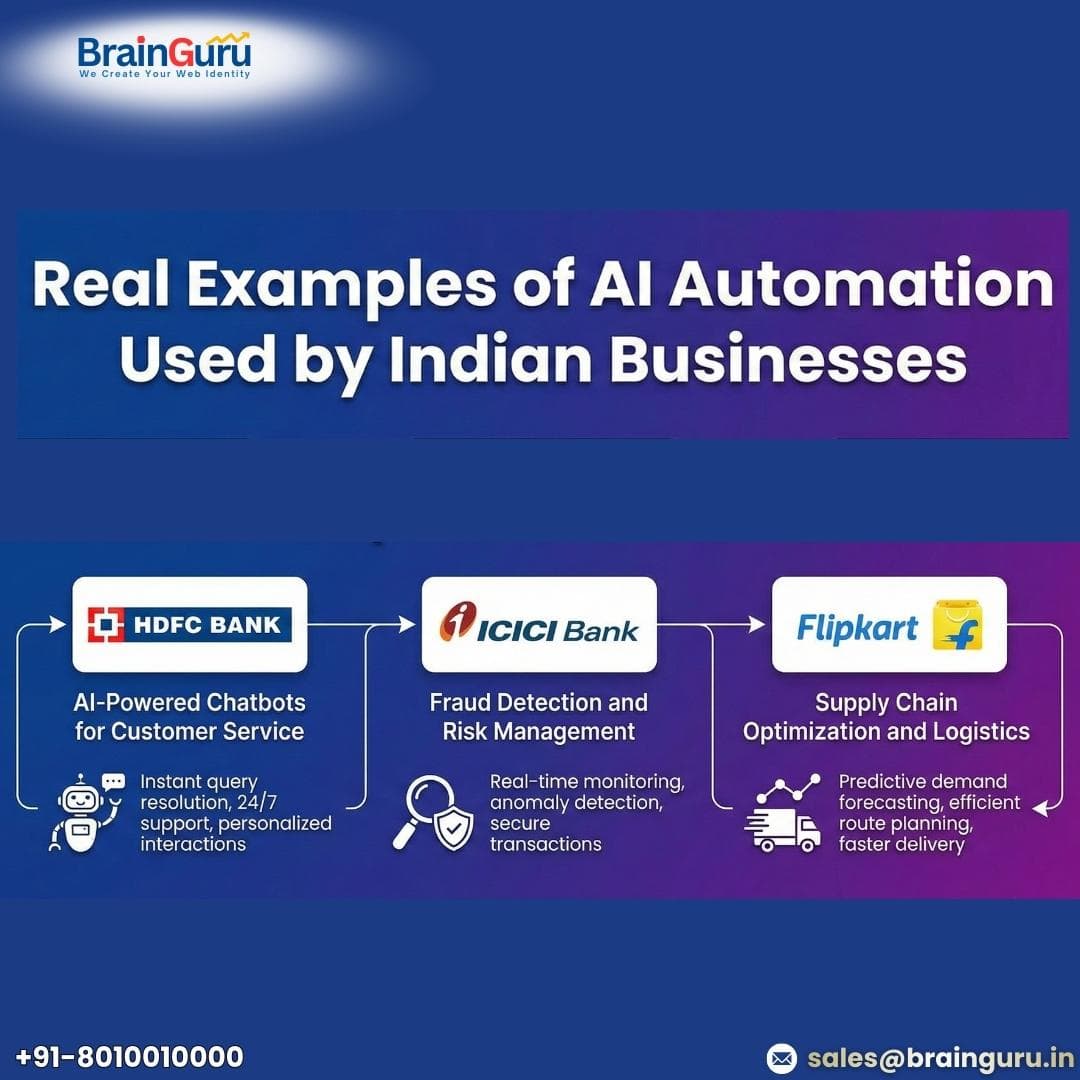
Real Examples of AI Automation Used by Indian Businesses
Real Examples of AI Automation Used by Indian Businesses (That Are Actually Working) Artificial Intelligence is no longer a “future technology” in India. It’s…
Read More
Comments
Be the first to share your thoughts on this article.