In this article
- What Is AI Marketing Automation (and What It Isn't)
- The 6 Core Automation Flows Every Indian Business Needs
- Setting Up AI Marketing Automation: A 30-Day Roadmap
- Common Mistakes Indian Businesses Make with Marketing Automation
- What Brainguru Builds for Indian Businesses
- Step-by-Step: Setting Up Your First AI Marketing Automation Workflow
- AI Automation Tools Comparison Table for Indian Businesses
- Hypothetical Scenarios: AI Automation in Action
- Common AI Automation Pitfalls and How to Avoid Them
- Building an AI Automation Strategy: The 90-Day Plan
- Frequently Asked Questions
- Related Services
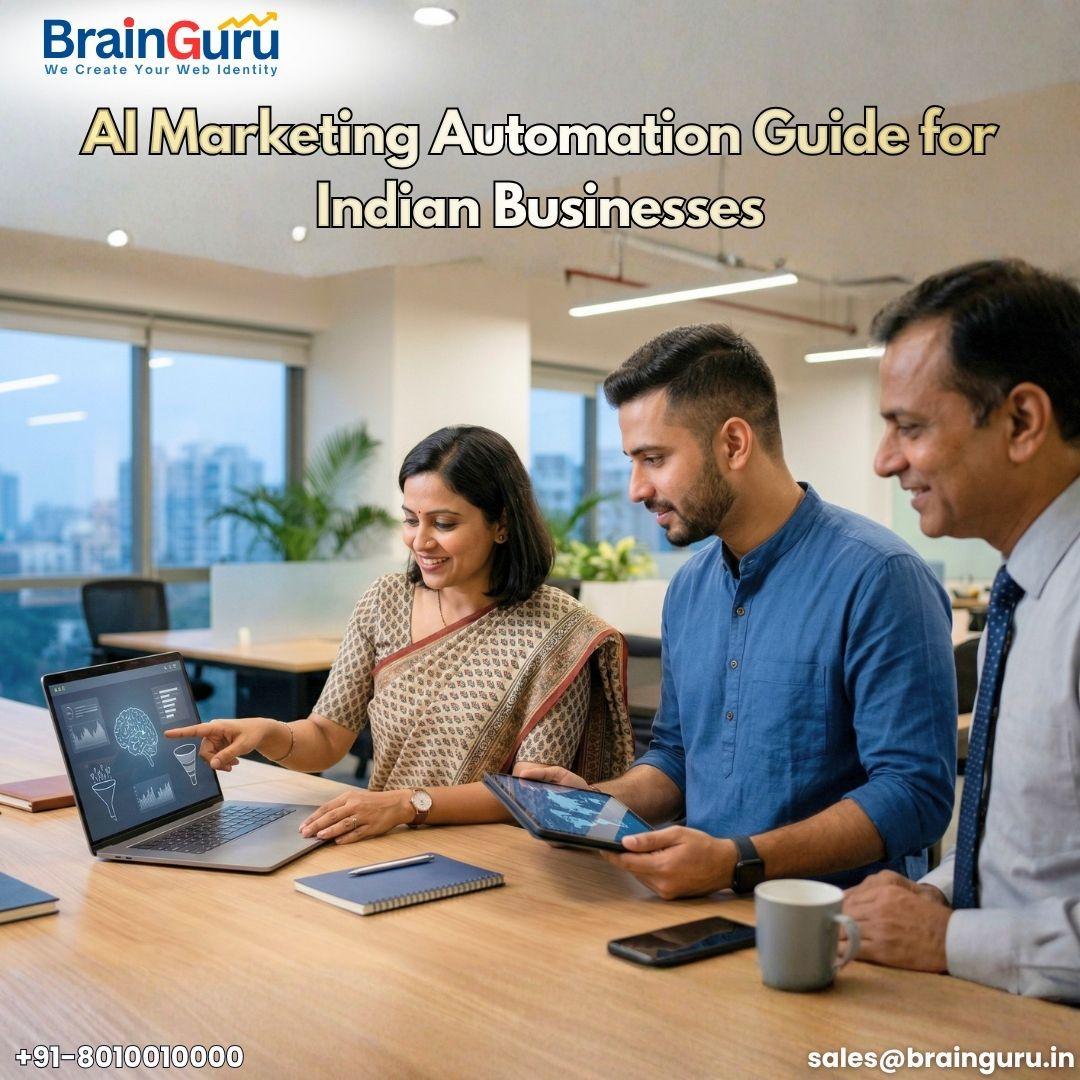

Marketing automation used to be a luxury only large enterprises could afford. In 2026, it's a survival tool and AI has made it accessible to every Indian startup and SMB with a working internet connection.
But here's the problem: most businesses set up automation tools, create a few email sequences, and call it done. That's not automation that's scheduling. Real AI marketing automation is dynamic, adaptive, and self-improving.
This guide shows you exactly what that looks like and how to build it.
What Is AI Marketing Automation (and What It Isn't)
Marketing automation = using software to trigger actions based on rules. AI marketing automation = using machine learning to trigger actions based on predicted behavior.
The difference is massive. Traditional automation sends email #3 after 3 days. AI automation sends the right email when a lead's behavior signals buying intent - regardless of when they signed up.
For Indian businesses where sales cycles are relationship-driven and decisions take time, this difference translates directly into more closed deals.
The 6 Core Automation Flows Every Indian Business Needs
1. Lead Capture & Instant Qualification
Every lead that hits your website should be instantly qualified by AI - automatically segmented by industry, company size, intent level, and buying stage. No human intervention needed.
Tools to implement: HubSpot AI, LeadNXT CRM with AI scoring (LeadNXT is Brainguru's own product), or a custom AI layer built by Brainguru on top of your existing CRM.
2. WhatsApp Nurture Sequences
India runs on WhatsApp. A properly built AI WhatsApp nurture sequence - personalized, behavior-triggered, and non-spammy - tends to get higher open and response rates than email.
Key rule: Don't blast. Trigger. Messages go out when a lead takes an action, not on a fixed schedule.
3. Email Personalization at Scale
AI email tools analyze each recipient's past behavior and dynamically change the email content - subject line, body copy, CTA, even the product recommendation - for each person. One campaign, thousands of personalized versions.
4. Retargeting Automation
AI retargeting goes beyond 'they visited this page, show them this ad.' Modern systems analyze micro-behaviors - scroll depth, video watch time, form abandonment - and serve ads that address the specific objection the user showed.
5. AI Chatbot for 24/7 Lead Conversion
Your website gets traffic at 11pm on a Sunday. Without a chatbot, those leads bounce. With an AI chatbot, they get answered, qualified, and booked into your calendar - automatically.
→ Explore CRM & Automation Solutions
6. Post-Sale Upsell & Retention Flows
Most Indian businesses focus automation only on acquisition. The smartest ones also automate upsell, renewal reminders, and customer health scores - turning one-time buyers into long-term revenue.
Setting Up AI Marketing Automation: A 30-Day Roadmap
Week 1: Foundation
- Connect all data sources: website, CRM, email, ads
- Define your lead stages and qualification criteria
- Choose your automation platform (our own LeadNXT, Zoho, or custom AI)
Week 2: Build Core Flows
- New lead welcome sequence (3–5 emails + WhatsApp)
- Demo/consultation booking automation
- Lead scoring rules based on behavioral data
Week 3: Launch & Monitor
- Go live with core flows
- Set up real-time dashboards for open rates, CTR, conversion
- Identify drop-off points and fix immediately
Week 4: Optimize with AI
- Run A/B tests on subject lines and CTAs
- Let AI optimize send times per individual user
- Add predictive scoring to prioritize hot leads for sales team
Common Mistakes Indian Businesses Make with Marketing Automation
Mistake 1: Over-automating Before Understanding the Customer
Automation amplifies your existing marketing - if your messaging is wrong, automation makes it wrong faster. Before automating, get your value proposition crystal clear.
Mistake 2: Treating WhatsApp Like Email
WhatsApp is a conversational medium. Mass blasts kill your number's reputation and annoy prospects. Use it for triggered, personalized, high-value messages only.
Mistake 3: Ignoring the Sales Team Handoff
Automation's job is to warm up leads and hand them to sales at the perfect moment. If your CRM doesn't alert sales when a lead hits a high intent score, you're leaving money on the table.
What Brainguru Builds for Indian Businesses
At Brainguru Technologies, we don't just implement off-the-shelf automation tools - we build custom AI marketing automation systems tailored to your specific business, industry, and customer journey.
From AI-powered CRM integrations to WhatsApp automation to full-funnel lead nurturing systems, we work with businesses across a wide range of industries in India.
Ready to Build Your AI Marketing Engine?
Brainguru Technologies has served 850+ businesses across India and helps them put AI-driven marketing to work.
Or explore our solutions:
Step-by-Step: Setting Up Your First AI Marketing Automation Workflow
If you have never built an AI-powered marketing workflow before, the easiest place to start is a simple lead-to-demo sequence. Here is the exact sequence we walk our Indian clients through on day one.
Step 1: Map the Trigger Event
Identify one clear action that indicates interest - a pricing page visit, a downloaded whitepaper, or a contact form submission. This becomes the entry point for your automation. Avoid starting with vague triggers like "signed up for newsletter" because they produce low-intent audiences.
Step 2: Enrich the Lead with AI
The instant a lead enters your funnel, an enrichment tool (Clay, Apollo, or ZoomInfo) should pull company size, industry, LinkedIn profile, and tech stack. This enrichment powers every personalisation decision downstream.
Step 3: Score with an AI Model
Feed the enriched data into a lead scoring engine. For first-time users, HubSpot's predictive scoring or Zoho's Zia Score are good starting points. Set thresholds: 0-40 is cold, 41-70 is warm, 71-100 is hot.
Step 4: Branch the Journey
Cold leads go into a low-touch educational email series. Warm leads get a personalised email plus a WhatsApp touchpoint after 48 hours. Hot leads trigger an immediate Slack alert to sales and a calendar booking link sent via WhatsApp Business API.
Step 5: Close the Loop with Analytics
Every touchpoint must feed data back to a central dashboard. After 30 days, review which branch converts best and let the AI re-optimise the scoring model.
AI Automation Tools Comparison Table for Indian Businesses
Choosing the right platform is the most important decision you will make. Here is how the leading tools stack up for Indian SMBs in 2026, with realistic INR pricing.
| Tool | Best For | Starting Price (INR/month) | AI Features | WhatsApp Integration |
|---|---|---|---|---|
| HubSpot Marketing Hub | Mid-market B2B, fast-scaling startups | Rs 4,000 (Starter) - Rs 75,000 (Pro) | Predictive lead scoring, content assistant, smart CRM | Native on Professional and Enterprise; third-party apps (Wati, AiSensy) on lower tiers |
| ActiveCampaign | SMBs needing deep email automation | Rs 1,500 - Rs 22,000 | Predictive sending, win probability, content AI | Check its current WhatsApp options (native or via connectors) |
| Mailchimp | D2C brands, small retailers | Free tier, paid from Rs 1,100 | Content optimizer, send-time AI, subject line helper | Limited (through integrations) |
| Brevo (ex-Sendinblue) | Cost-conscious Indian SMBs | Free tier, paid from Rs 750 | AI email generator, send-time optimisation | Native WhatsApp campaigns |
| Zoho Marketing Plus | Indian businesses already on Zoho | Rs 1,600 - Rs 4,800 | Zia AI assistant, lead prediction, journey builder | Native integration available |
Our recommendation for most Indian startups: start with Brevo or Zoho because they include native WhatsApp support, then graduate to HubSpot once your monthly lead volume crosses 3,000.
Hypothetical Scenarios: AI Automation in Action
Scenario 1 (hypothetical): A Bengaluru EdTech Startup
In this illustrative example, a K-12 tutoring platform was spending Rs 3.2 lakh/month on Google and Meta ads but only converting 1.8% of leads to paid trials. After deploying an AI workflow that scored incoming leads based on device type, referral source, and webinar attendance, they sent only the top 30% to the sales team and nurtured the rest with automated WhatsApp content drips. Within 90 days, trial conversion rose to 4.3% and cost per paid user dropped by 47%.
Scenario 2 (hypothetical): A Pune-Based D2C Ayurveda Brand
In this illustrative example, the brand was sitting on 48,000 dormant email subscribers with a 2% open rate. An AI win-back campaign analysed each subscriber's past purchase history, predicted their next likely category, and sent personalised product bundles with time-limited WhatsApp reminders. The campaign recovered Rs 11 lakh in revenue from inactive customers over six weeks.
Scenario 3 (hypothetical): A Delhi NCR B2B Logistics Company
In this illustrative example, the company handled enterprise sales the old-fashioned way - relationship managers chasing leads manually. They implemented AI lead scoring that pulled signals from website behaviour, email engagement, and LinkedIn interactions. High-intent accounts were automatically flagged and handed to senior RMs. Result: sales cycle shrank from 94 days to 58 days, and win rate improved from 19% to 31%.
Common AI Automation Pitfalls and How to Avoid Them
- Pitfall 1: Data silos. Your CRM, email tool, and ad platform do not talk to each other, so the AI never sees the full picture. Fix: Invest in a Customer Data Platform (CDP) or at minimum use Zapier/Make to sync core fields.
- Pitfall 2: Too many workflows, too fast. Teams build 15 automations in the first month and cannot debug which one misfired. Fix: Launch one workflow, monitor it for two weeks, then add the next.
- Pitfall 3: Ignoring DLT, DND and WhatsApp template rules. TRAI's DLT rules for commercial SMS are strict, and WhatsApp has separate Meta template and opt-in rules. SMS sent without a registered header and template can be blocked. Fix: Register your SMS headers and templates on DLT, send WhatsApp through an official BSP (Business Solution Provider), and get all templates approved.
- Pitfall 4: Over-reliance on AI-generated copy. Generic ChatGPT outputs make your emails sound like everyone else's. Fix: Feed the AI your brand voice guidelines and past winning emails before generating new ones.
- Pitfall 5: No human override. A hot enterprise lead gets stuck in a drip sequence because no one interrupted the automation. Fix: Always build a "manual exit" trigger so sales can pull a lead out of automation with one click.
- Pitfall 6: Measuring activity instead of outcomes. Teams celebrate "12,000 emails sent" without checking booked demos. Fix: Track only revenue-tied metrics - qualified leads, booked calls, closed deals, pipeline value.
Building an AI Automation Strategy: The 90-Day Plan
Days 1-15: Discovery and Foundation
Audit every marketing tool currently in use. Map the customer journey from first touch to repeat purchase. Identify the three biggest drop-off points. Pick one platform and commit. Connect all your data sources - website analytics, CRM, WhatsApp Business API, email, and ads. Build a single dashboard that tracks north-star metrics.
Days 16-45: First Workflows Live
Launch the core lead-to-demo workflow described earlier. Build a welcome series for new signups. Create an abandoned form recovery sequence for anyone who starts but does not finish a contact request. Deploy an AI chatbot on your two highest-traffic pages. Set up predictive lead scoring and connect it to your sales team's alert system.
Days 46-75: Optimisation and Expansion
Review the data from the first 45 days. A/B test subject lines, send times, and CTA copy. Add personalised product recommendations to your email flows. Launch a WhatsApp re-engagement campaign for dormant leads. Train the sales team on the new lead scoring system so they trust it.
Days 76-90: Scale and Systematise
Document every workflow in a playbook. Train a second team member to own the automation platform so you are not a bottleneck. Move from manual campaign launches to a fortnightly release cycle. Plan the next quarter's expansion - retention flows, upsell automation, and predictive churn alerts.
For a broader perspective on how automation fits into a complete AI marketing plan, read our guide on AI and machine learning solutions for Indian businesses.
Related Reading
Frequently Asked Questions
What is AI marketing automation?
AI marketing automation uses artificial intelligence to automate and optimize marketing tasks like email campaigns, ad targeting, content creation, lead scoring, and customer segmentation. It learns from data and makes intelligent decisions in real-time.
How much does AI marketing automation cost for Indian businesses?
Entry-level AI marketing tools start at Rs 5,000-15,000/month. Mid-range solutions cost Rs 25,000-75,000/month. Enterprise platforms can cost Rs 1-5 lakh/month. Many businesses start with a Rs 50,000/month stack covering essentials.
Related Services
Related Articles
How Indian Startups Are Using AI to Replace Marketing Agencies
Why Indian startups are ditching traditional marketing agencies and building AI-powered in-house marketing engines. The honest guide for 2026.
Read More
AI Marketing Stack for Startups Under ₹50K/Month (2026)
Build a complete AI marketing stack for under ₹50,000 per month. Best AI tools for Indian startups across SEO, ads, email, and lead generation.
Read More
How to Build an AI-Powered Marketing Funnel from Scratch (2026)
Step-by-step guide to building a complete AI-powered marketing funnel for Indian businesses. From awareness to revenue, fully automated.
Read More
Comments
Be the first to share your thoughts on this article.