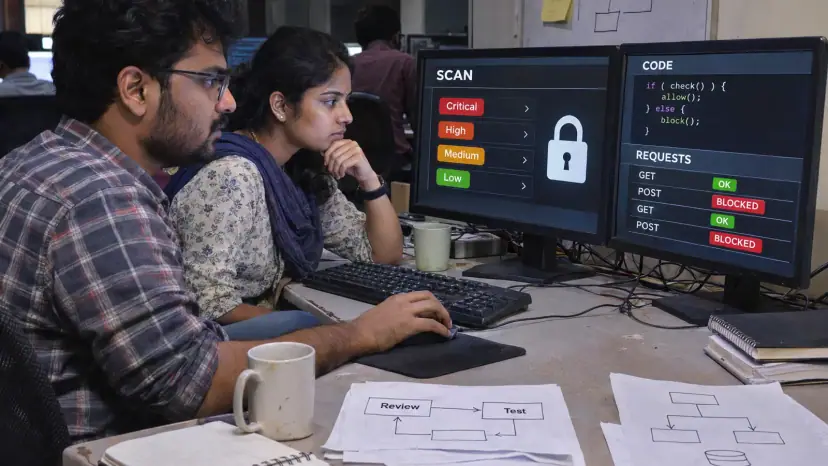
Application security services find and fix weaknesses in the software your business runs: web applications, mobile apps, APIs and cloud services. Brainguru reviews code and configuration, tests running applications the way attackers would, explains each finding in plain terms with a fix your developers can apply, and helps build security checks into every release.
Why application security matters
Attackers increasingly go after software itself. The Verizon 2026 Data Breach Investigations Report found that 31% of breaches now start with software vulnerabilities, ahead of stolen passwords, and that 48% of breaches involve ransomware. In India, the IBM Cost of a Data Breach Report 2025 put the average cost of a data breach at INR 220 million, with phishing (18%), third-party and supply chain compromise (17%) and vulnerability exploitation (13%) as the top three ways breaches began.
Most of these weaknesses are well known and preventable. Access checks missing on the server, outdated libraries, weak session handling and secrets left in code appear again and again. Finding them before launch costs far less than handling a breach afterwards.
The most common application risks
The OWASP Top 10:2025 is the standard list of the most critical web application risks. Its 2025 edition ranks them as:
- Broken access control
- Security misconfiguration
- Software supply chain failures
- Cryptographic failures
- Injection
- Insecure design
- Authentication failures
- Software or data integrity failures
- Logging and alerting failures
- Mishandling of exceptional conditions
Two points stand out. According to the OWASP page on broken access control, 100% of the applications tested had some form of it. And software supply chain failures, meaning risks from the libraries, build tools and services your software depends on, were ranked first by exactly 50% of respondents in the community survey, according to the OWASP supply chain page.
Our application security services
Security assessment and code review
- Static testing (SAST): Scans source code for weaknesses early, while they are cheapest to fix.
- Dynamic testing (DAST): Tests the running application from outside, as an attacker would see it.
- Interactive testing (IAST): Watches the application from inside while tests run, for more precise findings.
- Dependency checks: Lists the open-source libraries you use and flags those with known vulnerabilities.
- Manual code review: Focused review of authentication, authorisation, payments and other high-risk code.
Penetration testing
Our testers try to break the application the way a real attacker would: bypassing access controls, injecting code, abusing business logic and chaining small weaknesses into a serious one. Each finding comes with its severity, business impact, proof and a recommended fix. Our security testing page covers testing methods in more detail.
API security
APIs expose data directly, so we test authentication, object-level authorisation, rate limits and data exposure for REST, GraphQL and SOAP APIs, and check for forgotten or undocumented endpoints. Building a new API? Our API development services design these controls in from the start.
Mobile application security
For Android and iOS apps, we check data stored on the device, network traffic, hard-coded secrets, reverse engineering risks and the APIs the app calls, using the OWASP mobile testing guidance as a reference. Functional and device testing sits with our mobile app testing services.
Secure development and DevSecOps
Security works best as part of everyday development. We help add code scanning, dependency checks and secret detection to your CI/CD pipeline, set rules for when a build should fail, and run secure coding training for developers. If you also need help with pipelines and releases, see our DevOps as a Service.
Cloud application security
We review configuration on AWS, Azure and Google Cloud: storage permissions, identity and access rules, network exposure, secrets management and logging, which are common sources of misconfiguration.
Managed application security
For ongoing protection, our managed service covers vulnerability management, patch tracking, security event monitoring and alerting, including 24/7 threat detection and response through our security operations service.
Compliance and reporting duties in India
Security testing also helps you meet legal duties. Under the CERT-In directions of 28 April 2022, service providers, intermediaries, data centres, body corporates and government organisations must report specified cyber incidents to CERT-In within 6 hours of noticing them, and keep logs of their ICT systems for a rolling 180 days within India. Good logging in your applications makes both possible.
The Digital Personal Data Protection Act, 2023 requires reasonable security safeguards to protect personal data, and its main duties start on 13 May 2027 under the DPDP Rules. Depending on your business, PCI DSS for card data, ISO 27001, SOC 2, the GDPR for European users or HIPAA for US health data may also apply. We provide reports, evidence and gap analyses that support these audits; certification itself comes from the relevant auditor.
Our process
- Scoping: Agree which applications, environments and test types are in scope, and the rules of engagement.
- Threat modelling: Identify what attackers would want, how they might get it, and which parts of the system matter most.
- Testing: Automated scanning plus manual testing and review.
- Reporting: A clear report with an executive summary, prioritised findings, evidence and fixes.
- Remediation support: Working sessions with your developers to fix issues correctly.
- Retesting: Confirming each fix works and has not broken anything else.
Tools we use
- Code scanning: SonarQube, Checkmarx and Fortify.
- Dynamic testing: Burp Suite, ZAP and Acunetix.
- Interactive testing: Contrast Security and Veracode.
- Mobile: MobSF and QARK.
- Cloud: Prisma Cloud, AWS Security Hub and Microsoft Defender for Cloud.
Tools find the obvious problems. Business logic flaws, such as letting a user approve their own refund, usually need a person to find them.
How often should you test?
As a guide, test before the first launch, after major releases or architecture changes, and on a regular schedule for applications that handle money, health or other sensitive data. Automated scans in the pipeline catch many issues on every change, while deeper manual testing suits each major release. Your own risk, regulators and customers may set stricter rules.
What affects the cost of application security testing?
We do not publish prices. These factors drive the estimate:
- Number and size of applications: Screens, roles, APIs and integrations to cover.
- Depth of testing: Automated scanning only, or manual penetration testing and code review.
- Access level: Black-box testing from outside, or grey and white-box testing with credentials and code.
- Platforms: Web, mobile, API and cloud each need different skills and tools.
- Retesting and ongoing services: One-off assessment, periodic testing or managed monitoring.
Smaller teams can start with their most critical application and add coverage over time. We work with clients in India and abroad, with delivery from our Noida office, and handle your code and data under a non-disclosure agreement.