Banaras, Kashi or Varanasi: one address and one clear booking path
A guest may write to you about Kashi, search for Banaras and arrive with a booking for Varanasi. Your records should treat that as one place, and your replies must be accurate. This guide helps Travel and Hospitality teams serving Varanasi offer verified destination information and hand bookings over to the right person. It shows what to collect, which local sources to check, what an assistant may do and where a person approves the next step. These are planning examples, not Brainguru client results. Our services are scoped around each business’s actual data, permissions and work.
Three city names and the official sources
The district uses Varanasi, while enquiries may use Banaras or Kashi. Match all of these to a documented address and do not create duplicate establishments. For destination information, rely on current district resources and on the access instructions from the actual operator.
Open Varanasi district for local administrative context. This does not prove market demand or commercial availability, and it is not an endorsement of a private hotel or operator. Enter the three names with the actual address, and check them against the approved business record. If the record differs, a reviewer should correct it before any directions, coverage information or appointment instruction reach a guest.
For tourism context there is the official Tourism page. Once you have read it, confirm the operator’s current access arrangements. The page does not show hotel availability, a commercial package or a transfer commitment.
What to note on each Varanasi guest request
A city name next to an unrelated national offer does nothing for someone planning a visit. Use the fields below, and show the source and reviewer for each statement. Send any missing detail to a person. The model must not assume what the operator would have said.
- Actual property or operator address: Enter the actual address, linked to the Varanasi, Banaras and Kashi names. It should be the operating site, not your advertising audience.
- Destination and access-information source: Note the district resource or operator instruction behind any access detail.
- Room/package identity and inclusions: Specify the room or package and what is included, and hold back anything unconfirmed for review.
- Live availability source: Record where you check current availability. A photograph or a city name cannot show that dates are open.
- Traveller request and access needs: Write down the requested dates, the next step wanted and any access needs. Requests you cannot support go in a separate pile.
- Booking-review owner: Say which person checks the booking and confirms what the guest is told.
An illustrative Varanasi request has to pass the location check and the destination and access-information source check before staff suggest a commercial or professional next step. If it does not, it is handed over marked unresolved, so that reservations staff have a clear question and no falsely qualified lead.
Keeping official information and package terms apart
Every travel enquiry starts with the actual accommodation or operator location, the requested dates and current availability. AI can sort questions about an approved package or property, and a person confirms before a booking commitment is made. Keep official destination information apart from the operator’s commercial inclusions and access instructions. Mentioning a city attraction does not show that the hotel has a partnership, an entry entitlement or an included transfer.
Connect only the sources and systems authorised by the business: an approved knowledge pack, the relevant operational system and a CRM or intake route where you need one. Make a note of the source version each guest answer relied on. Before live guest data is used, test access permissions and who can update the content. Reviewers can use a draft, prediction or extracted field as an aid, but none of them commits the operator commercially.
Promises to keep off a Varanasi travel page
Do not state travel times, permit availability, accessibility features or guaranteed entry unless they are confirmed, and never invent them. Cancellation and refund terms should come from current operator-approved material. An itinerary that relies on a permission or a site’s opening arrangements needs a fresh check with the operator and the official source before confirmation.
Check the age of every destination source you rely on. The district's tourist places page lists the Ganga ghats, Sarnath and the Kashi Vishvanath Temple, and it shows a last updated date of June 2020. That makes it a useful starting point for names and general description, but not for opening arrangements, access routes or crowd conditions. Confirm anything a guest might act on with the operator, and note the date you checked it. A destination page tells you where something is. It does not tell you that your guest will be admitted.
Hindi and English, search names and tracking the stay
When guests need Hindi and English, competent speakers should review the terminology, locality names and proposed next step. Weigh these options with the business, as we make no claim that every guest uses them or that we supply every translation. Hold one real address and contact route across the page and business records. Do not make extra offices or profiles to suggest a local presence.
A traveller’s location and the place they will stay can differ, so record them separately for Varanasi. Base page content and enquiry routing on the area the operator is approved to serve. Measure these stages independently: destination enquiry → dates/inclusions checked → quote reviewed → booking confirmed → cancellation/completion. Rejected, cancelled and unsupported requests remain in your evaluation, because a click or a conversation is not a booking or revenue.
Before launch, test a closed attraction, sold-out dates, a requested accessibility feature and an itinerary outside the operator’s supported area. Hold spending at its current level until reviewed outcomes have been compared with the business’s own baseline. Go through search queries for mismatched intent and improve the answer or handoff that caused it. Nobody here is promising rankings, a place in AI answers, a volume of leads or a return on investment.
A common mistake is to copy a room description from a booking aggregator because it looks complete. It happens because the property's own description is thin. The copy may include features or inclusions the property no longer offers. Write the description from the property manager's approved source, keep it short, and ask the reservations lead to read it against the live booking system before it is published.
Other guides and starting a conversation
Learn about the industry scope on our Travel & Hospitality solutions page. AI Consulting for Indian Enterprises (2026): What It Should Actually Deliver has implementation detail on a related workflow. It is not evidence of a Varanasi engagement.
There are Varanasi guides for Restaurants & Food and Entertainment & Media too. To see supported information and official references for other places, visit Varanasi and other city guides.
Your free consultation will go better if you have the actual property or operator address, the destination and access-information source, approved source material and the reviewer who can decide the next step. We deliver from our Noida office and do not have a Varanasi branch. Scope, integrations and on-site work are discussed with each hotel or operator.
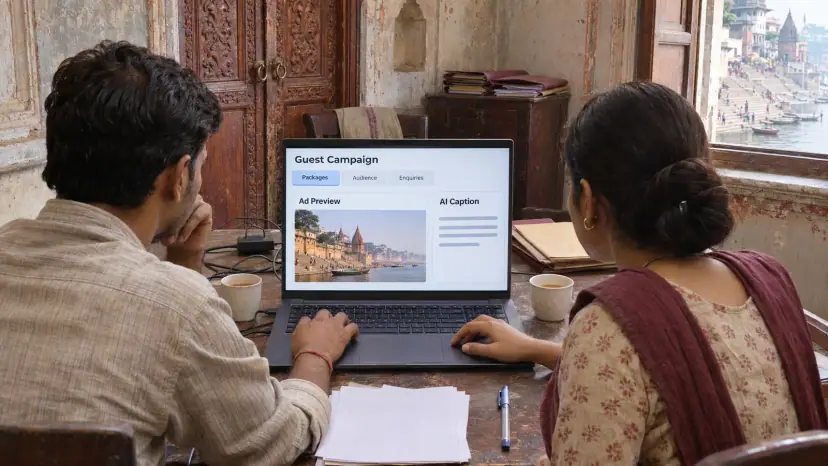
Local and sector resources were last checked on 5 October 2026, and current instructions should be checked again before a campaign changes. Images on this page are illustrative and are not verified photographs of local offices, customers or facilities.