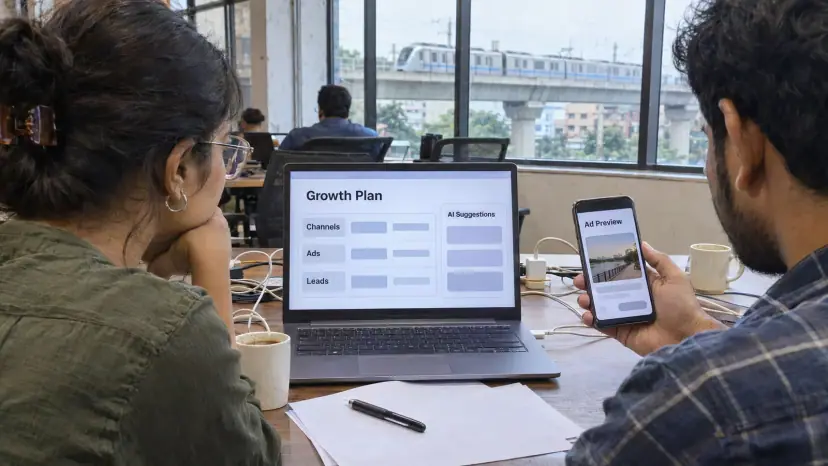
Delhi founders: validating first customers and getting ready for a pilot
Early on, a founder needs to find out whether a real customer has the problem and whether the product can support a pilot. This guide is for Startups teams serving Delhi who need first-customer validation and pilot-readiness briefs. It tells you the information to collect, which local source to consult, what an assistant may do and where a person must approve the next step. What follows is planning material, not a report of Brainguru client results. We scope any service to your actual startup, data and permissions.
Delhi district records and the rest of the NCR
Delhi is one scope and the wider NCR is another. Noida and Gurugram have different state administrations, so never file their addresses under Delhi. The Revenue Department's district resources will identify the office linked to an actual Delhi address.
Refer to the Delhi Revenue Department first, for administrative context. A government resource does not establish customer demand, commercial availability or endorsement of a private startup. Log the Delhi district and locality, keep NCR locations apart and check the result against the founders' approved record. If they do not agree, a reviewer has to resolve it before the page or assistant gives directions, coverage details or a meeting instruction.
A pilot-readiness brief for Delhi founders
A city name next to an unrelated national offer validates nothing. Complete these fields as your working brief and put a source and reviewer against each statement. Record unknowns and send them to a person, and do not let a model answer with assumptions.
- Target customer and job to be done: Describe who the customer is and the job they need done, and note the Delhi district and locality, with NCR sites separate. Use the real location, not the advertising audience.
- Prototype or released-product status: Say plainly whether the thing offered is a prototype or released, with its limits and current reference.
- Approved demonstration evidence: Identify what has been approved for showing, and what is needed to check it. Missing pieces remain questions for review.
- Pilot prerequisites and limits: Keep approved, current evidence of what a pilot requires and where it stops. A photograph or city name cannot show readiness.
- Validation question: Write down the question this conversation should answer, the next step requested and the details it needs. Separate out misrouted or unsupported requests.
- Founder/product-review owner: Name the founder or product lead who confirms the answer before a next step is offered.
Say a Delhi prospect makes a request, by way of illustration. It should clear the location check and the prototype or released-product status check, and after that a commercial or professional next step can be suggested. Failures stay marked as unresolved at handoff. The founder then has a concrete question to answer, not a lead that merely looks qualified.
A testable customer question, with AI doing the groundwork
Begin with a customer question you can test, and leave broad promises of rapid growth aside. AI can organise approved discovery notes, prepare a demonstration brief and group the reasons people enquire, all for the founders to review. Your startup should explain what exists today, what is still a prototype and which next step it can fulfil. Incubation interest, investment conversations and customer pilot evidence are three separate files, because taking part in an ecosystem does not demonstrate product demand.
Hook up only sources and systems the startup has authorised: an approved knowledge pack, the relevant operational system and a CRM or intake route if you need one. Note the source version behind each answer to a prospect. Access permissions and who can revise the content must be tested before live customer data arrives. A draft, prediction or extracted field gives a founder something to review and is no automatic commercial commitment.
Here is how a pilot conversation might be planned, as an example. After a call, the founder writes down the customer's task in one sentence, what the product does for it today, what it does not do yet, what data the pilot needs and who on the customer side will decide whether it worked. If any of those lines is empty, the next step is a question, not a proposal. The assistant can draft the note, but the founder reads it and sends it, and the customer's own words stay in quotation marks so nobody improves them later.
Grants, investors and early results to report honestly
Do not make up grants, incubator admissions, investors or customer results. Demonstrations should use authorised or synthetic data only. A referral or an introductory conversation does not count as a signed pilot. Judge a small experiment against the question it set out to answer before you promote harder or call the responses market validation.
The Startup India site says DPIIT recognition is open to eligible companies and lists benefits such as self-certification and simpler procurement rules. Say you are recognised only if you hold the certificate. A pending application is not recognition, and recognition is not evidence that a customer wants the product.
Hindi and English, Delhi search and evidence at each stage
If prospects need Hindi and English, competent speakers should review terminology, locality names and the proposed next step. Weigh those languages with the startup, since they do not claim that every customer uses them or that we supply every translation. Keep the actual address and a consistent contact route on the page and in business records, and resist adding offices or profiles that simulate local presence.
For Delhi, the place an audience sits in and the place a service is fulfilled are distinct, and the approved serviceable area should steer page content and enquiry routing. Follow each stage independently: discovery enquiry → relevant customer task → demonstration → scoped pilot → evidence reviewed. Rejected, cancelled and unsupported requests stay in the evaluation, as clicks and conversations bring no revenue.
Test a prospect outside the intended segment, demo data that is unavailable, a feature you do not support and a pilot with no buyer owner. Compare reviewed outcomes with the startup's own baseline before more money goes in. Search queries showing mismatched intent will tell you which answer or handoff to improve. We cannot guarantee a ranking, a place in AI answers, a set number of leads or a return on investment.
What to read next and how to prepare
The Startups solutions page describes the industry scope. Implementation detail is available in MVP Development for Indian Startups (2026): Scope, Cost and Timeline, though it covers a related workflow and does not evidence a Delhi client engagement.
Other Delhi planning tasks include SaaS and Fintech. For founders comparing places, Delhi and other city guides set supported information beside official references.
Founders attending a free consultation should bring the target customer and job to be done, the prototype or released-product status, approved source material and the reviewer who can decide the next step. Startup projects are delivered from our Noida office, and no Delhi branch is claimed. We agree scope, integrations and any on-site work with each founding team.
Resources, both local and sector, were checked on 5 October 2026, and instructions deserve a recheck before campaigns change. Photographs are there to illustrate the topic and are not verified images of local offices, customers or facilities.