Chennai project evidence and enquiry routing that buyers can trust
AI marketing for Real Estate in Chennai has to answer a plain question first: where is the site, really? A buyer who sees Chennai in an advert may assume the visit is close by. This guide helps promoters and sales teams build a project-evidence pack, keep amenity claims true to sanctioned plans and route enquiries to authorised people.
We describe planning examples here and report no Brainguru client results. Nothing below is legal or investment advice, and no prices are given. Scope depends on the real business, its data and its permissions.
Audience versus site: getting Chennai addresses straight
Use Chennai district to get local administrative context. The portal calls Chennai the capital of Tamil Nadu and gives the district's area as 426 sq km. Its glance panel counts 3 revenue divisions, 16 taluks and 122 revenue villages, while local government is a single corporation split into 15 zones and 200 wards. Tamil and English are the languages it names. Nothing there measures how many people want to buy, says what is for sale or vouches for a developer.
The metropolitan picture is wider. The Chennai Metropolitan Development Authority's site, CMDA, offers an online planning permission application, publishes a list of registered professionals and developers, and carries master plan land use maps. It describes the expanded Chennai Metropolitan Area as falling in five districts: Chennai and parts of Thiruvallur, Kancheepuram, Chengalpattu and Ranipet, after an expansion in October 2022, with a present extent of 5,904 sq km. So a project advertised as Chennai may sit in a different district, and your pack should say which authority covers the actual site.
Record the site's district and taluk as one detail and the audience you target as another, then check the location against the approved business record. A disagreement goes to a reviewer, who resolves it before a buyer receives directions or a visit time.
AI marketing for Real Estate in Chennai under TNRERA
The Tamil Nadu Real Estate Regulatory Authority (TNRERA) covers Tamil Nadu and the Andaman and Nicobar Islands. When we read its site on 5 November 2026, in English with a Tamil option, it listed registered building and layout projects, registered agents, agents whose registration has lapsed and complaint benches. Its notifications include a Public Caution Notice listing projects in which promoters are not authorised to sell any space, and show cause notices for penalties over non-registration. Before any campaign, search the project there and confirm it appears on neither list.
Two recent circulars matter to marketing teams. One, dated 14 October 2026, concerns uploading site photographs depicting project amenities; another, dated 2 November 2026, concerns uploading quarterly progress reports for building projects. We have not summarised either; your compliance owner should read them. The practical lesson is simple: the amenity photographs a buyer can see on the regulator's site and the ones in your advert should tell the same story.
Sanctioned plans set the limit for amenity claims
The Real Estate (Regulation and Development) Act, 2016, which we read on the Haryana RERA acts page on 5 November 2026, ties the promoter to its approved plans. Section 14(1) says the project shall be developed and completed in accordance with the sanctioned plans, layout plans and specifications approved by the competent authorities. Section 14(2) bars additions and alterations to those plans after disclosure without the consent the Act describes, and TNRERA's downloads include a format for obtaining two-thirds consent from allottees under section 14(2)(ii). Section 11(3)(a) makes the promoter, at booking and allotment, provide the sanctioned plans and layout plans with specifications by display at the site or another place the regulations specify.
For an AI assistant this sets a hard rule. A clubhouse, a pool or a tower count can be mentioned only if it appears in the sanctioned plans held in the pack. If a buyer asks about an amenity the pack does not show, the reply is a handoff, not a hopeful yes. Section 3(1) also requires registration before any advertising, and section 11(2) requires the registration number and the Authority's website in every advertisement.
Six entries for the Chennai property enquiry brief
Every project statement carries its own source and reviewer. If a detail is unavailable, write down the gap and give it to a person, so the model never assumes anything about a project.
- Actual project address and phase: Write the site address, its district and taluk and the phase, using where the project truly is and not where you advertise.
- Promoter/project identity: Give the full promoter and project names, along with the limits of what this enquiry's answer covers.
- Applicable authority and approved registration references: List the planning authority and the approved references, and add the project's RERA registration reference, checked on the state authority's own pages (TNRERA); unverified entries remain open for review.
- Current inventory-information source: Point to the approved inventory record in its current version, because a site photograph or city name will not confirm a unit.
- Buyer enquiry and visit request: Note what the buyer wants to know and whether a visit is requested, and set aside misrouted requests.
- Authorised sales/document reviewer: Record the sales or document colleague authorised to confirm the action before you offer it.
Keeping AI answers inside the approved project pack
Each permitted floor plan, amenity line and visit instruction links to one exact phase. Advertised project locality and audience city remain apart; a property in a neighbouring district never borrows a Chennai address to attract searches. Connect only authorised systems, usually the pack, the inventory sheet and a CRM intake route, save the source version with every answer, and test access before live customer data arrives.
A planning example: a buyer on WhatsApp asks whether the second tower will have a rooftop garden like the render. The assistant checks the sanctioned plan summary in the pack, finds no rooftop garden for that tower and says the render is illustrative and that sales will answer. A salesperson then replies, and the render's caption is corrected.
What Chennai property marketing cannot promise
Possession dates, appreciation, finance approval and investment returns must never be promised, and no price appears in assistant replies. Treat a source portal as a way into independent records, since it neither certifies project quality nor carries our endorsement. Renders and illustrative photographs must be labelled accurately.
Plain notices and grievances under the DPDP Rules
Rule 1(4) of the Digital Personal Data Protection Rules, 2025, from the Gazette of 13 November 2025, holds most duties back until 13 May 2027. Rule 3(a) says the notice must be understandable on its own, without other material, so a Chennai enquiry form explains in its own words what it collects and why. Under rule 14(3), the business states openly how quickly its grievance system replies, and that period may not go beyond ninety days. Put that period on the privacy page and make sure the CRM can actually meet it.
Tamil and English, property search and the road to a site visit
For Tamil and English audiences, a fluent reviewer reads each version for property terms, locality names and the next step offered. Agree the languages with the promoter; this guide makes no claim about what Chennai buyers read, and translation is scoped separately. Use one real address and one contact route in all listings, and never invent offices or profiles.
Count each step from first question to sale separately: the document check, the booked visit, the attended visit and the sales stage. Leave failed, cancelled and unanswerable requests in the totals; a click is not a sale. Run a similarly named phase, stale inventory, an amenity not in the sanctioned plan and a missing document through the system before launch, and compare reviewed outcomes with the business's own baseline before adding spend. We promise no project a high search position, a mention in AI answers, a set number of leads or any particular return.
Moving forward with a Chennai project
The industry scope is set out in AI Marketing for Real Estate, and implementation detail in Real Estate Lead Generation and CRM Automation in India; that article explains a related workflow and offers no evidence of a Chennai client engagement. To see how a bot can be held to a pack, read our AI chatbot development page, and for the WhatsApp entry point, the guide to WhatsApp click-to-chat links. Review of disclosures and data handling is covered under governance and compliance.
Chennai readers may also want AI Marketing for Insurance in Chennai and AI Marketing for EV and Clean Energy in Chennai, and can compare official references through Chennai and other city guides.
A free consultation is most useful once you have the site address and phase, the TNRERA registration, the sanctioned plan summary and the reviewer who decides the next step. The work is delivered from our office in Noida; no Chennai branch exists or is claimed. Scope and integrations are settled project by project.
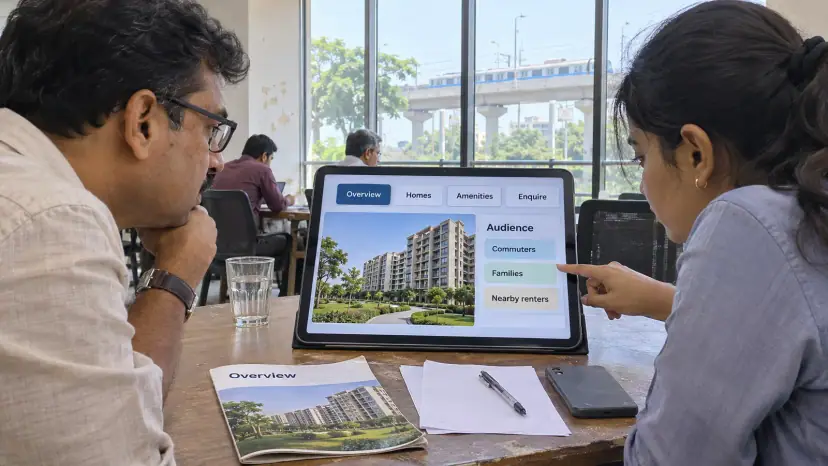
Local and sector resources for this page were first checked on 5 October 2026, then read again on 5 November 2026 with TNRERA, the Act and the DPDP Rules added, so recheck the current instructions before your next campaign change. The photographs are topic images, not verified pictures of local offices, customers or project facilities.