AI marketing for manufacturing in Chennai without small-print rescues
AI marketing for manufacturing in Chennai works well when a claim needs no footnote to stay true, export statements match the documents and every RFQ reaches engineering complete. This guide covers disclaimers, export and consent records, the RFQ summary, breach reporting and the decisions a person keeps.
It is for owners, export managers and sales teams at Chennai plants. The examples are made up for planning and are not Brainguru client results, and you will find no sales or ranking figures here. Scope follows your plant, its records and the access you grant.
Chennai District and the plant address
The Chennai District portal of the Government of Tamil Nadu, with a Tamil version, says Chennai is the capital city of the state. Its district panel gives an area of 426 sq km, Tamil and English as languages, 3 revenue divisions, 16 taluks and 122 revenue villages, and its departments list includes a District Industries Centre.
Record each site's taluk in its own field and check it against the company's registrations before the address appears on a map listing, an export brochure or an RFQ reply. Keep the plant, any warehouse and any office as separate entries if they are at different addresses. Having a Chennai address gives a firm no government standing, so pages should never hint that the district administration backs it.
What the District Industries Centre page offers
The district's District Industries Centre page, dated 6 February 2025, posts a District Export Action Plan for Chennai, links a document with more information and scheme details, and points to the DGCIS site for export-related data.
Read the action plan as background to how the district approaches exports, not as evidence about your own plant. If a scheme document seems relevant, a named person checks its current terms with the issuing office before any page mentions it. The assistant should never tell a buyer that a plant is backed by a government scheme.
Disclaimers that clarify, not contradict
Guideline 11 of the CCPA's Guidelines for Prevention of Misleading Advertisements and Endorsements for Misleading Advertisements, 2022 says a disclaimer may expand on, clarify or qualify a claim, but must not contradict the material claim or the main message, must not hide material information, and must not be used to cure a misleading claim. Under guideline 11(2), the disclaimer has to use the claim's language and font, sit prominently and be legible to a person with normal sight at a reasonable distance and speed.
Suppose an export page carries a bold headline such as "ships worldwide in 15 days" and a footnote that excludes most destinations. Rewrite the headline so it is true without the footnote, then keep the footnote for genuine detail. If the claim appears in Tamil and English, the disclaimer appears in both. The assistant repeats claims and their qualifications together, word for word. Your legal adviser can say how far the guidelines extend to trade buyers.
Consent and authorisations on the record
The Tamil Nadu Pollution Control Board site links consent applications through its Online Consent Management and Monitoring System, a consent fee details page, lists of consents and consent orders granted, and a separate online intimation route for white category industries. It also lists hazardous waste, biomedical waste, plastic waste and e-waste authorisations.
When an overseas buyer's audit form asks about environmental consent, the reply comes from the compliance owner's current order, with its reference and validity recorded in the approved pack. The website and assistant say a plant holds a consent or authorisation only when that document is on file and the wording has been approved. The board's pages list the routes; which consent a unit needs is confirmed by its compliance owner.
The Chennai RFQ summary
- Product and drawing: the item, drawing number and revision, shared through the plant's approved file route.
- Specification: material, finish and the tolerances the buyer cares about, compared with the approved data.
- Destination: the country or site goods must reach and any shipping terms the buyer names, for the export owner to check.
- Quantity and schedule: trial lot, regular volume and needed dates.
- Documents asked for: certificates, test reports or consent copies, routed to the person who holds them.
- Owners: engineering for feasibility, export for shipping questions, sales for the quote.
A planning example: a buyer abroad asks for fasteners, delivery in a set number of weeks and a copy of the plant's consent order. The assistant gathers the drawing, grade and quantity, says the delivery time will come from the export owner, and sends the consent request to compliance. It quotes no lead time from an old brochure and attaches no document it has not been cleared to share.
Reporting a breach to the Board: DPDP rule 7
Rule 7 of the Digital Personal Data Protection Rules, 2025 begins on 13 May 2027 under rule 1(4), the Rules having been notified on 13 November 2025. Rule 7(2) says a Data Fiduciary, once aware of a personal data breach, must inform the Data Protection Board without delay and, within seventy-two hours or any longer time the Board grants on a written request, send the detail: the facts and reasons behind the breach, the measures taken, any findings about who caused it, steps to prevent recurrence and a report on the notices sent to affected people.
Enquiry systems hold buyers' names, numbers and emails, and often drawings. Name the person who would file the report, list the systems that hold buyer contacts, and keep a template ready. Seventy-two hours passes quickly when the facts are scattered across a CRM, a chat tool and shared inboxes.
Tamil and English, listings and the stages to an order
The district portal lists Tamil and English. If buyers use either or both, fluent reviewers should read product names, export terms and the next step before they go live; we make no assumption about the language Chennai buyers prefer. One real address and one contact route should appear on every listing.
Keep separate tallies for export enquiries, complete RFQs, engineering reviews, quotations and purchase orders, including rejected and cancelled requests. Before launch, test a headline that only a footnote makes true, a consent request with no document on file, a destination the export owner has not cleared and a quantity the plant cannot produce. Rankings, mentions in AI answers, RFQ numbers and return on spend are not promised.
Related pages and a Chennai consultation
For the sector as a whole, read AI Marketing for Manufacturing; order and dealer questions are covered in AI chatbots for Indian manufacturing. If buyers find you through maps and local search, Local SEO Services explains keeping listings consistent with the real address. These show no Chennai engagement of ours.
Chennai also has guides for logistics and supply chain, automotive and EV and clean energy firms; Chennai and other city guides lists more.
A free consultation goes further if you bring an export brochure with its disclaimers, your consent and authorisation references, a sample of recent RFQs and the names of the people who approve replies. Chennai work is delivered from our Noida office; no Chennai branch is claimed. Scope and integrations are agreed separately with every plant.
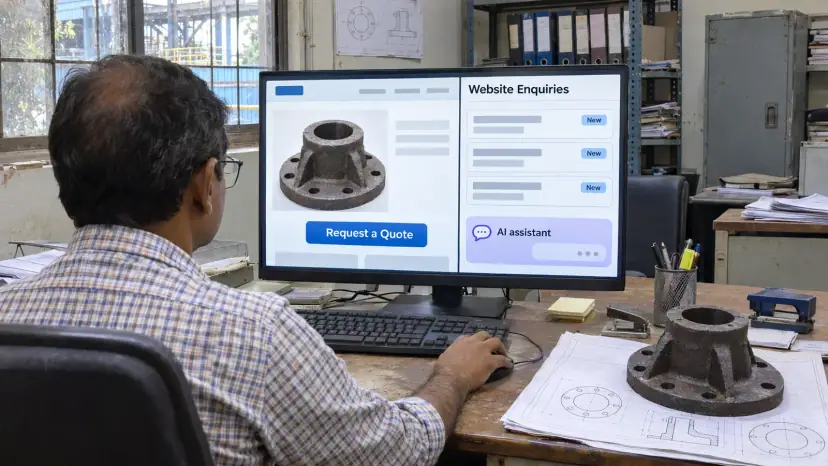
Source dates: first read 5 October 2026, reread 5 November 2026. Look at the current versions before changing a campaign. The images stand in for the subject and are not photographs of a real Chennai plant, buyer or office.