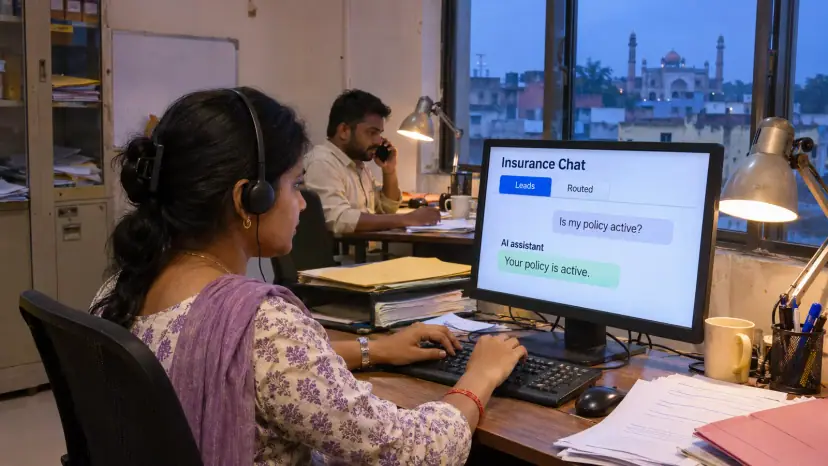
Explaining policies in Lucknow and routing enquiries to a licensed provider
A new-product question, a servicing request and a claim each need a different person. This guide helps insurance teams serving Lucknow give approved policy education and route enquiries to a licensed provider. It covers what to collect, which local source to use, what an assistant may do and where a person must approve the next step. The workflows are planning examples, not client results of ours. We scope any service around your business, your data and your permissions.
Checking a Lucknow address before you share it
The Lucknow district portal publishes the administrative setup and public utility contacts. Pick the relevant entry using the actual business address, then check commercial availability with the business itself. A public directory entry is not a recommendation, and it does not tell you who is available.
Your first reference is Lucknow district. It gives you local administrative context only. It does not show market demand or commercial availability, and it does not endorse any private business. Note the Lucknow locality and the verified directory entry, then compare them with the approved business record. If they differ, a reviewer needs to sort that out before the page or assistant gives directions, coverage information or an appointment instruction.
What to record for each Lucknow insurance enquiry
Use these fields as a working brief. A city name beside an unrelated national offer does not help. Each statement needs a named source and a named reviewer. If something is unknown, note the gap and pass it to a person, because the model should never fill it with an assumption.
- Insurer/intermediary identity: Record who is responsible for the product, along with the operating address, not the advertising audience, so the enquiry goes to the right provider.
- Approved policy/product version: Note the exact version being discussed, because an older wording can give the customer a wrong answer.
- Coverage, exclusion and eligibility information source: Point to the approved document behind each statement on cover or exclusions. A photograph or a city name proves none of this, and missing details stay open for review.
- Servicing versus new-product enquiry: Mark which of the two this is, and move a claim or a misrouted request out of the sales path.
- Minimum contact permission: Ask only for the contact details and consent the handoff really needs, and nothing further.
- Authorised product/claims reviewer: Name the person who can confirm the answer before the customer is offered a next step.
Take a sample request from Lucknow. It should pass the location check and the approved policy or product version check before anyone suggests a commercial or professional next step. A failed policy check stays open in the handoff. The receiving team then has a clear question, not a falsely qualified lead.
What the assistant can answer and what stays with the insurer
An insurance assistant should find the current approved policy explanation and tell a new-product question apart from policy servicing or a claim. It should capture only what the handoff needs. The insurer or authorised intermediary confirms eligibility, terms and any recommendation. An automated marketing reply must never read like a claim approval or a final coverage decision.
Your business decides which systems the assistant may reach, usually an approved knowledge pack, the policy or servicing system involved and, if needed, a CRM or intake route. Note the source version used for each answer. Before any live customer data goes in, test access permissions and who can change the content. Drafts, predictions and extracted fields help the reviewer, but none of them is a commercial commitment.
Rules on insurance claims and sensitive documents
Take product information from IRDAI resources and from the responsible provider's approved documents. Do not promise that a proposal will be accepted, a claim settled or money saved. Health and financial documents belong in the provider's approved process, not in a general contact form on a city page. A testimonial or a local audience label does not show that a policy suits someone.
For an independent reference, see the Insurance Regulatory and Development Authority of India. Check its current instructions again, and ask the responsible professional whether they apply to what you plan to do.
Hindi review, local search and what to measure
If your audience needs Hindi and English, ask competent speakers to review the terminology, locality names and proposed next step. We would assess these languages with you, without claiming that every customer uses them or that we supply every translation. Show the actual address and one contact route on the page and in your business records, and do not create extra offices or profiles to look local.
Someone can be in Lucknow while the service is fulfilled elsewhere, so record those two locations separately. Page wording and enquiry routing should follow the approved serviceable area for each policy. Measure each stage on its own: policy question, product or servicing triage, authorised reviewer, then the agreed application or service step. Keep rejected, cancelled and unsupported requests in the numbers, since a click or a chat is not revenue.
Test with an exclusion question, an outdated policy version, a claim-status enquiry and a request for guaranteed settlement. Compare reviewed results with your own baseline before spending more. Look through search queries for mismatched intent, then improve the answer or handoff that fell short. We cannot guarantee rankings, a place in AI answers, a volume of leads or a return on investment.
A worked example: a claim question that begins as a sales question
This is a planning example, not a result. A visitor writes that their family's claim was delayed and asks which plan is best to buy now. These are two requests. The assistant answers neither on the merits. It says the claim question belongs to the insurer's own servicing and grievance route, gives that route from the approved pack, and records the new-plan question for a later conversation.
The note to the reviewer separates them: claim status, handled by servicing, and new-product interest, which waits. The assistant does not ask for claim papers or health records. The reviewer decides whether and when to approach the person about a new product, and only with the contact permission recorded. If the person is upset, the first reply is about the claim. A sales step that arrives before the claim is answered will usually be remembered for the wrong reason.
Next steps for your Lucknow team
Read Insurance solutions for the scope of our industry work and AI Claims Document Processing: Workflow, Data Requirements and Human Review for implementation detail. The article explains a related workflow and is not evidence of a Lucknow client engagement.
We also have planning guides for BFSI (Banking & Finance) and Healthcare in this city. You can browse Lucknow and other city guides to compare what each one supports and which official references it uses.
For a free consultation, please bring the insurer or intermediary identity, the approved policy or product version, your approved source material and the reviewer who can decide the next step. This work is delivered from our Noida office, and we claim no Lucknow branch. We agree scope, integrations and any on-site work with each insurer or intermediary separately.
We checked the Lucknow and IRDAI resources on 5 October 2026, so check them again before changing a campaign. Photographs are illustrative and do not show verified local offices, customers or facilities.