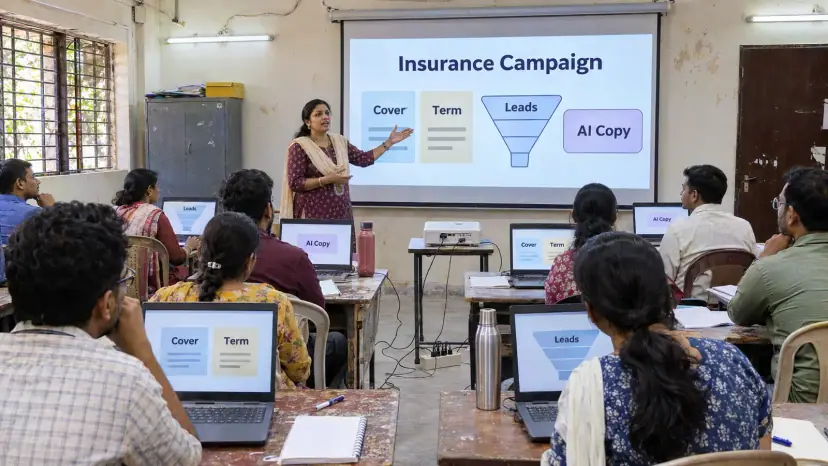
Hyderabad insurance enquiries: approved policy explanations, licensed routing
Hyderabad insurance teams handle quote questions, servicing requests and claim worries, often through the same contact form. This guide helps you explain policies from approved material and send each enquiry to a licensed provider. You will see what to record, which local source helps, what an assistant is allowed to do and who has to approve. None of this reports a Brainguru client result, because these workflows are planning examples. We scope services to the actual business, data and permissions in front of us.
Does the Hyderabad district resource cover your address?
District information, public utilities and service contacts come from the Hyderabad district administration. A documented address decides if that resource covers an operating location. A Hyderabad search keyword does not prove that every metropolitan address falls within one district.
Consult Hyderabad district for administrative context, keeping in mind that it does not establish market demand, commercial availability or endorsement of any private insurer. Note the Hyderabad address and the verified district, then compare them with the approved business record. A reviewer decides on any difference before a page or assistant shares directions, coverage information or an appointment instruction.
Building the Hyderabad enquiry brief for insurance
A national offer with a city name beside it, unrelated to anything local, is what this brief replaces. Tag every statement with a source and a reviewer. When details are unavailable, list them as a gap and give them to a team member, and do not let the model paper over them with assumptions.
- Insurer/intermediary identity: Name the insurer or intermediary, plus the Hyderabad address and verified district where it actually operates, not where the ads appear.
- Approved policy/product version: Cite which approved version applies, including limits and a current reference, since people act on the wording they are shown.
- Coverage, exclusion and eligibility information source: Tell reviewers which source supports coverage, exclusions and eligibility, and treat missing requirements as open questions.
- Servicing versus new-product enquiry: Separate existing policyholders from new buyers, with approved and current evidence on file, as a picture or city name cannot show which applies.
- Minimum contact permission: Collect the least contact permission that the requested next step needs, and hold unsupported or misrouted requests apart.
- Authorised product/claims reviewer: Record the authorised product or claims person able to confirm the reply before the next step is offered.
Try this with an illustrative Hyderabad request. It must meet the location check and the approved policy or product version check before anyone raises a commercial or professional next step. A failed check is carried in the handoff as unresolved, which gives the licensed provider a specific question instead of a falsely qualified lead.
One extra check helps before launch. Pick three real brochures and see whether the assistant's explanations match them, line by line, including the exclusions. Ask the product owner to mark each mismatch as wording or substance, and fix the source document before fixing the assistant.
Routing by assistant, confirmation by the insurer
Your insurance assistant should fetch the current approved policy explanation and sort new-product questions from policy servicing and claims. Ask for only what the handoff depends on. The responsible insurer or authorised intermediary confirms eligibility, terms and recommendations. No automated marketing response may stand in for a claim approval or a final coverage decision.
Authorised sources and systems are the only ones to connect: an approved knowledge pack, the relevant operational system and a CRM or intake route if required. Every reply on a policy should keep its source version. Test permissions and who can update content before you use real customer data. Drafts, predictions and extracted fields assist a reviewer, and a commercial commitment never follows from them automatically.
Walk through an example. A policyholder writes in Telugu asking how to renew a motor policy that lapsed a few days ago. The assistant explains the renewal route from the approved servicing guide and says that lapse terms are for the insurer or intermediary to confirm. It does not say the policy can be reinstated. It sends the policy reference route to the servicing team, who check the status and reply. The reply, not the assistant, states what applies.
What the regulator's material and your documents require
Applicable product information should come from IRDAI resources and the approved documents of the responsible provider. Do not tell anyone that acceptance, claim settlement or savings are assured. Route health and financial documents through the provider's approved process, away from a general contact form on a city page. Testimonials and local audience labels are not proof of suitability.
See the Insurance Regulatory and Development Authority of India for an independent sector reference. Instructions change, so recheck them and ask the responsible professional to review whether they apply to this activity.
Telugu, Urdu and English, search listings and tracked stages
An audience needing Telugu, Urdu and English calls for competent speakers to review terminology, locality names and the proposed next step. Assess these languages as options with the business, not as a claim that all customers use them or that we supply each translation. Maintain one actual address and a consistent contact route across the page and business records. Do not create additional offices or profiles to simulate local presence.
Audience location in Hyderabad and the place where the service is fulfilled are separate entries. Pages and routing follow the approved serviceable area. Record each stage independently: policy question → product/servicing triage → authorised reviewer → agreed application or service step. The evaluation still counts rejected, cancelled and unsupported requests, because a click or conversation does not produce revenue.
For testing, use an exclusion question, an outdated policy version, a claim-status query and a person demanding guaranteed settlement. Review outcomes against the insurer's own baseline before committing more spend. Examine search queries for mismatched intent, and refine the answer or handoff they reveal. No promise is made on rankings, AI-answer inclusion, lead volume or return on investment.
Decide who owns the policy wording on the page. The product owner should confirm each description matches the approved brochure, and the compliance reviewer should approve each claim about benefits. Keep a record of the brochure version beside the page. When the insurer issues a new version, someone must be responsible for finding every page that quotes the old one.
Related pages and arranging a talk
Learn the industry scope on Insurance solutions, and get implementation detail from AI Claims Document Processing: Workflow, Data Requirements and Human Review. The article concerns a related workflow and does not evidence a Hyderabad client engagement.
Hyderabad teams may also find BFSI (Banking & Finance) or Healthcare relevant. Hyderabad and other city guides collects supported information and official references for comparison.
Your free consultation should start with the insurer or intermediary identity, the approved policy or product version, approved source material and the reviewer who can decide the next step. Delivery for this work is from our Noida office, and Hyderabad has no branch claimed by us. Scope, integrations and on-site work are settled for each insurer.
A check of these local and sector resources was done on 5 October 2026, and you should recheck instructions before making campaign changes. No photograph here is a verified image of a local office, customer or facility, as all are illustrative topic images.