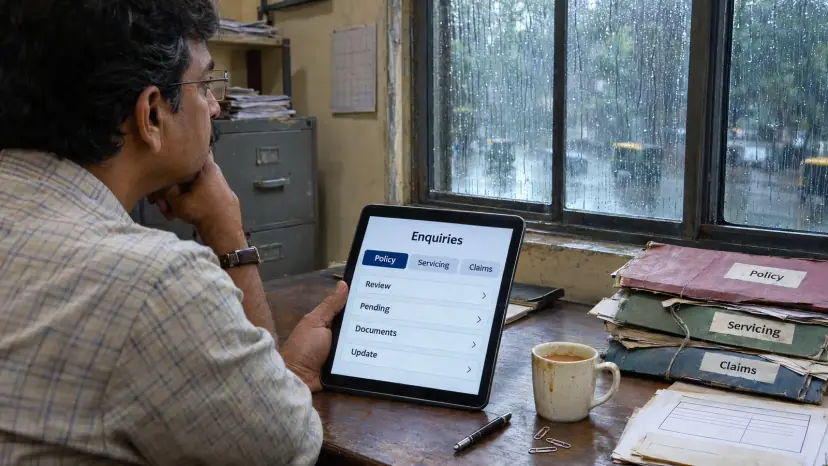
Guwahati insurance teams: approved policy education and routing to licensed providers
An Insurance team serving Guwahati has to teach people about policies using approved wording, and then route each enquiry to a licensed provider. We cover the information to collect, the local source to consult, the work an assistant may do and the step a person has to approve. Treat the following as planning examples and not as reported Brainguru client results. Services are shaped by your actual company, its data and the permissions it holds.
A Guwahati address is not all of Northeast India
Local information for Guwahati officially starts with the Kamrup Metropolitan administration. A Guwahati city audience should never be merged with every destination described as Northeast India. Your pickup, meeting or operating address also stays separate from a wider regional service request.
Begin at Kamrup Metropolitan district for administrative context. That is all it supports: it does not establish market demand or commercial availability for insurance, and it does not endorse a private business. Enter the Guwahati address and record any Northeast destination apart from it. Next, match the location to the approved business record, and let a reviewer resolve any conflict before the page or assistant offers directions, coverage information or an appointment instruction.
The working brief for a Guwahati insurance enquiry
Publishing Guwahati next to an unrelated national insurance offer helps nobody, so collect these fields instead. Each statement should show where it came from and who reviewed it. An unknown policy detail is recorded as a gap and sent to a person, because the model may not assume it.
- Insurer/intermediary identity: Show who the insurer or intermediary is, together with the Guwahati address and, on a separate line, any Northeast destination. The actual operating address counts, regardless of who sees the advertising.
- Approved policy/product version: Quote the exact approved version of the policy or product, with its limits and its current reference.
- Coverage, exclusion and eligibility information source: Identify where coverage, exclusion and eligibility answers come from and what is required to check them. Any missing detail goes to review as a question.
- Servicing versus new-product enquiry: Separate existing-policy servicing from new-product questions, and file the approved evidence and its current version accordingly. Neither a photograph nor a city name helps here.
- Minimum contact permission: Collect the least contact permission that allows the requested next step, along with necessary information. Unsupported or misrouted requests sit apart.
- Authorised product/claims reviewer: Say which authorised product or claims reviewer can confirm the answer or action ahead of a next step.
Before a commercial or professional next step is mentioned, a sample Guwahati request has to pass two checks: location, and approved policy or product version. Failures stay unresolved within the handoff. That way the receiving team has a concrete question to work on, not a falsely qualified lead.
Servicing, claims and new products: keeping them apart with AI
The job of an insurance assistant is to fetch the current approved policy explanation and to separate new-product questions from policy servicing and claims. Capture what the handoff requires and no more. Eligibility, terms and recommendations are for the responsible insurer or authorised intermediary to confirm. Automated marketing replies should never represent a claim approval or a final coverage decision.
Limit connections to authorised sources and systems, which means an approved knowledge pack, the operational system concerned and a CRM or intake route if one is needed. Each explanation of a policy should have its source version logged. Live policyholder data comes after you test access permissions and content-revision rights. Think of drafts, predictions and extracted fields as aids for a reviewer, not as commercial commitments.
Take a planning case where someone asks, in the chat box, whether their father's existing condition will be covered and attaches a discharge summary. The assistant should not read the document. It says that cover for existing conditions depends on the policy terms and the insurer's decision, asks the person to use the provider's approved process for health documents and offers a handoff to a licensed adviser. The adviser then explains the terms from the approved wording. The attachment never sits in a marketing inbox.
Staying within insurance limits
Applicable product information should come from IRDAI resources and from documents the responsible provider has approved. Nobody should guarantee acceptance, claim settlement or savings. Health and financial documents go through the provider’s approved process and stay away from a general city-page contact form. Testimonials and local audience labels are no proof of suitability.
See the Insurance Regulatory and Development Authority of India for an independent sector reference. Current instructions need rechecking, and the responsible professional should review their applicability to the proposed activity.
Assamese and English, one address and a clear trail of stages
Have competent speakers review terminology, locality names and the proposed next step when the audience needs Assamese and English. We suggest assessing these options with you and make no claim that all customers use them or that we supply all translations. Your page and business records should share the actual address and contact route, with no extra offices or profiles created to look local in Guwahati.
Audience location in Guwahati is one thing and the location where the requested service is fulfilled is another, so split them and base page content and enquiry routing on the approved serviceable area. Four stages get their own count: policy question, product or servicing triage, authorised reviewer, and agreed application or service step. Clicks and conversations are not revenue, which is why rejected, cancelled and unsupported requests remain in your review.
Exercise the workflow with an exclusion question, an outdated policy version, a claim-status enquiry and a request for guaranteed settlement. Before spending more, check reviewed outcomes against the company’s own baseline. Mismatched intent in insurance search queries tells you which answer or handoff to improve. Our advice carries no guarantee of ranking, AI-answer inclusion, lead volume or return on investment.
Waiting periods, exclusions and renewal terms are the points where translation can mislead. Have the provider's reviewer read the Assamese and English versions of each explanation side by side and keep the approved English text as the reference. If the two cannot say the same thing, the assistant hands off. In the first weeks, read the questions that staff answered by hand, and add those answers to the approved pack once the reviewer agrees.
Further resources and how to engage us
You can read Insurance solutions for the industry scope and AI Claims Document Processing: Workflow, Data Requirements and Human Review for implementation detail. Because it describes a related workflow, the article does not count as evidence of a Guwahati client engagement.
In Guwahati there is also planning material for BFSI (Banking & Finance) and Healthcare. Go to Guwahati and other city guides for a comparison of supported information and official references.
Prepare for a free consultation by bringing the actual insurer or intermediary identity, the approved policy or product version, approved source material and the person able to decide the next step. We run delivery from our Noida office and do not claim any branch in Guwahati. Scope, integrations and on-site work for an insurance business are decided case by case.
Local and sector resources had their last check on 5 October 2026, so confirm current instructions before campaign changes. Photographs on this page are illustrative topic images, and they do not verify local offices, customers or facilities.