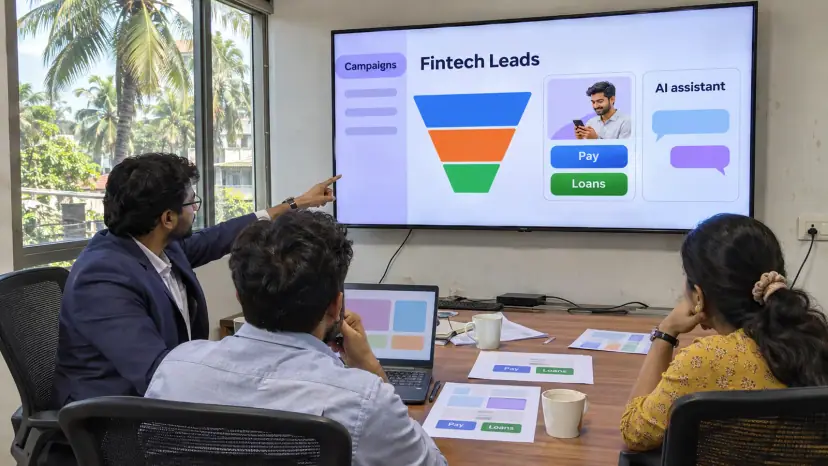
Chennai fintech: teaching the software and handing off regulated questions
A visitor to a fintech page may want a demo or may think they are applying for a loan. This guide is for Fintech teams serving Chennai who explain software use cases and need clean handoffs to regulated providers. You will see what information to collect, which local source to consult, what an assistant may do and at what point a person must approve the next step. The workflows are planning examples, with no reported Brainguru client results behind them. Our services depend on your actual business, data and permissions.
Chennai audience, operating address and collection point
The Chennai district portal supplies administrative and public-service information. A customer audience in Chennai is not the same as the exact operating address used for a visit, collection or delivery, so split them. Before you direct a customer to an official office, check the district entry for that address.
Chennai district supplies the local administrative context you need here. It cannot establish market demand, commercial availability or any endorsement of a private business. Enter the Chennai operating address and the collection point for this workflow, then hold them up against the approved business record. A disagreement goes to a reviewer, and only after that may the page or assistant give directions, coverage information or an appointment instruction.
A Chennai fintech enquiry brief, field by field
Avoid setting a city name beside an unrelated national offer, and use these fields as a working brief. Every statement stays attached to a source and a reviewer. In fintech especially, a missing fact should be recorded and passed to a person, and the model must not assume it.
- Software provider and regulated partner identities: Name who supplies the software and who, if anyone, is the regulated partner, then add the Chennai operating address and collection point from the actual address, not the advertising audience.
- Product task and supported channel: Describe what the product does and the channel where that is supported, with its limits and current reference.
- Approved explanatory material: Show which approved material may be used to explain the product; missing details remain questions for review.
- Eligibility/decision boundary: Mark where explanation stops and a decision on eligibility begins, and keep the current approved version on record, as a photograph or city name settles nothing.
- Demo or service enquiry type: Say whether this is a demo or a service request and what it needs, separating out anything unsupported or misrouted.
- Compliance/product reviewer: Give the name of the compliance or product colleague whose confirmation a fintech answer needs before any next step goes out.
An illustrative Chennai request needs to clear both the location check and the check on product task and supported channel before a commercial or professional next step is suggested. Whatever fails remains unresolved in the handoff. The receiving team sees a concrete question and is spared a falsely qualified lead.
Software enquiry or financial application?
These are two different journeys. AI can explain approved software capabilities or prepare a product demonstration, while financial decisions and product disclosures belong to the responsible regulated entity. Be clear about which organisation provides the technology and which, if any, supplies the regulated service. A city landing page must never imply permission to lend, insure or advise.
Limit connections to the sources and systems the business has authorised: an approved knowledge pack, the relevant operational system and a CRM or intake route where needed. Save the source version behind every answer. Access permissions and content-revision rights need testing before live customer data is touched. Drafts, predictions and extracted fields support the reviewer but are not automatic commercial commitments.
Fintech language that compliance must approve
Stay away from guaranteed approval, guaranteed returns and unsupported claims of regulator endorsement. Explain the limitations of automated scoring. Sensitive account documents do not belong in a general marketing form. Product and compliance reviewers sign off the source material first, and only then can the assistant draw on it.
For an outside view of the sector, consult the Reserve Bank of India. Check its current instructions again, and have the responsible professional review how they apply to the proposed activity.
Tamil and English, local presence and the handoff path
Tamil and English may both be needed by your audience, and in that case competent speakers should review terminology, locality names and the proposed next step. Assess these with the business as language options. That says nothing about what every Chennai customer uses, and we do not promise to supply every translation. Keep one actual address and contact route across the page and business records, without extra offices or profiles created to simulate local presence.
Chennai enquirers and the place the service is fulfilled are separate locations, and the approved serviceable area should guide page content and enquiry routing. Record these stages independently: software enquiry → use-case review → demonstration → regulated handoff where relevant → agreed next step. Rejected, cancelled and unsupported requests remain in the evaluation, because a click or conversation does not count as revenue.
Build tests around an enquiry confusing software with lending, an expired disclosure, a partner identity mismatch and an unsupported request for a financial decision. Only increase spend after comparing reviewed outcomes with your business's own baseline. Search queries showing mismatched intent mean the relevant answer or handoff needs improving. There can be no guarantee of rankings, AI-answer inclusion, lead volume or return on investment.
One mixed message, sorted into two journeys
This is a planning example, not a real enquiry. A message arrives in Tamil from the operations head of a lender. She asks whether the fintech's software can connect to her loan management system, and she adds that a customer of hers wants to know whether he will be approved for a loan.
The assistant splits the message in two. The software question goes to the product reviewer, with the integration named and the approved documentation attached. The approval question is not for the fintech at all. The assistant says that approval decisions belong to the lender and does not guess at an answer or invite the customer's details into the chat.
The product reviewer then replies about integration prerequisites and proposes a demo. The record keeps the two journeys apart, so a software demo request is never counted as a loan application, and the lender's regulated process stays with the lender.
Next steps for Chennai fintech teams
Fintech solutions outlines the industry scope. AI Marketing for Fintech in India (2026): The Compliance-Ready Playbook for Lending, Wealth & Insurance Startups adds implementation detail on a related workflow, and it does not show a Chennai client engagement.
In Chennai you could also plan work on BFSI (Banking & Finance) or Insurance. To compare supported information and official references city by city, try Chennai and other city guides.
For a useful free consultation, have ready the actual software provider and regulated partner identities, the product task and supported channel, approved source material and the reviewer who can decide the next step. All our delivery runs from the Noida office, and we claim no Chennai branch. Scope, integrations and on-site work are considered case by case.
All local and sector resources were checked on 5 October 2026. Please recheck current instructions before any campaign change. Images in this fintech guide are illustrative and do not verify local offices, customers or facilities.