AI marketing for BFSI (Banking and Finance) in Chennai, from first question to review
AI marketing for BFSI (Banking and Finance) in Chennai works when product answers match the branch a customer will deal with and each application reaches a reviewer. This guide covers that work for BFSI (Banking and Finance) teams serving Chennai: the record to keep, the district source to read, the assistant's limits and the reviewer's role.
None of the workflows is a reported Brainguru client result, and nothing here is investment, credit or insurance advice. The regulated entity decides what is published, and any project is scoped to its own business, data and permissions.
Chennai customers, operating addresses and the district source
Chennai district is the place to begin, as a source of local administrative context. The portal names Chennai as the capital of Tamil Nadu and gives the district an area of 426 sq km, split into 3 revenue divisions, 16 taluks and 122 revenue villages, with one corporation of 15 zones and 200 wards. It lists Tamil and English as the district's languages.
Those numbers explain why "Chennai" on a loan page is too vague. For each BFSI (Banking and Finance) enquiry, capture the Chennai operating address and the collection point, with the taluk or corporation zone, then check them against the approved business record. Any disagreement goes to a reviewer before the page or assistant gives directions or an appointment step.
The portal cannot establish market demand or commercial availability, and it does not amount to an endorsement of a private financial business. Its departments list, which includes a District Industries Centre, and its helplines such as the Collectorate control room on 1077, are public services and nothing more.
Six fields behind a Chennai product answer
Keep each field with its source and the name of whoever confirmed it. A blank field is a question for staff, not something the assistant fills in.
- Regulated provider identity: Name the regulated provider, with its Chennai operating address and collection point, using the real address and not the advertising audience.
- Actual branch or service channel: State precisely which branch or channel handles the request, including its limits and current reference, because the customer needs the one that supports the task.
- Approved product-information version: Note the version in use and what is needed to check it; anything missing stays a question for review.
- Eligibility information source: Store the approved eligibility text with its date. The assistant quotes it and never works out eligibility itself.
- Application enquiry type: Record the customer's requested next step and the information it requires, and move unsupported or misrouted requests to a separate pile.
- Authorised reviewer: Identify the authorised person who can confirm the answer or action before the next step is offered.
The Key Facts Statement belongs to the lender
Chennai copy must not make the RBI look like a backer of a private service, must not promise loan approval and must not present a quoted return as a sure thing. For an independent check on the sector, Chennai teams can go to the Reserve Bank of India; its official website carries Master Directions and a list of circulars withdrawn, so read the current version and ask the compliance officer how it applies.
The RBI's NBFC Responsible Business Conduct Directions, 2025 set out the Key Facts Statement used by finance and housing finance companies for retail and MSME term loans sanctioned from 1 October 2024 onward. Banks have a separate version of the same Directions. Under paragraph 29:
- Language and acknowledgement: the KFS goes to every prospective borrower in a language they understand, its contents are explained, and the lender obtains an acknowledgement that they understood it.
- Validity period: it carries a unique proposal number and stays valid for at least three working days for loans of seven days or more, and one working day for shorter loans.
- Cost of credit: it includes a computation sheet of the Annual Percentage Rate, covering all charges the lender levies, and the repayment schedule, and it appears as a summary box in the loan agreement.
So a marketing assistant should never produce something that looks like a KFS. It can explain that the lender will provide one, describe what it contains in general terms and pass the customer to staff for the actual figures.
A Tamil top-up enquiry, worked through
Someone writes in Tamil through a website chat and asks whether a personal loan top-up is possible on an existing loan. The assistant does not know the customer's account and must not pretend to. It retrieves the approved top-up explanation, shows the product sheet version it used and asks only what the handoff needs: the preferred branch or channel and a good time for a call. The reviewer calls, checks eligibility inside the lender's own systems and, if the customer goes ahead, the KFS follows from the lender.
System access stays narrow: an approved knowledge pack, the relevant operational system and, if needed, a CRM or intake route, and only where the business has authorised them. Our CRM solutions page, and the governance and compliance page for review processes, show how an intake route carries such a handoff and who signs it off. Test permissions with dummy records, and log the source behind each reply.
DPDP safeguards for Chennai forms
Personal data gathered through a chat or form comes under the Digital Personal Data Protection Act, 2023. Under the DPDP Rules, 2025, gazetted on 13 November 2025, rule 1(4) sets 13 May 2027, eighteen months on, as the start for most Data Fiduciary duties. Rule 6 asks for reasonable security safeguards, and rule 9 asks the Data Fiduciary to publish the contact of a person who can answer questions about how data is processed.
For a Chennai chat that means no account numbers or identity documents in the conversation, a short plain notice of what the details are for, a way to correct or withdraw them and a named contact on the form.
Tamil and English review, Chennai search and the stages worth tracking
Tamil and English are the options to assess here, and the portal itself lists both. Because paragraph 10 of the same RBI Directions wants borrower communication in the vernacular or another language the borrower knows, have a competent speaker of each language read the financial terms, locality names and next step before launch. Some customers will read only Tamil or only English, and full translation of every sheet is not something we offer.
The page, the business listing and any local SEO work should show one real address and contact route, with no added profiles. Keep the customer's location separate from where the service is given, and route by the approved service area.
Count answered questions, matched branches or channels, contacted reviewers and started applications each on their own, and tally refused requests too. Before launch, test a Tamil message with no approved Tamil text, an existing customer asking for a top-up and a request for exact loan figures. Raise the budget only when the reviewed numbers improve on the lender's own earlier ones. Rankings, AI-answer mentions, lead numbers and returns carry no promise from us.
Further reading and a consultation
Read AI Marketing for Fintech to see the industry scope. Implementation detail comes from AI Marketing for Fintech in India: A Compliance-Ready Playbook, whose related workflow is no evidence of a Chennai client engagement.
Neighbouring planning tasks in Chennai have their own guides, AI Marketing for Fintech in Chennai and AI Marketing for Insurance in Chennai. Official references for other cities sit under Chennai and other city guides.
Booking a free consultation? Keep the regulated provider identity to hand, along with the taluk or zone of every branch, the approved product sheets in Tamil and English and the reviewer who signs off. Delivery is from our Noida office, and no branch of ours in Chennai is claimed. Integrations are planned with each lender on its own terms.
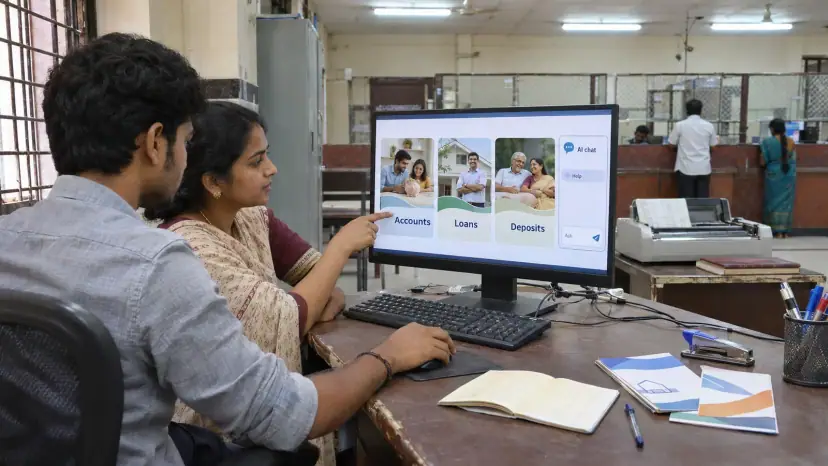
We read the Chennai portal, the RBI pages and the Gazette first on 5 October 2026 and again on 5 November 2026; check them afresh before making campaign changes. Images serve as illustrations and are not photographs of any Chennai branch or customer.